Hello! Welcome to the first lesson in our new module, "Advanced Fluency and Meeting Management."
In our last module, you did excellent work learning how to participate in discussions. You practiced expressing your opinion, giving reasons, and even defending your ideas in a simulated work meeting. But what happens when someone asks you a tough question and you need a moment to think? Even the most fluent speakers need time to organize their thoughts.
Today, our goal is to use filler phrases to gain thinking time. These are words and phrases like "Let me see..." or "That's a good question..." that help you pause in a conversation without being silent. Using them correctly is a key skill that will make you sound more natural, fluent, and confident in professional conversations.
1. What Are Filler Words and Why Do We Use Them?
First, let's understand what filler words are. You have probably heard them many times in English. They are words like "um," "ah," "like," and "you know." In your native Arabic, you might use words like "يعني" (ya'ni) for a similar purpose.
People use them for many reasons, but the most important one for us is to pause and think.
What Are Filler Words? (11 Super Common Words)
This article, 'What Are Filler Words?' from Resound.fm, gives a good introduction to what these words are and why we use them.
Please read the first two main sections: The introduction right below the main title, which defines filler words. The section titled 'Why Do We Use Filler Words?' Focus on the reason 'To Show That We’re Still Thinking.'
As the article explains, a well-placed "um" can tell your listener that you are gathering your thoughts. Here is a list of some of the most common filler words and phrases you will hear.
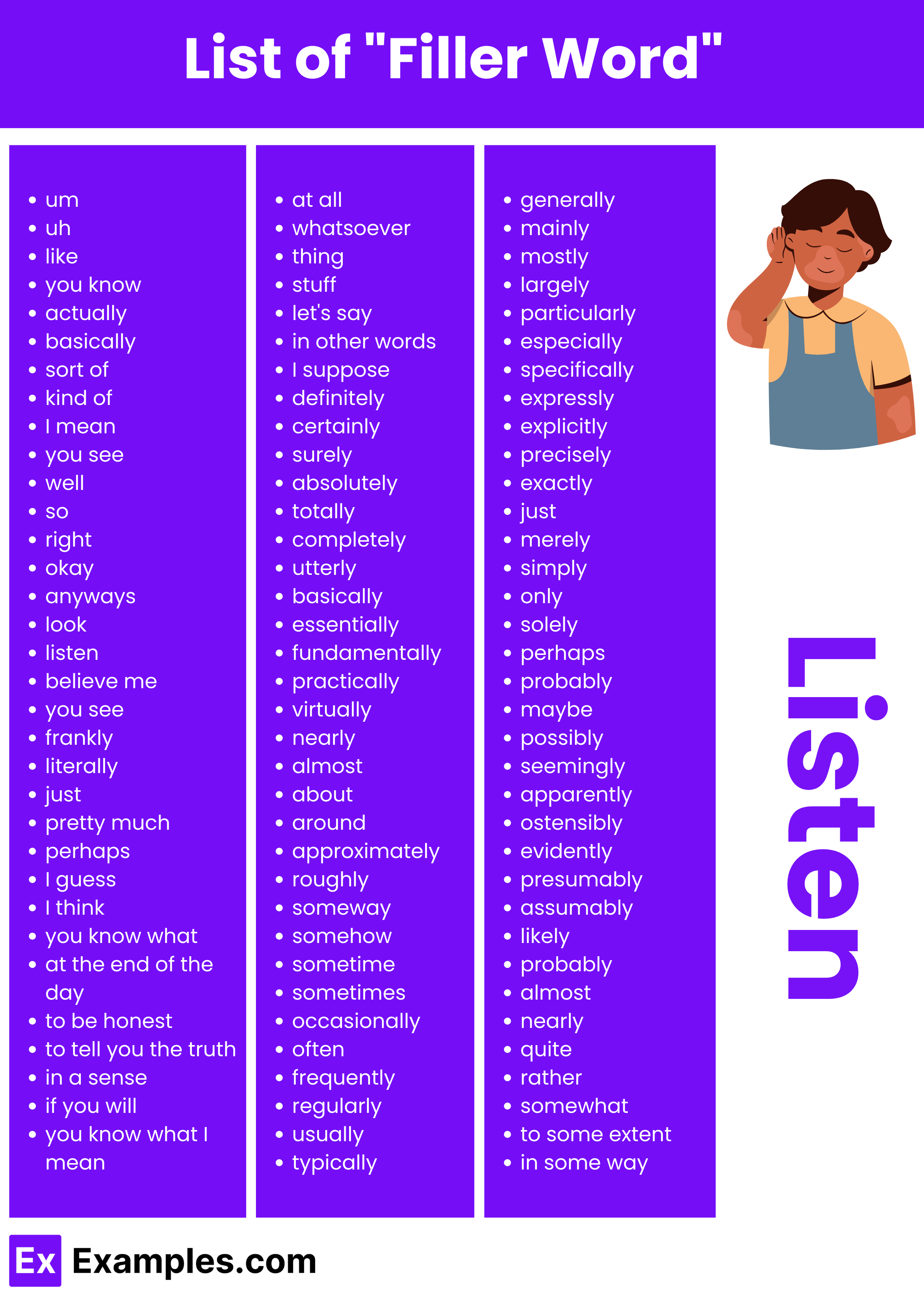
It's important to know that these fillers are not "bad" English. They are a natural part of speech. In fact, linguists have studied them and found they serve an important purpose.
“Um, Like, So”: How Filler Words Can Be Effective in ...
This article from Stanford Graduate School of Business, '“Um, Like, So”: How Filler Words Can Be Effective in Communication', explains the science behind fillers like 'um' and 'uh'.
Read the section that begins with the question from Matt Abrahams: 'In my world, as somebody who focuses on spoken communication, filler words, loom large, the uhs and the ums...'. Focus on how the expert, Valerie Fridland, describes 'um' and 'uh' as 'filled pauses' that signal 'cognitive processing load'. This means they show your brain is working hard.
The key idea is that "um" and "uh" signal to the listener: "I am thinking, I need a short pause, and I am not finished with my turn to speak." For someone with your technical background, you can think of it as signaling that your brain is processing a complex request.
However, in a professional setting, we can use more structured and impressive phrases to achieve the same goal.
2. Professional Phrases for Gaining Thinking Time
While "um" and "uh" are acceptable, relying on them too much can make you sound hesitant or unprepared. A more professional strategy is to use full phrases that acknowledge the question and give you a clear space to think.
Let's watch a video that presents some excellent, professional phrases for this purpose.
25 Smart English Phrases for Meetings | English for Daily Use
This video, '25 Smart English Phrases for Meetings' from the English to Excel channel, has a great section on phrases to buy yourself some time to think.
Please watch the section from 09:15 to 10:13. Listen carefully to these three phrases: 'Good question. Let me think about that for a second.' 'I'd like to give that a little more thought.' 'I'd like to revisit that after I've had a chance to review.'
These phrases are powerful because they make you sound thoughtful and in control. They turn a moment of hesitation into a moment of careful consideration.
3. A Simple Strategy: Pause, Phrase, and Repeat
Now, let's learn a very practical, step-by-step strategy for when you are asked a difficult question in a meeting.
Think Fast and Talk Smart On the Spot: How to Talk Fast and Clearly in Meetings
The video 'Think Fast and Talk Smart On the Spot' by communication coach Kara Ronin demonstrates a simple but effective technique for handling unexpected questions.
Watch from 04:39 to 05:27. Pay close attention to the technique the speaker demonstrates. It has three parts: Pause and take a breath. Use a thinking phrase (e.g., 'Hmm, that's a good question...'). Repeat the question back to the person.
Let's break down this excellent strategy:
- Pause: Don't feel rushed to answer immediately. A calm pause makes you look confident.
- Use a Phrase: Start with one of the phrases you've learned.
- "That's a good question."
- "Let me see..."
- "Hmm, that's interesting."
- "Let me think about that for a moment."
- Repeat or Rephrase the Question: This is a fantastic technique. It confirms you understood the question and gives your brain several extra seconds to prepare the answer.
For example, if a colleague asks, "What are the security implications of using the NextGen system?"
You could respond:
"Hmm, that's an important question. So, you're asking about the specific security implications of the NextGen system... Well,..."
That small pause gives you valuable time to structure your thoughts.
Test your understanding!
Imagine your manager asks you: "Can you give me a status update on the satellite deployment for the new client?" You are not prepared to answer immediately. How would you use the three-step strategy (Pause, Phrase, Repeat) to respond?
Show answer
There are many good ways to answer. Here is one example:
"Of course. Let me see... a status update on the satellite deployment for the new client... Okay, so currently, we have completed the initial calibration phase..."
Another good example:
"That's a good question. The status of the new client's deployment... Right. So, this week we are focusing on..."
4. Practice Scenario
Let's apply this to the scenario from our last lesson. We were discussing whether to recommend the reliable "Legacy" system or the new, faster "NextGen" system. You were defending your choice of the NextGen system.
Me (as your colleague): "You've made a good case for the speed of the NextGen system. But I'm still concerned. What is our specific plan to fix problems if the NextGen system fails during the first month? The client will need a concrete guarantee."
This is a tough, specific question. Instead of answering immediately, your task is to use one of the thinking phrases or the full 3-step strategy to give yourself time to think. You don't need to invent a technical plan; just show me how you would pause the conversation professionally.
(Please write your response below)
Show a model answer
An excellent response would be something like:
"That's a very important point. A specific plan for potential failures in the first month... Let me think about that for a second. Okay, so..."
Why this is effective:
- It validates my question ("That's a very important point").
- It repeats the core of the question ("A specific plan for potential failures...").
- It uses a clear thinking phrase ("Let me think about that for a second").
This response makes you sound thoughtful and responsible, not unprepared. You are now in a much better position to give a structured answer.
Conclusion
Great job today! You've learned a skill that is essential for fluency and confidence.
Key Takeaways:
- Filler words like "um" and "uh" are a natural part of speaking, often signaling that you are thinking hard.
- In professional settings, using structured thinking phrases ("That's a good question," "Let me see...") is more effective for gaining time.
- A powerful strategy for handling difficult questions is: Pause, use a thinking phrase, and repeat/rephrase the question. This gives you control and time to think.
Preview of the Next Lesson:
Using thinking phrases gives you time to find the right words. But what if you still can't remember a specific word? In our next lesson, we will learn how to handle that situation by learning to apply paraphrasing techniques, which is another critical skill for maintaining a smooth flow in your conversation.