Hello! Welcome to a new module focused on participating in group discussions.
In the previous module, you did excellent work learning how to manage one-on-one conversations to solve technical problems. Now, we'll shift our focus to a group setting: professional meetings. To be an active participant in meetings, you need to be able to share your ideas clearly and confidently.
Today's lesson is the first step. You will learn how to use set phrases to express your opinion politely. We will cover the most common phrases, from simple ones like "I think..." to more nuanced expressions that show how certain you are about your idea. This is a fundamental skill for making valuable contributions to any technical or business discussion.
1. The Basic Phrases for Sharing Your Opinion
Let's start with the most common and direct ways to express an opinion in English. You might already know some of these, but it's important to master them as they are your foundation.
How to Express Your Opinion in English
The video 'How to Express Your Opinion in English' by Learn English with Bob the Canadian provides a great introduction to everyday phrases. We'll start with the most common ones.
Please watch the section from 00:49 to 01:18. It covers the three simplest and most-used phrases.
As the video shows, the most common phrases are:
- I think...
- I feel like...
- In my opinion...
These are simple, clear, and can be used in almost any situation, both formal and informal. In a professional context, "I think..." and "In my opinion..." are very common and safe choices.
For example:
- "I think we need to investigate the server logs first."
- "In my opinion, this approach is too risky."
2. Structuring Your Opinion for Professional Impact
Just stating your opinion is good, but to be truly persuasive and professional, it's best to follow a simple structure. This helps your colleagues understand not just what you think, but why you think it.
A clear, professional opinion usually has three parts:
- State your opinion: Begin with a clear opening phrase.
- Explain your reason: Give the 'why' behind your opinion.
- Conclude or ask a question: This makes your point feel complete and invites others to respond.
Let's see this structure explained.
The Best Professional Connectors to Explain Your Opinions in English
The video 'The Best Professional Connectors to Explain Your Opinions in English' from Speak Confident English clearly explains this three-part structure. It's a key strategy for sounding logical and confident.
Please watch from 01:57 to 04:33. Pay close attention to the three steps and the examples provided.
Here is a technical example following this structure:
- (1) State Opinion: "I believe we should adjust the project timeline."
- (2) Explain Reason: "...since the current deadlines don't give us enough time for quality control."
- (3) Ask a Question: "What's your take on this?"
Using this structure makes your contribution much stronger than just saying "The timeline is too short." It shows you have thought about the issue and are open to discussion.
3. Expanding Your Vocabulary: Expressing Different Levels of Certainty
In a professional setting, you don't always want to express your opinion with the same strength. Sometimes you are 100% sure, and other times you are just suggesting an idea. Using different phrases shows this nuance.
We can group phrases for giving opinions into three categories: Strong, Normal, and Weak (or Tentative).
The article 'English Phrases for Meetings' from Espresso English provides an excellent list of phrases organized by strength. This will help you choose the right words for the right situation.
Please read the section titled 'Giving Your Opinion.' It is divided into 'Strong,' 'Normal,' and 'Weak' categories. Focus on understanding the difference between them.
Let's review these categories with some examples relevant to your work:
Strong Opinions
Use these when you are very confident about your point, perhaps based on data or direct experience.
- "I'm convinced that updating the firewall will solve the security issue."
- "I strongly believe that we should adopt the new framework."
Normal (Neutral) Opinions
These are your standard, everyday phrases for sharing your thoughts. They are polite and professional.
- "From my point of view, the documentation is clear."
- "In my experience, rebooting the system is the quickest fix for this type of error."
- "I'd say that the performance gains are worth the effort."
Weak (Tentative) Opinions
These are very useful when you are not 100% sure, or when you want to be extra polite and encourage discussion, especially if you are disagreeing with someone more senior.
- "It seems to me that the API is responding slower than usual."
- "My initial reaction is that the user interface looks a bit cluttered."
- "I tend to think that we might need more time for testing."
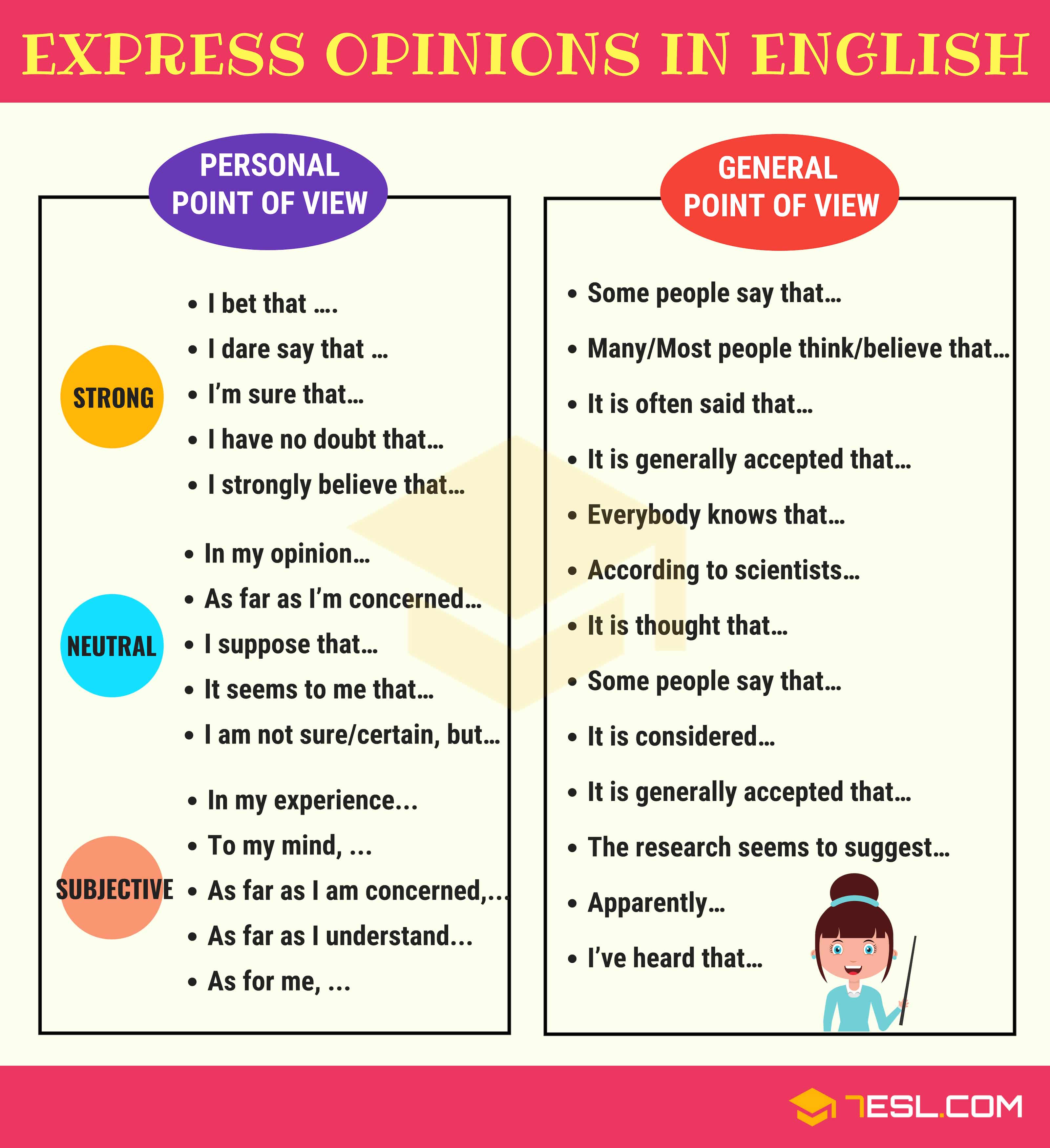
The image below gives you a great summary of different phrases you can use. You can save it as a quick reference sheet.
Test your understanding!
Imagine you are in a team meeting to decide on a new software tool. Your manager seems to prefer Option A. You have used Option B in a previous job and know it is much better.
Which category of phrase (Strong, Normal, or Weak) would you use to express your opinion, and why? Give an example phrase.
Show answer
You would likely use a Strong opinion phrase because you have direct, positive experience. This shows confidence in your recommendation.
Example: "I'm convinced that Option B is the better choice for our team. In my last role, it helped us increase productivity by 20%."
(Using a "Normal" phrase like "I think Option B is good" would also be fine, but a stronger phrase adds more weight to your experience.)
4. Practice Scenario
Now, let's put it all together. Read the following mini-dialogues from a technical meeting. Your task is to complete the sentences using an appropriate opinion phrase from the list above. Think about the context and choose a phrase with the right level of strength.
-
Situation: Your team is discussing a project deadline. You think it's possible but will be very difficult.
- Your colleague says: "So, we all agree we can finish the deployment by Friday?"
- You say: "__________________, that timeline is a bit optimistic. We haven't accounted for final testing."
-
Situation: The team is brainstorming causes for a system crash. You just remembered that a similar issue happened last year and it was caused by a memory leak. You are almost certain this is the cause again.
- Your manager asks: "Any ideas what could be causing these crashes?"
- You say: "__________________ this is another memory leak. The symptoms are exactly the same as the issue we had last year."
-
Situation: You are looking at a new design for the company website. A colleague asks for your general thoughts. You like it overall.
- Your colleague asks: "What do you think of the new homepage mockup?"
- You say: "__________________, it's a big improvement. It looks much more modern."
Show suggested answers
Here are some possible answers. Your choices might be different, and that's okay, as long as they fit the context.
-
"To be honest / It seems to me that that timeline is a bit optimistic. We haven't accounted for final testing."
(A weak/tentative phrase is good here because you are politely raising a concern about an agreement.) -
"I'm positive that / I'd say that this is another memory leak. The symptoms are exactly the same as the issue we had last year."
(A strong or confident normal phrase works well because you have experience to back up your opinion.) -
"I think / From my point of view, it's a big improvement. It looks much more modern."
(A standard, normal phrase is perfect for giving a general, positive opinion.)
Conclusion
Great job today! You've learned how to express your opinion in a variety of ways, which is a critical skill for actively participating in professional discussions.
Key Takeaways:
- Start with simple, common phrases like "I think..." and "In my opinion..."
- For greater impact, structure your opinion: State it, explain why, and then conclude or ask a question.
- Choose your phrase based on your level of certainty: use strong phrases when you're sure, and weak/tentative phrases when you want to be more cautious or polite.
Preview of the Next Lesson:
Today we learned how to state an opinion. The next logical step is learning how to support it effectively. In the next lesson, we will focus on how to provide a reason or example to support your stated opinion. This will help you build more convincing and logical arguments in any discussion.