Hello! Last time, you identified nouns and pronouns—the words that name people or things, or stand in for them. Now you will look at what those people or things do or are. This lesson shows you how to find a sentence’s main verb and decide whether any other verbs are helping it. Allow about 35–40 minutes, including the video and reading.
Find the main verb first
A verb can express an action: The bird sang. It can also express a state or condition: The bird was quiet. An action need not be something you can see. In She remembered the story, remembered is a verb too.
The main verb carries the central action or state. In The lantern flickered, flickered tells you what happened. In The lantern was bright, was tells you about the lantern’s state. Neither sentence has a helping verb; a main verb can stand on its own.
Compare that with The lantern was flickering. Now flickering names the action, while was helps express how that action unfolded. The two words work together, but they have different jobs.
Main Verbs VS Auxiliary (Helping Verbs) in English | Beginner Grammar Lesson on Parts of Speech
Watch “Main Verbs VS Auxiliary (Helping Verbs) in English” from Sparkle English for a clear comparison between a verb standing alone and one accompanied by a helper.
Watch the comparison. Notice how plays is the only verb in one sentence, while is playing contains a main verb and a helping verb. The speaker also shows how did helps form a question.
What makes a verb a helping verb?
A helping verb, also called an auxiliary verb, works with a main verb. Together they form a verb phrase. For example, in She is leaving, leaving is the main verb and is is the helping verb. In I have finished my work, finished is the main verb and have is the helper.
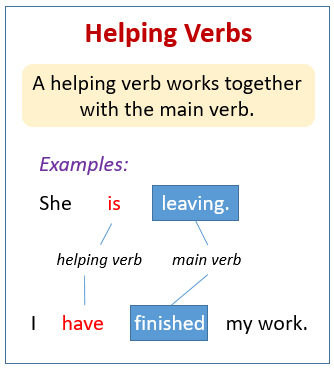
Helpers can add information about time, possibility, or how a sentence is being expressed. For now, you do not need to learn the names of different verb tenses. Focus on identifying each word’s job:
The children play outside.
The children will play outside.
The children might play outside.
Play is the main verb in all three sentences. The second sentence adds will; the third adds might, which suggests possibility. Common helping verbs include forms of be (am, is, are, was, were), have (have, has, had), and do (do, does, did), as well as words such as can, could, will, would, may, might, should, and must. You will meet other forms as you read.
Read Elizabeth O’Brien’s “Helping Verbs & Verb Phrases” to see how main verbs and helpers combine—and why a word on a list of helpers is not always helping.
Under “Main Verbs, Helping Verbs, & Verb Phrases,” begin with the explanation. Include the “List of Helping Verbs” and the small table of verb phrases; concentrate on the roles of the words, not on memorizing the list. Immediately below, read the two examples contrasting “I was sleeping” with “I was captain.” Then read the question paragraph and the table beneath it, ending with “No, I don’t know her.” Notice that a helper and main verb need not sit side by side. Stop before the paragraph beginning “Psst!”
A sentence may have more than one helper. In The dog has been barking, barking is the main verb; has and been both help it. The whole group, has been barking, is the verb phrase.
The same word can do either job
Do not label a word “helping” simply because it appears on a list. Look at the sentence around it:
She has a book.
She has read a book.
In the first sentence, has is the main verb: it expresses possession, and there is no other verb for it to help. In the second, read is the main verb and has helps it.
The same distinction works with is:
The room is quiet.
The room is growing quiet.
In the first sentence, is is the main verb. In the second, growing is the main verb and is is its helper. Ask yourself: Is this word carrying the main action or state, or is it working with another verb that does?
Main Verbs VS Auxiliary (Helping Verbs) in English | Beginner Grammar Lesson on Parts of Speech
Return to the Sparkle English video to see both multiple helpers and words that change roles from sentence to sentence.
Watch two helpers in “have been waiting.” Then watch changing roles, paying particular attention to the comparisons using does and have. The important question is what each word does in that sentence.
When the verbs are apart
A useful first step is to find the main verb, then check for a helper. But do not assume the two must be next to each other. In a question, the helping verb can appear near the beginning:
Did she open the door?
Open is the main verb; did helps form the question. Similarly, in She did not open the door, did is the helper and open is the main verb. Not is not a helping verb—it adds a negative meaning between the two verbs.
Here is a final comparison:
She did her work.
Did she finish her work?
In the first sentence, did is the main verb. In the second, finish is the main verb and did is the helper. Looking for the main verb before assigning any helpers will serve you better than relying on a memorized list.
Key takeaways
Every simple sentence needs a main verb to express its central action or state. Some also have one or more helping verbs that work with it. A familiar word such as is, has, or did may be a main verb in one sentence and a helper in another, so judge its role from the whole sentence.
Next, you will use what you know about nouns, pronouns, and verbs to locate the subject and predicate of a simple sentence.