Hello. This first module examines why quitting cigarettes can be difficult even when someone understands the health risks and wants to stop. Later lessons will address cravings, withdrawal, and the supports that can help with a quit attempt. For now, the focus is narrower: how nicotine engages the brain’s reward system, how repeated exposure changes that system, and why dependence is not simply a failure of willpower.
Allow about 35–40 minutes to read, watch, and study the diagram. You do not need a background in neuroscience; the important ideas are the relationships between a fast drug effect, repeated use, and adaptation.
A fast signal to the reward system
The brain’s reward system helps us learn which experiences are worth repeating. One of its chemical messengers, dopamine, contributes to that learning and motivation. Dopamine is not exclusively a “pleasure chemical,” and experiencing a dopamine response does not mean someone has lost control. The key point here is that nicotine can repeatedly stimulate a system that influences what we seek out again.
Start with two short excerpts from the Centers for Disease Control and Prevention (CDC). The first distinguishes dependence from a routine; the second shows what nicotine does when it reaches the brain.
Nicotine Addiction and Withdrawal
Watch “Nicotine Addiction and Withdrawal” from the CDC for an introduction to tobacco dependence and the brain’s reward pathway.
Watch dependence explained at the start. Then skip to nicotine and dopamine. Focus on the distinction between nicotine binding to receptors on nerve cells and the subsequent release of dopamine; they are related events, not the same event.
A receptor is a protein on or in a cell that responds to particular chemical signals. Nicotine attaches to receptors called nicotinic acetylcholine receptors. That attachment changes nerve-cell activity and helps stimulate dopamine release in reward-related brain circuits. The diagram makes one part of this pathway visible.
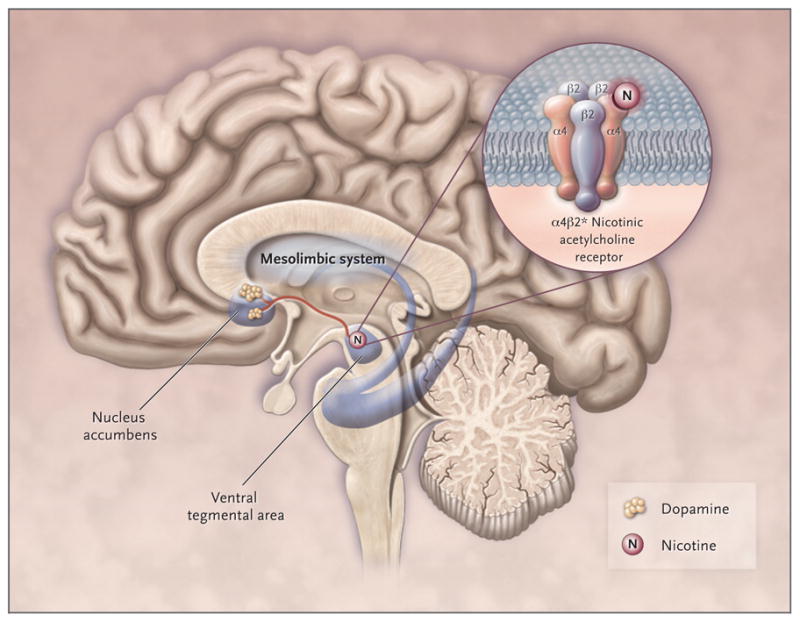
The labels are less important than the distinction they illustrate: nicotine is the incoming substance; dopamine is one of the brain’s responses. The ventral tegmental area and nucleus accumbens are parts of a wider reward network, not an isolated “addiction switch.”
Why the speed of cigarettes matters
A cigarette delivers nicotine through the lungs to the bloodstream and then rapidly to the brain. That timing matters. When a drug effect follows an action quickly, the brain can more readily link the action with what happened afterward. Nicotine’s rewarding effects are also brief. Repeating the action can therefore become compelling even though any single cigarette provides only a short-lived effect.
Read the two opening paragraphs of the National Institute on Drug Abuse (NIDA) page below. They connect dopamine, repeated exposure, and the unusually rapid delivery of nicotine from cigarette smoke.
Is nicotine addictive? | National Institute on Drug Abuse (NIDA)
Read NIDA’s “Is nicotine addictive?” to connect the initial reward effect with the changes that accompany continued smoking.
In the “Is nicotine addictive?” section, read from the reward discussion through the end of its first paragraph. Continue into the next paragraph, beginning with its explanation of how the body processes nicotine; read the delivery discussion through that paragraph’s end. Notice that NIDA describes both a fast onset and a fast decline in nicotine’s acute effects.
Two related processes are taking shape. First, nicotine can make smoking rewarding: an effect of the cigarette increases the likelihood of smoking again. Second, as its effects wear off in someone who has become dependent, another cigarette can prevent or relieve discomfort. Researchers call these positive reinforcement and negative reinforcement, respectively. “Negative” here means removing an unpleasant state, not that the person has done something wrong.
Neither process requires a strong euphoric “high.” For a person who smokes regularly, the experience may be subtler: a brief change in how they feel, followed later by a sense that something is missing. The rapid delivery of nicotine from cigarettes helps make that pattern repeatable throughout a day.
Adaptation changes what “normal” feels like
The first cigarette and the hundredth do not act on an unchanged brain. With repeated nicotine exposure, receptors and connected circuits adapt. Tolerance means that some effects of a given amount of nicotine become less pronounced over time. Dependence means that the brain and body have adapted to regular nicotine exposure, so its absence can produce cravings or withdrawal symptoms. These concepts overlap, but they are not interchangeable: tolerance describes a change in response to nicotine; dependence includes what happens when nicotine is no longer supplied.
For a closer look at the biology, read just the first two paragraphs of “Neuroadaptation” in the clinical review below. Its terminology is more technical than NIDA’s. The useful terms to carry forward are desensitization—receptors temporarily becoming less responsive—and an increase in nicotine-receptor binding sites with repeated exposure. You do not need to memorize the receptor names.
Read the opening of “Neuroadaptation” in the clinical review “Nicotine Addiction” to see what adaptation means at the receptor level.
Under “BRAIN MECHANISMS,” find the subsection “NEUROADAPTATION.” Read its first two paragraphs, stopping before the paragraph that begins “Nicotine withdrawal causes anxiety and stress.” Focus on how receptor changes relate to both tolerance and the relief felt when nicotine is supplied again.
The CDC video gives a shorter account of tolerance. Watch this excerpt with one qualification in mind: tolerance develops to some effects of nicotine; it does not mean every person must continually increase how much they smoke.
Nicotine Addiction and Withdrawal
This later excerpt of the CDC video summarizes tolerance and the role of avoiding withdrawal discomfort.
Watch tolerance and relief. Pay particular attention to the distinction between seeking a satisfying effect and maintaining nicotine levels to avoid feeling unwell.
These changes help explain a common puzzle: a cigarette can seem to improve someone’s mood or concentration, yet part of that improvement may be relief from an emerging nicotine withdrawal state. If nicotine levels fall between cigarettes or during sleep, a dependent person may feel an urge to smoke or feel irritable or unsettled. Smoking supplies nicotine again and can briefly ease that discomfort. This is a real effect, but it should not be mistaken for proof that cigarettes are necessary for the brain to function well.
Adaptation also does not mean permanent damage or a brain that cannot function without nicotine. The brain can readjust after nicotine use stops, although the experience and pace vary among people. A later lesson will examine the usual course of withdrawal more carefully.
Why “just use willpower” misses the mechanism
Deciding to quit is meaningful, but a decision does not instantly reverse changes produced by repeated nicotine exposure. A person trying to stop may face urges generated by a reward system that has learned to respond to nicotine, alongside discomfort when a familiar nicotine supply is absent. NIDA also notes changes in circuits involved in learning, stress, and self-control. That combination can make it difficult to follow through on a resolution even when the reasons for quitting remain clear.
This is why dependence is an explanation, not a moral judgment. It does not mean quitting is impossible, nor does it mean choices and preparation are irrelevant. It means that effort alone is a poor account of the problem. Support and treatment can address parts of the process that determination by itself does not remove. The nicotine that sustains dependence is also distinct from the cigarette smoke responsible for many of smoking’s health harms—a distinction that will matter when the course turns to cessation treatments.
For now, keep the causal story in view: cigarettes deliver nicotine rapidly; nicotine stimulates reward-related signaling; repeated exposure changes the brain’s response; and, once dependence develops, nicotine’s absence can feel uncomfortable. The desire to smoke may then reflect both pursuit of a rewarding effect and relief from that discomfort.
Key takeaways
Nicotine dependence develops through learning and biological adaptation, not simply through weak resolve. Nicotine acts on brain receptors and promotes dopamine signaling; the fast delivery from cigarettes strengthens the link between smoking and its effects. With repeated exposure, the brain adapts, so stopping nicotine can bring urges and discomfort even when a person sincerely wants to quit.
The next lesson adds another layer: how ordinary situations and routines become linked to smoking, and why a craving can arise even after the most immediate physical withdrawal has eased.