Welcome back. The previous lesson showed why a familiar cue can bring on a craving even after the body has begun adjusting to life without nicotine. This lesson looks more closely at that physical adjustment: what nicotine withdrawal can feel like, when symptoms tend to be strongest, and why no single timetable fits everyone. Allow about 35–40 minutes for the short video, readings, and timeline.
Withdrawal is an adjustment, not a single symptom
With repeated smoking, the body becomes accustomed to nicotine. When nicotine is no longer arriving regularly, it has to adjust. That adjustment is called nicotine withdrawal. It can affect attention, sleep, mood, appetite, and the urge to smoke; it does not feel the same to everyone.
Read Smokefree.gov’s Managing Nicotine Withdrawal for its definition and its careful description of variation.
Managing Nicotine Withdrawal | Smokefree
Smokefree.gov explains why symptoms occur after stopping nicotine and why their course differs between people.
In “What Is Nicotine Withdrawal?”, read the explanation from the paragraph beginning “Nicotine is the main addictive substance” through the end of the section. Then read the opening paragraph immediately below that section, from the statement that withdrawal differs for everyone through the warning about the first week. Pay particular attention to the general pattern: symptoms tend to become weaker and less frequent, rather than ending at a precise hour.
The first week can be difficult partly because smoking may seem to offer quick relief from withdrawal discomfort. That relief helps explain the temptation to smoke again; it does not mean the discomfort would otherwise continue at the same intensity indefinitely. The course usually improves, even though a particular day or craving can still feel hard.
What symptoms can appear?
A craving may be the most noticeable sign, but withdrawal is broader than an urge for a cigarette. This brief passage from the CDC’s Nicotine Addiction and Withdrawal gives an overview of both the symptoms and their usual course. It covers different material from the passages used in the previous lesson.
Nicotine Addiction and Withdrawal
Watch the CDC’s “Nicotine Addiction and Withdrawal” for its concise account of what people may experience soon after stopping tobacco.
Watch withdrawal symptoms. Notice that the speaker describes a typical pattern, not a prediction of which symptoms any one person will have.
For a fuller list, read the National Cancer Institute’s Handling Nicotine Withdrawal and Triggers When You Decide To Quit Tobacco. Its timeline will also be useful in the next section.
Tips for Coping with Nicotine Withdrawal and Triggers - NCI
The National Cancer Institute distinguishes common from less common symptoms and gives a more nuanced timeline than a day-by-day chart.
Under “What are some of the nicotine withdrawal symptoms associated with quitting tobacco?”, read the common symptoms and the following less common symptoms. Continue into the next paragraph, beginning “The good news is that there is much you can do,” and read the timeline. Stop before “What can I do about nicotine cravings after I quit?”, which concerns cravings and triggers covered in the previous lesson.
The common symptoms fall into several overlapping experiences. A person might feel irritable, anxious, restless, or low; find it harder to concentrate or sleep; or notice more hunger alongside cravings. Headache, fatigue, dizziness, coughing, mouth ulcers, and constipation are among the less common symptoms the NCI lists. “Possible” does not mean “inevitable”: someone may have only a few symptoms, and their most troublesome symptom may not be the one another person notices most.
Symptoms can also affect one another. A poor night’s sleep may make concentration harder the following day. Irritability may feel more pronounced when a strong craving interrupts a task. This is one reason a list of symptoms is more useful than treating each sensation as an entirely separate event.
Read the timeline as a pattern, not a deadline
The chart below depicts one simplified rise-and-fall pattern during the first four days after the last cigarette. Use it to visualize why the early period can be demanding, not to predict an exact peak or finish time.
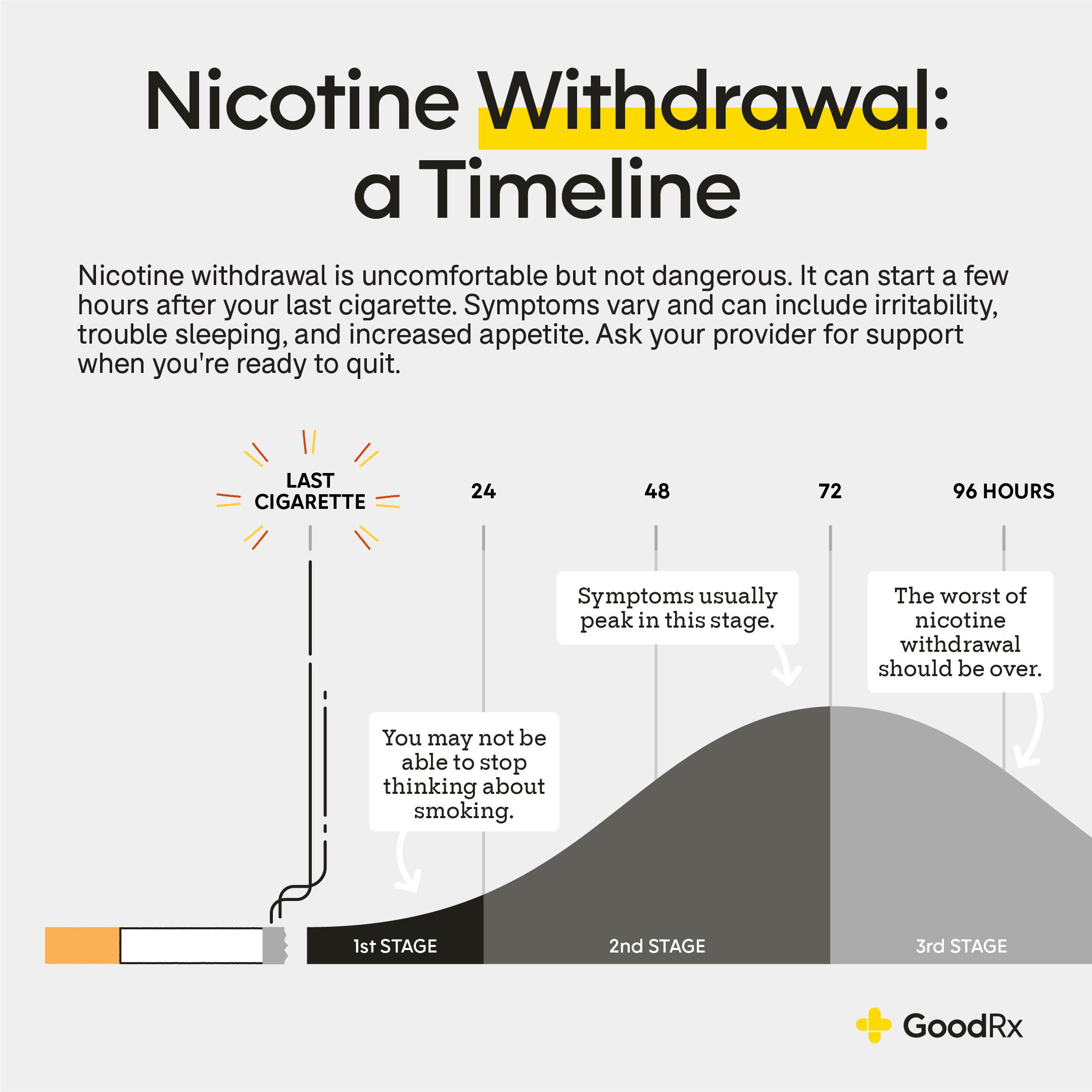
The NCI reports that symptoms are usually worst in the first week, often peaking during the first three days. Intensity generally declines over the first month, though some people experience symptoms for several months. Those statements describe groups of people, not a rule that every symptom must peak together. In particular, the chart’s suggestion that “the worst” should be over by 96 hours is too definite to use as a personal forecast.
There are three useful time scales to keep distinct:
- Soon after stopping: Cravings can begin within hours. Other symptoms may emerge during the first day or two.
- The early days and weeks: Withdrawal is commonly at its most intense early on, then tends to become less intense and less frequent. Improvement need not be smooth from one day to the next.
- Later on: Occasional urges can still occur after the main period of physical adjustment. As the previous lesson explained, a familiar cue can revive a craving without putting someone back at the start of withdrawal.
Imagine that concentration improves after the first week, but sleep remains unsettled for a while longer. Or that most days become easier, yet a stressful afternoon brings a strong urge. Neither pattern contradicts gradual improvement. That phrase refers to the overall course, not an uninterrupted sequence of better days.
Why the course varies
People differ in which symptoms they experience, how strongly they feel them, and how long they last. Their circumstances matter too: sleep, stress, and exposure to familiar smoking cues can change how difficult a particular day feels. A person with few physical symptoms might still encounter strong cue-linked cravings; someone else might find early mood changes or poor sleep more disruptive.
This variation makes two interpretations especially important. First, a difficult day after an easier one is not proof that adjustment has stopped. Look at the broader pattern rather than one moment. Second, not every new symptom should automatically be assigned to withdrawal. If something is severe, unusual, worsening, or otherwise concerning, professional assessment is more useful than assuming it is simply part of quitting. The next lesson will examine that distinction more closely.
Withdrawal is temporary in its overall course, but its discomfort is real. Knowing what commonly happens makes it easier to understand why the early period can be challenging without mistaking a typical timeline for a guarantee.
Key takeaways
Nicotine withdrawal is the body’s adjustment to no longer receiving nicotine regularly. Common experiences include cravings, mood changes, restlessness, difficulty concentrating or sleeping, and increased appetite; not everyone experiences all of them. Symptoms are generally strongest in the first few days or first week and tend to ease over subsequent weeks, but the pace and individual symptoms vary. Later cravings may reflect learned cues rather than a return to the earliest physical withdrawal.
The next lesson will use this understanding to distinguish expected discomfort from symptoms that call for professional assessment or urgent help.