A smoking trigger can arrive before you have had time to think through your quit plan: a cup of coffee, a stressful moment, or the sight of someone lighting a cigarette. This lesson gives you a short routine to use in that moment. You will practice delaying, changing what you are doing, and breathing at a comfortable pace—not to make every craving vanish on command, but to give yourself time to respond without smoking.
Allow about 35–40 minutes, including the readings and a brief rehearsal. You do not need to be experiencing a craving to practice.
Make room between an urge and an action
A craving can feel urgent without requiring an immediate response. Some urges ease within a few minutes; others last longer, recur, or become stronger in a familiar smoking situation. A useful first goal is therefore modest: do not decide whether to smoke during the next five minutes. Spend those minutes doing something else. If the urge remains, you can repeat the routine or use another part of your quit plan.
The image below presents a memorable version of this approach. Its four actions can happen together rather than in a rigid order: you can take a drink of water while waiting, or breathe slowly after moving away from a trigger.
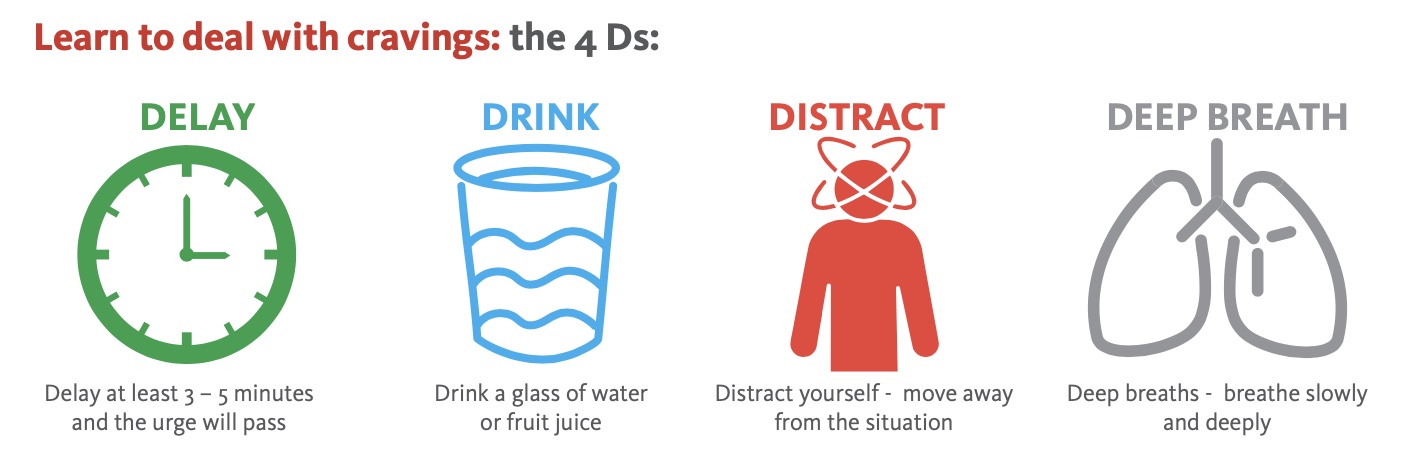
Tips to Handle Cravings | QuitNow.ca
Read QuitNow’s “Tips to Handle Cravings” for a practical explanation of the four actions and examples of things to do during a delay.
In “Prepare to handle cravings: the 4Ds strategy,” read the “Delay,” “Distract,” “Deep breathing,” and “Drink water” subsections. Start with the four actions, ending at the suggestion to sip water slowly. Notice how changing activity gives you something concrete to do during the wait. Treat the suggested three-to-five-minute craving duration as a common pattern, not a deadline by which every urge must disappear.
A routine you can use in the moment
Use the following as a five-minute script. Its purpose is to interrupt the familiar response to a cue, while giving your attention and hands another task.
- Name the urge and delay. Silently say, “This is a craving. I can wait five minutes before doing anything about it.” Use a timer if it is safe and convenient, or simply mark the start of the delay. The commitment is to wait, not to prove that you feel calm.
- Change the activity or setting. Leave the place where people are smoking, switch rooms after a meal, start washing dishes, take a short walk, or occupy your hands with a small task. Choose an action that fits the situation; distraction need not be elaborate to be useful.
- Breathe comfortably. Breathe in through your nose and out slowly through your mouth for around ten breaths. Keep the pace gentle rather than forcing a very deep breath or holding it. If you feel lightheaded, stop the exercise and return to normal breathing.
- Use a simple substitute if helpful. Sip water, chew sugar-free gum, or pick up another suitable snack. This can give your hands or mouth something to do while you stay with the delay.
- Notice what has changed. At the end of the interval, the urge may have eased, shifted, or stayed strong. If it is still strong, begin another short delay with a different activity or draw on the support and treatment already in your quit plan.
The breathing is an aid to getting through the moment, not a requirement to eliminate the craving. The National Cancer Institute offers a straightforward version without a demanding counting pattern.
Tips for Coping with Nicotine Withdrawal and Triggers - NCI
Read the National Cancer Institute’s brief craving-management advice to see how the delay, substitutes, and breathing fit alongside one another.
Near the top of the page, find the bulleted craving-management tips immediately before “What can I do about anger, frustration, and irritability after I quit?” Read from the reminder and breathing advice. Focus on the instruction to breathe in through the nose and blow out slowly through the mouth. The medication tip nearby is part of a broader quit plan; this particular routine addresses what to do during an urge.
Rehearse where the routine has to work
The words “change activity” become more useful when attached to a specific setting. The National Cancer Institute’s driving and coffee examples show why the same routine needs different practical details. A person can leave the table after coffee, but should not reach for a phone or try to set a timer while driving.
Tips for Coping with Nicotine Withdrawal and Triggers - NCI
Continue with the National Cancer Institute’s examples of cravings tied to everyday routines. Read for safe, realistic changes of activity rather than trying to memorize every suggestion.
In “How can I resist the urge to smoke when I'm driving or riding in a car?”, go to “Tips for short trips:” and read the car suggestions through the end of the long-trip tips. Then, in “How can I resist the urge to smoke when I’m having coffee or tea?”, start at the paragraph explaining the coffee-and-smoking association and read the coffee suggestions through the instruction to change activities or rooms. Compare what can be changed in advance with what can be done when an urge actually appears.
Guided rehearsal — about eight minutes. Run through the next two scenes, saying the response quietly or picturing each action. If you can, physically take the breaths and change your position for the first scene. No actual craving is needed.
First, imagine finishing coffee in a place where you used to smoke. Notice the impulse to reach for a cigarette. Say, “I’m delaying for five minutes.” Stand up and move to another room or begin clearing the cup. Take ten comfortable breaths, with a slow exhale through your mouth, then sip water. Picture yourself continuing the new activity if the urge is still present when the five minutes end. Run through the sequence once more, this time choosing a different activity that would genuinely be available to you.
Now imagine an urge during a car journey. Keep your attention on driving: do not handle a phone, close your eyes, or attempt a timed breathing pattern that distracts you. Silently name the urge and postpone acting on it. Breathe normally and gently while keeping your focus on the road. If you are a passenger, you may have more options, such as occupying your hands. If you are driving and need a bigger change of activity, make it at a safe stop. Notice how the principle stays the same—delay and redirect—while the action changes to suit the setting.
A rehearsal is useful even if it feels uneventful. It makes the first action easier to recall when a real cue leaves less room for deliberation. If cravings are frequent or remain difficult to manage, a short routine need not carry the whole quit attempt; behavioral support and cessation treatment can work alongside it.
Takeaway
A craving-management routine is a short, repeatable response, not a promise that an urge will end in exactly five minutes. Delay acting, change your activity or setting where safe, breathe gently, and use a substitute such as water if it helps. When the interval ends, respond to what is actually happening rather than treating a lingering craving as failure.
The next lesson will use a simple craving-and-symptom log to spot patterns and decide where a quit plan may need adjusting.