Welcome back. The previous lesson examined how counseling, quitlines, groups, and digital support help someone change smoking routines and stay engaged with a quit attempt. This lesson adds a different kind of help: nicotine replacement therapy (NRT). You will see why giving the body nicotine without cigarette smoke can ease withdrawal, why a patch and a faster-acting product serve different purposes, and how NRT fits alongside behavioral support rather than replacing it.
Why replace nicotine when the goal is to quit?
Stopping cigarettes and stopping nicotine do not have to happen on the same day. Nicotine dependence means that, after regular smoking, a sudden drop in nicotine can produce cravings, irritability, difficulty concentrating, and other withdrawal symptoms. NRT supplies a measured dose of nicotine without burning tobacco. It can make the transition away from cigarettes more manageable while a person works on the routines and cues associated with smoking.
That distinction matters for health. Cigarette smoke exposes the body to many toxic and cancer-causing substances. Getting nicotine from an approved replacement product is far less harmful than smoking a cigarette, although nicotine is not harmless and NRT should be used according to its instructions. NRT is a treatment for quitting smoking, not a claim that nicotine has no effects.
The National Cancer Institute (NCI) explains both the withdrawal-relief purpose of NRT and how its different forms deliver nicotine. Read its overview before comparing products below.
Tips for Coping with Nicotine Withdrawal and Triggers - NCI
Read the National Cancer Institute's explanation of how nicotine replacement products relieve withdrawal and how the available forms differ.
Find the question “Do nicotine replacement products relieve nicotine cravings and withdrawal symptoms?” after the page's coping tips. Start with the answer explaining that the products deliver measured doses. Continue through the descriptions of the patch, gum, lozenge, nasal spray, and inhaler, ending with the inhaler paragraph's caution: inhaler caution Focus on where nicotine enters the body and whether each product provides steady coverage or is used more promptly when an urge occurs. The approval and prescription details on this page concern the United States; availability varies elsewhere.
The forms differ, but none requires inhaling cigarette smoke. A patch delivers nicotine through the skin. Gum and lozenges release nicotine through the lining of the mouth. The nicotine inhaler described by NCI delivers most of its nicotine to the mouth and throat; despite its name, it does not deliver nicotine to the lungs as a cigarette does. Nasal spray delivers nicotine through the nose. These routes help explain why NRT can relieve withdrawal without recreating the exposure from smoking.
The patch: a steady background level
A nicotine patch is worn on the skin and releases nicotine gradually. Think of its job as background withdrawal control, not instant relief for a craving that has already arrived. Nicotine takes time to pass through the skin, and the patch provides a relatively steady supply rather than the rapid rise associated with smoking a cigarette. That can help with the ongoing discomfort of having stopped cigarettes, even on a day when no single trigger stands out.
Watch the patch demonstration for a concrete picture of skin delivery. Concentrate on the route and pace of nicotine delivery, rather than treating any particular dose as a recommendation for everyone.
Watch “How To Use Nicotine Patches” from Taking Texas Tobacco Free to see how a patch is applied and why its delivery is gradual.
Watch patch application. Notice where the patch is placed, then listen for the explanation that nicotine passes through the skin into the bloodstream and is released steadily. Follow the instructions for a particular product, rather than relying on a demonstration to choose a personal dose.
Steady coverage has a limit: a familiar smoking cue can still produce a sudden urge. Someone may feel generally comfortable on a patch yet strongly want a cigarette during a usual smoking break. That does not necessarily mean the patch has stopped working. Withdrawal and cue-linked craving overlap, but they are not identical. The patch addresses the background need for nicotine; a learned association with a break, emotion, or social situation may still need a coping response.
Faster-acting products: help when an urge breaks through
Gum and lozenges are examples of shorter-acting NRT. They deliver nicotine more promptly than a patch and can be used as directed when cravings arise. “Faster” is relative: they are not the same as taking a puff of a cigarette, and their benefit need not be instantaneous. Gum is used differently from ordinary chewing gum: nicotine is released as it is chewed and then held against the cheek, where it can be absorbed. A lozenge is allowed to dissolve in the mouth. Product instructions matter for using either effectively.
A patch and a shorter-acting product can therefore do complementary jobs. The Centers for Disease Control and Prevention (CDC) describes this as combination NRT: steady nicotine from a patch, with gum or a lozenge available for urges that break through.
How to Combine Quit Smoking Medicines | Quit Smoking | Tips From Former Smokers | CDC
Read the CDC's explanation of why a patch may be paired with a shorter-acting nicotine product.
In the main body, below the opening image, find the paragraph beginning “Using combination NRT starts with putting on a patch each morning.” Read the combination explanation through its account of using gum or a lozenge for urges. Then look at the “Combine quit-smoking medicines as follows” table immediately below the images to see which products it classifies as long- and short-acting. Focus on the two roles, not on assuming every person needs the same combination.
Consider a person who has quit cigarettes and wears a patch but encounters a strong urge during their usual afternoon break. The patch may be helping with withdrawal across the day. A shorter-acting NRT product, used according to its directions, may help with that particular urge. Changing the break routine or contacting a counselor can address the learned expectation of smoking at that time. Neither the patch nor the coping strategy has to do the other's job.
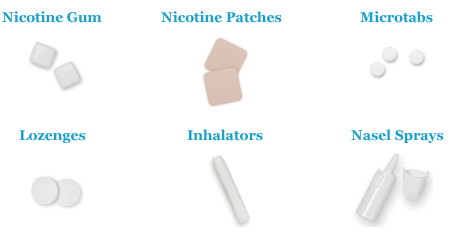
The image shows several ways NRT can be delivered. It is useful for recognizing the products, but it is not a universal list of approved or available treatments: for example, the microtabs pictured are not among the five US FDA-approved forms listed on the NCI page. An inhalator or nicotine inhaler is also distinct from an e-cigarette.
What NRT can—and cannot—solve
NRT can reduce nicotine withdrawal and improve the chance of quitting, but it does not erase every craving or automatically change a smoking routine. A person might still need a plan for a difficult commute, a stressful conversation, or being offered a cigarette. This is why the behavioral support from the previous lesson and NRT fit together: one helps with skills, cues, and follow-through; the other helps with nicotine withdrawal. The NCI notes that NRT is more effective when combined with advice or counseling from a health professional.
Choosing a form also involves practical considerations, not just speed. Patches can irritate skin, and wearing one at night can cause vivid dreams for some people. Gum may be unsuitable for some dental or jaw problems. Nasal spray and nicotine inhalers have their own potential irritation and, in the United States, require prescriptions. The right product, strength, and duration depend on circumstances and the product's directions; the patch-plus-gum example is an option, not an instruction for everyone to start both.
Read the NCI's closing discussion for the balance between benefit and caution.
Tips for Coping with Nicotine Withdrawal and Triggers - NCI
Return to the NCI page for its summary of combining products and its comparison of NRT with smoking.
Immediately after the inhaler description you read earlier, find the paragraph beginning “Using a long-acting form of nicotine replacement therapy.” Read through its statement that combination treatment can be helpful and that advice or counseling can add benefit. Then, under “Are nicotine replacement products safe?”, read from the safety comparison through the pregnancy caution. Keep the comparison precise: less harmful than cigarettes does not mean appropriate to self-start in every circumstance.
If someone is pregnant or trying to become pregnant, has a relevant health condition, experiences troublesome effects, or is unsure which product is suitable, professional advice is particularly important before choosing a treatment. A clinician or pharmacist can help interpret the options and product instructions. A later lesson will examine these situations more closely.
Key takeaways
NRT supplies measured nicotine without cigarette smoke, easing withdrawal while a person stops smoking. A patch offers gradual, steady background coverage; gum, lozenges, and other shorter-acting forms can help with urges that arise despite that coverage. Combining a patch with an appropriate shorter-acting product can be useful, but product choice and use should follow directions and, where needed, professional guidance. Behavioral support remains valuable because nicotine delivery alone does not undo learned smoking cues.
The next lesson turns to other cessation medicines—varenicline, bupropion, and cytisine where available—and how their roles differ from NRT.