¡Hola! Welcome back.
In our last lesson, you learned how to express feelings by saying "Estoy feliz" (I am happy) or describing your son's mood with "Él está cansado" (He is tired). Now, we'll learn the other side of that conversation: how to ask about feelings. This is a vital skill for checking in with your son and for polite interactions with others, like his teachers.
Today, we will focus on two essential questions: ¿Cómo estás? (How are you?) and ¿Qué te pasa? (What's wrong?). By the end of this lesson, you'll be able to start a simple conversation about feelings with confidence.
1. The Most Common Question: ¿Cómo estás?
The most direct and common way to ask "How are you?" in Spanish is ¿Cómo estás?. However, Spanish has a social layer that's important to understand: the difference between informal and formal address. This will be key when you speak with your son versus his teachers.
To understand this crucial distinction, please read the following article. It breaks down when to use the informal and formal versions of "you."
How Are You in Spanish Language A Practical Guide
The article 'How Are You in Spanish Language A Practical Guide' from Spanish.sg clearly explains the difference between the informal ¿Cómo estás? and the formal ¿Cómo está usted?.
Please read the first three sections, starting from the top and ending just before the heading 'Sounding Natural with Casual Greetings'. Focus on the table that shows when to use the informal ('Tú') versus the formal ('Usted') phrase.
Here's a quick summary of the main point for your specific situations:
- For your son, family, and friends (Informal): Use
¿Cómo estás?- This is the friendly, familiar form.
- For your son's teacher, elders, or people you don't know (Formal): Use
¿Cómo está usted?- This is the respectful form. Notice the verb changes from
estástoestá, and we addusted.
- This is the respectful form. Notice the verb changes from
The golden rule is: when in doubt, use the formal ¿Cómo está usted?. It's always better to be too polite.
This poster is a great visual reminder of how this question connects to the feeling words you already know.
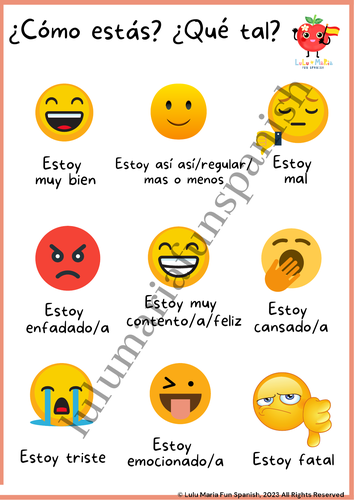
2. A Casual Alternative: ¿Qué tal?
While ¿Cómo estás? is always correct, in casual, friendly conversations, you will very often hear ¿Qué tal?. It's a versatile phrase that works like "What's up?" or "How's it going?" in English.
You can use ¿Qué tal? with your son and friends as a relaxed way to ask how they are. It’s generally considered informal.
Let's refer back to the previous article to see how it fits in.
How Are You in Spanish Language A Practical Guide
This section of the same article introduces ¿Qué tal? as a common, friendly greeting.
Read the section titled 'Sounding Natural with Casual Greetings'. It explains how ¿Qué tal? is used.
A great, very natural-sounding habit is to combine your greeting with the question, like this:
¡Hola! ¿Cómo estás?¡Buenos días! ¿Qué tal?
3. Asking "What's Wrong?": ¿Qué te pasa?
Sometimes you can see that your son is not happy, and you want to ask what's specifically wrong. A simple ¿Cómo estás? might not be direct enough. In these moments, the perfect question is:
¿Qué te pasa? (What's happening to you? / What's wrong?)
This question is incredibly useful for a parent. It shows concern and invites your child to share what's bothering them.
- Imagine your son comes home from school looking sad. You could say:
"Hola, cariño. ¿Qué te pasa?" (Hello, dear. What's wrong?)
- He might then reply with what you learned last lesson:
"Estoy triste." (I am sad.)
This simple exchange is the foundation of having a supportive conversation in Spanish.
Test your understanding!
For each scenario, which question would you use? Choose from ¿Cómo estás?, ¿Cómo está usted?, or ¿Qué te pasa?.
- You are dropping your son off at school and greet his teacher.
- Your son is sitting quietly and looks like he might cry.
- You are playing with your son and want to check in on him in a friendly way.
Show answer
¿Cómo está usted?(This is a formal situation with an authority figure.)¿Qué te pasa?(This is the best choice to ask what is specifically wrong.)¿Cómo estás?or¿Qué tal?(Both are perfect informal, friendly greetings.)
4. Encouraging a Response
When you ask your son these questions, it's a great opportunity for him to practice. This next resource, aimed at parents, highlights the importance of asking and encouraging a full answer.
The article 'Spanish for Emotions' from Trufluency Kids has a great section on how to ask your child about their feelings.
Please read the section titled 'Ask them in Spanish how they feel'. It reinforces the use of ¿Cómo estás? and the value of getting a complete sentence in response.
The key idea is to model the conversation. By asking in Spanish, you create a natural environment for your son to respond in Spanish.
Conclusion
¡Fantástico! You can now both state and ask about feelings, allowing for a complete two-way conversation.
Key Takeaways:
- To ask "How are you?", use the informal
¿Cómo estás?with your son and the formal¿Cómo está usted?with his teachers. ¿Qué tal?is a common, casual alternative to¿Cómo estás?.- When you notice something is wrong, use
¿Qué te pasa?to show concern. - Combining
Holawith these questions (e.g.,Hola, ¿qué tal?) is very natural.
Next Steps
Now that you can identify a feeling and ask about it, the next step is to provide comfort. In our next lesson, we will learn phrases like no llores (don't cry), todo está bien (everything is okay), and estoy aquí (I'm here) to comfort and support your child.
¡Hasta luego