¡Hola! Welcome to your new lesson.
In our last session, we learned how to ask where things are with ¿Dónde está...? and answer using aquí and allí. This is a fantastic tool for finding things around the house. Now that we can find objects, let's learn how to count them!
Today, we're moving into a new module focused on the building blocks of many fun activities: numbers, colors, and shapes. Our goal for this lesson is to count from 1 to 20 in Spanish. This skill is essential for playing games, reading books, and talking about school activities with your son.
1. The Foundation: Numbers 1-10 (uno to diez)
Let's start with the first ten numbers. These are the most important, as they form the basis for many other numbers.
Here is the list:
- 1: uno
- 2: dos
- 3: tres
- 4: cuatro
- 5: cinco
- 6: seis
- 7: siete
- 8: ocho
- 9: nueve
- 10: diez
For a detailed breakdown including pronunciation tips and memory tricks, the following resource is very helpful.
Lesson 3: Numbers 1-20 - cj Spanish
The article 'Lesson 3: Numbers 1-20' provides a clear table and useful tips for mastering the first ten numbers.
Please read Part 1: Numbers 1-10 (Los Números del 1 al 10). Pay attention to the pronunciation guide and the memory tricks, which can be very effective.
A Quick Note on uno:
The word for "one" changes slightly depending on what you're counting.
- When counting generally ("one, two, three..."), you say
uno. - When counting a masculine noun (e.g., el libro - the book), you use
un. For example, "un libro" (one book). - When counting a feminine noun (e.g., la mesa - the table), you use
una. For example, "una mesa" (one table).
You'll see un and una a lot, so it's good to be aware of this from the start.
2. The Unique Teens: Numbers 11-15 (once to quince)
The numbers from 11 to 15 have their own unique names that don't follow a pattern, so they need to be memorized.
- 11: once
- 12: doce
- 13: trece
- 14: catorce
- 15: quince
The same webpage we used before also explains these numbers well.
Lesson 3: Numbers 1-20 - cj Spanish
Let's return to the 'Lesson 3' article to look at the next group of numbers.
Now, read Part 2: Numbers 11-15 (Once a Quince). Notice how trece, catorce, and quince are loosely related to tres, cuatro, and cinco.
3. Finding the Pattern: Numbers 16-20
From 16 onwards, a helpful pattern emerges! These numbers are formed by combining "ten and..." (diez y...). Over time, this has fused into a single word.
The pattern is dieci- + number (6, 7, 8, 9).
- 16: dieciséis (from
diez y seis) - 17: diecisiete (from
diez y siete) - 18: dieciocho (from
diez y ocho) - 19: diecinueve (from
diez y nueve)
And finally:
- 20: veinte
This structure is explained clearly in the next part of our reading resource.
Lesson 3: Numbers 1-20 - cj Spanish
The article clearly explains the logic behind the numbers from 16 to 19.
Read Part 3: Numbers 16-19 and Part 4: Twenty (Veinte). Pay close attention to the 'How the Pattern Works' explanation and the note about the accent mark on dieciséis.
4. Hearing it All Together
Now let's listen to all the numbers from 1 to 20 pronounced clearly. This video is great because the speaker counts real objects, just like you might do with your son.
Numbers in Spanish 1-20 | Kids Learn Spanish | Habla Pamela
In this video from Spanish Playground, 'Numbers in Spanish 1-20', Pamela counts lemons. Her pronunciation is very clear and at a manageable pace.
Watch from 00:13 to 01:05 as she counts from 1 to 20. Listen carefully to the rhythm and sound of each number. You can even try counting along with her.
5. Summary and Practice
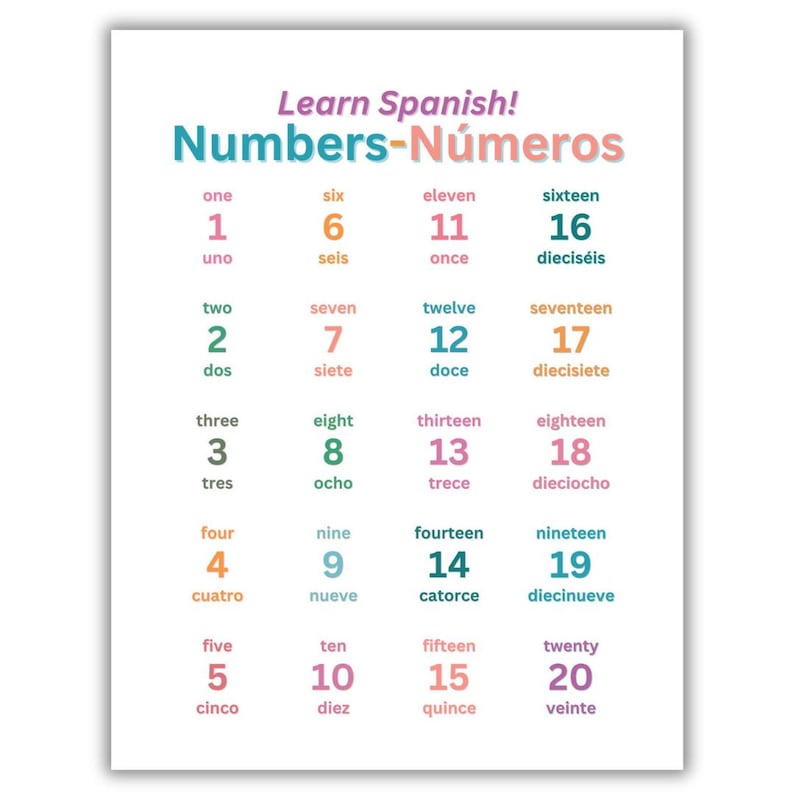
Here is a chart summarizing all the numbers from 1 to 20. You can use this as a quick reference.
Test your understanding!
What are the following numbers in Spanish?
- 8
- 15
- 17
- 4
- 20
Show answer
- ocho
- quince
- diecisiete
- cuatro
- veinte
Activity: Making Numbers Practical
The best way to learn numbers is to use them. Since your goal is to talk with your son, here are some ideas:
- Count toys: While playing, count his blocks (
bloques) or cars (coches). "¡Uno, dos, tres coches!" - Count steps: When walking to the park or up the stairs, count the steps together in Spanish.
- Snack time: Count out grapes or crackers. "¿Quieres cinco galletas?" (Do you want five crackers?)
- Read number books: Find a simple Spanish counting book to read together.
Key Takeaways
¡Muy bien! You have learned a crucial set of words for daily interactions.
- Numbers 1-10 (
unotodiez) are the essential foundation. - Numbers 11-15 (
oncetoquince) are unique and must be memorized. - Numbers 16-19 follow a pattern:
dieci-+ the single digit. - The number for twenty is
veinte.
Next Steps
You've successfully learned to count to 20. This is a huge step! In our next lesson, we will continue building on this theme by learning to identify basic colors (rojo, azul, verde, amarillo, naranja). Combining numbers and colors (dos coches rojos - two red cars) will greatly expand what you can talk about with your son.
¡Hasta la próxima