¡Hola! Welcome to your next lesson.
In our last session, we finished our module on safety by learning essential phrases for being out and about, like dame la mano and vamos a cruzar la calle. You're now equipped with key commands to keep your son safe.
Today, we're starting a new, exciting module: Communicating About School. Since your son is now in a Spanish-speaking school, this is a perfect time to build the vocabulary you need to connect with him about his day. Our goal for this lesson is to learn the Spanish names for common school-related items. By the end, you'll be able to identify things like a backpack (mochila), pencil (lápiz), book (libro), and teacher (profesor/a), which is the first step toward asking him what he did at school.
1. What's in the Backpack? - ¿Qué hay en la mochila?
Let's start with the items your son takes to and from school. The most important word is, of course, the backpack itself: la mochila.
We're going to watch a short video that introduces the vocabulary for what a student, Manuel, packs for school. It's a great way to hear the pronunciation of these new words in context.
Aprender español: Objetos de clase 📖 (nivel básico)
The video 'Aprender español: Objetos de clase' from the 'Tu escuela de español' channel clearly presents vocabulary for school supplies. We'll start with the first part, which focuses on what a student puts in their backpack.
Please watch from 00:33 to 02:26. Pay close attention to the names of the items Manuel packs. Listen for words like 'libros', 'cuadernos', 'lápiz', and 'mochila'.
From that video, here is the essential vocabulary for what's inside la mochila:
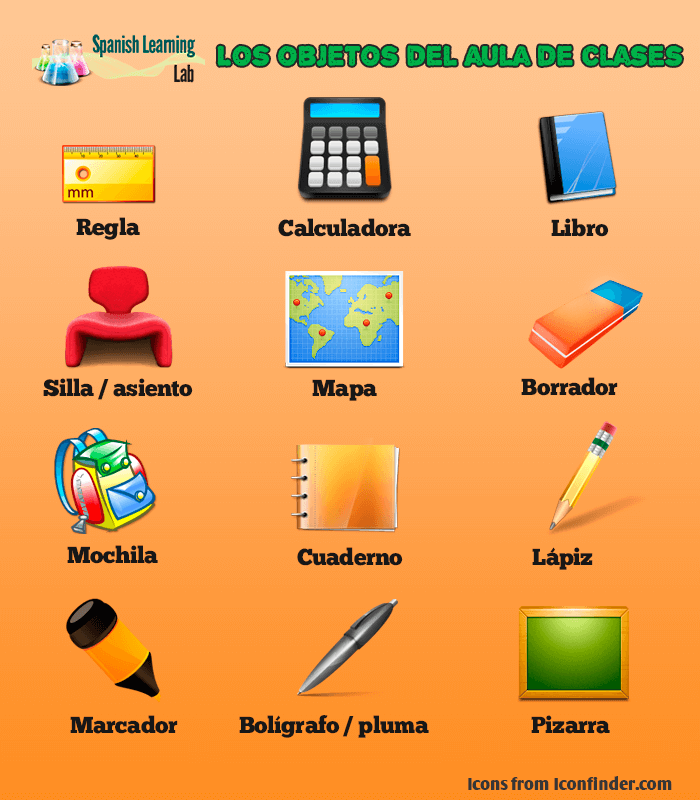
la mochila(la mo-CHEE-lah) - backpackel libro(el LEE-broh) - bookel cuaderno(el kwa-DERR-no) - notebookel lápiz(el LAH-pees) - pencil
Notice how each word has either el or la before it. As we learned in our first module, this tells you if the noun is masculine (el) or feminine (la).
2. Inside the Classroom - Dentro del aula
Now let's learn a few words for things found inside the classroom, or el aula de clases. The most important person there is the teacher.
el profesor(el pro-feh-SOR) - the male teacherla profesora(la pro-feh-SOR-ah) - the female teacher
It's very important to use the correct one depending on whether the teacher is a man or a woman.
Let's return to the same video to learn a few more words for objects in the classroom.
Aprender español: Objetos de clase 📖 (nivel básico)
Now, let's watch the second part of the same video, where Manuel arrives in his classroom.
Watch from 02:52 to 04:15. This section introduces people and objects in the classroom. Listen for 'profesor', 'silla', 'mesa', and 'pizarra'.
Here are the key words from that section:
la silla(la SEE-yah) - chairla mesa(la MEH-sah) - tablela pizarra(la pee-SAH-rrah) - blackboard / whiteboard
You can see these words, plus the ones from the backpack, in this helpful chart.
Test your understanding!
You're helping your son pack his bag. You point to his things and say the name in Spanish. What do you call these items?
- The bag he carries on his back.
- The object he uses to write or draw.
- The main book he reads from.
- If his teacher is a woman, what is her title in Spanish?
Show answer
la mochilael lápizel librola profesora
3. Hearing it in Conversation
Now that you have the basic words, let's see how they sound in a natural conversation. The following resource has a short audio dialogue between a father and his daughter getting ready for school. This is a perfect example of the kind of conversation you can aim for with your son.
Los Objetos del Aula en Español: Lista y Oraciones
The article 'Los Objetos del Aula en Español' from Spanish Learning Lab includes a great listening exercise that shows this vocabulary in action.
Find the section titled 'Ejercicio de escucha: ¡Alistándose para ir a la escuela!'. First, read the short script ('Guión de la conversación') between Papá and Mercedes. Notice how they talk about 'mochila', 'mesa', 'libros', and 'lápiz'. If you have time, play the audio on the website to hear the pronunciation.
Reading and listening to this dialogue is excellent practice. It combines the new vocabulary with phrases you already know, like está sobre la mesa (it's on the table).
Conclusion
¡Excelente! You've just taken a big step toward being able to talk with your son about his school life. You now have a foundational vocabulary for the most common items he'll be using every day.
Key Takeaways:
- Items in the backpack:
la mochila(backpack),el libro(book),el cuaderno(notebook),el lápiz(pencil). - People and items in the classroom:
el profesor/la profesora(teacher),la mesa(table),la silla(chair),la pizarra(board). - Remembering
el(masculine) andla(feminine) for each noun is key.
In our next lesson, we will build directly on this. You'll learn how to ask your son simple questions about his school day, such as ¿qué hiciste hoy? (what did you do today?). You'll soon be able to combine today's nouns with tomorrow's questions to have your first simple conversations about school.
¡Hasta la próxima