¡Hola! Welcome back.
In our last few lessons, we've focused on essential commands for attention (ven aquí, mira) and safety (¡cuidado!, no toques). Today, we'll shift from giving instructions to fostering teamwork. This is a crucial step in teaching your son about responsibility and collaboration.
This lesson focuses on how to ask for help and cooperation. By the end, you'll be able to use two fundamental phrases: ayúdame (help me) and recoge tus juguetes (pick up your toys). These phrases will help you manage daily routines, like tidying up after playtime, and turn them into cooperative activities.
1. Asking for Help: Ayúdame
The simplest and most direct way to ask for help is with the command ayúdame.
Pronunciation: ah-YOO-dah-meh
This single word combines the verb ayudar (to help) with me. It's a friendly but clear request. You can use it whenever you need a little assistance, for example, when carrying groceries or tidying up.
Let's hear how it's pronounced.
How to give COMMANDS in Spanish
The following short clip from the 'Spanish With Liliana' channel demonstrates the pronunciation and use of 'ayúdame'.
Watch the segment from 05:04 to 05:13. Listen for the phrase 'ayúdame'.
You can make this request even more polite by adding por favor, which you already know.
Ayúdame, por favor.(Help me, please.)
You can also frame it as a question, which is a very common and slightly softer way to ask for help:
¿Me ayudas?(Can you help me? / Will you help me?)
This article provides some excellent context for these phrases.
A printable list of common Spanish phrases to use with kids.
The article 'A printable list of common Spanish phrases to use with kids' from Spanish Playground has a great section on politeness and consideration.
Please read the two phrases under the 'Be Considerate' heading: 'Ayúdame, por favor.' and '¿Te ayudo?'. Notice how '¿Te ayudo?' ('Can I help you?') is the perfect phrase to teach your son so he can offer help too.
2. Asking for Cooperation: Recoge tus juguetes
One of the most common moments for cooperation is cleaning up. The key phrase here is recoge tus juguetes.
Let's break it down:
Recoge: "Pick up" (from the verbrecoger). Pronounced reh-KOH-heh.tus: "your" (the plural form oftu, which you learned in Module 2).juguetes: "toys". Pronounced hoo-GEH-tes.
So, all together: Recoge tus juguetes (Pick up your toys).
The following video will help you with the pronunciation of recoge.
This video from Learn Spanish World, while focused on a classroom, clearly demonstrates the command 'recoge'.
Watch from 05:49 to 06:17. Listen for the pronunciation of 'Recoge' and how it's used with objects like 'el lápiz' (the pencil).
A very common and useful synonym for recoge in this context is guarda (from guardar, to put away/store).
Guarda tus juguetes.(Put away your toys.)
Both recoge and guarda work perfectly for tidying up. You can use them interchangeably. You'll find the phrase Guarda los juguetes in the "Bedtime" section of the Spanish Playground article we looked at earlier.
3. Expanding Your Requests
Now that you have the basic structures, you can combine them to ask for help with many different household chores.
¿Me ayudas a + [chore]? (Can you help me...)Ayúdame a + [chore]. (Help me to...)
This image shows several common chores your son might be able to help with.
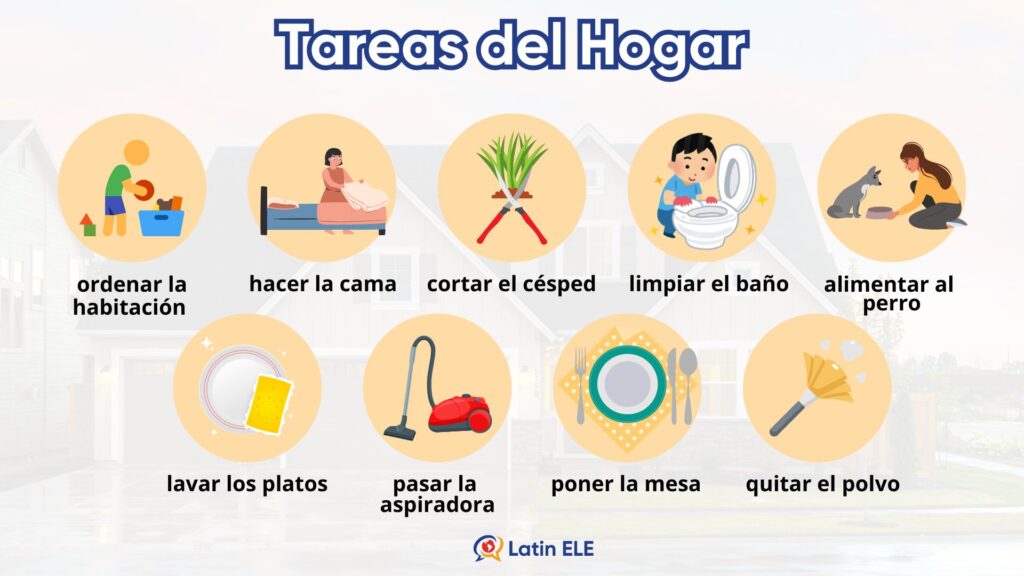
The following resource is fantastic for expanding your vocabulary on this topic. It lists verbs and specific chores you can use to make requests.
Doing Chores at Home (Free Spanish Lessons for Kids)
The article 'Doing Chores at Home' from Spanish.Academy offers a wealth of vocabulary for this topic.
First, skim the section 'How to Ask Your Kids for Help Around the House' to see examples like '¿Me ayudas a limpiar la cocina?'. Then, look at the table under 'Verbs to Describe Chores in Spanish' to find 'Recoger' (To pick up). Finally, browse the list under 'Common Chores in Spanish for Kids' to find useful phrases like 'Poner la mesa' (To set the table) or 'Recoger la mesa' (To clear the table).
Using what you just learned, you could say:
¿Me ayudas a poner la mesa?(Can you help me set the table?)Ayúdame a regar las plantas, por favor.(Help me water the plants, please.)
Test your understanding!
How would you ask your son to do the following?
- Playtime is over and his blocks are all over the living room floor.
- You are bringing in the grocery bags from the car and need him to help with a light one.
- You are about to have dinner and want him to help you put the plates on the table. (Hint: "to set the table" is poner la mesa).
Show answer
- You would say:
Recoge tus juguetes, por favor.orGuarda tus juguetes, por favor. - You would say:
Ayúdame, por favor.or¿Me ayudas? - You would say:
¿Me ayudas a poner la mesa?
Conclusion
¡Buen trabajo! You've just learned how to turn instructions into invitations for teamwork. This is a wonderful way to build your son's sense of responsibility and strengthen your connection in Spanish.
Key Takeaways:
- To ask for direct help, use
ayúdame(help me) or the question¿Me ayudas?(can you help me?). - To ask your child to clean up, use
recoge tus juguetes(pick up your toys) orguarda tus juguetes(put away your toys). - You can combine these phrases to ask for help with specific chores:
¿Me ayudas a poner la mesa?
In our next lesson, we will build directly on this by learning more specific location words. After your son picks up his toys (recoge tus juguetes), you'll be able to tell him exactly where to put them using words like dentro (inside) and abajo (down).
¡Hasta la próxima