¡Hola! Welcome back.
In our last lesson, we took a big step by learning how to use es and está to form simple sentences. You can now say important phrases like Él es mi hijo (He is my son) and Mi hijo está en casa (My son is at home).
Today, we're going to zoom in on that little word mi (my) and learn its partner, tu (your). This lesson is all about showing ownership. Our goal is to use the possessives 'mi' and 'tu' to talk about family and belongings. This is a crucial skill for your daily conversations, as it will allow you to talk about what belongs to you (mi libro) and what belongs to your son (tu pelota).
What Are Possessive Words?
Possessive words do exactly what they sound like: they show who possesses something. In English, we use "my," "your," "his," etc. In Spanish, the most common and useful ones for your conversations will be mi (my) and tu (your).
Let's start by reading a short introduction that explains this concept perfectly. It's written with parents and young learners in mind, so the context is ideal for you.
Possessive Words (Mi, Tu, Su) for Little Learners
The article 'Possessive Words (Mi, Tu, Su) for Little Learners' from Spanish Academy provides a clear and simple introduction to this topic.
Please read the first few paragraphs of the article, starting from the top down to just before the section titled 'The Main Possessive Words (Short Forms)'. Focus on understanding the basic idea of what these 'tiny words' do.
The Core Words: mi (my) and tu (your)
Now for the main rule. It's very straightforward:
mimeans "my"tumeans "your" (when talking to one person you know well, like your son)
You simply place these words before the noun, just like in English.
mi hijo— my sontu mamá— your mommi casa— my housetu libro— your book
A Quick Note: Be careful not to confuse tu (your) with tú (you). The version with the accent mark (tú) is the pronoun "you," while the one without (tu) is the possessive "your." We're focusing on tu today.
What About Plurals? mis and tus
Here is the most important rule for possessives in Spanish: the possessive word must agree in number with the item being possessed, not the owner.
This means if you are talking about one thing, you use mi or tu. If you are talking about more than one thing, you add an s to make them mis or tus.
mi libro(my book) →mis libros(my books)tu zapato(your shoe) →tus zapatos(your shoes)mi amigo(my friend) →mis amigos(my friends)
Notice the noun also becomes plural (libro -> libros). This "agreement" is a fundamental concept in Spanish.
To see and hear this explained clearly, let's watch a short video.
Say “Mom,” “Dad,” & More in Spanish!
The Language Tutor offers a very clear, step-by-step explanation. We'll watch the parts that cover 'my' and 'your' and their plural forms.
Please watch the following segments: mi (my): from 03:33 to 03:59. tu (your): from 03:59 to 04:24. Plural forms (mis, tus): from 06:14 to 07:00. Pay close attention to how he explains that mi casa becomes mis casas.
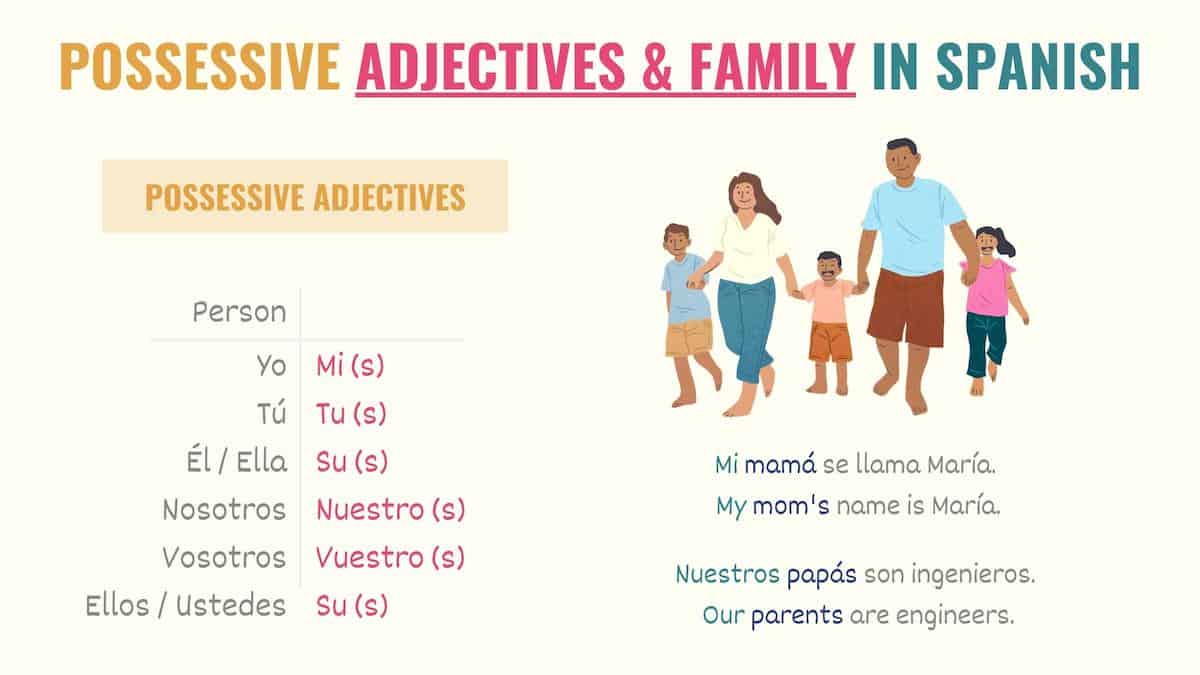
This image provides a great visual summary of the possessive words in the context of family.
Test your understanding!
Choose the correct possessive word (mi, mis, tu, or tus) to complete each sentence.
- (Your)
___hijo es muy activo. — Your son is very active. - ¿Dónde están (my)
___llaves? — Where are my keys? - (My)
___casa está aquí. — My house is here. - Recoge (your)
___juguetes, por favor. — Pick up your toys, please.
Show answer
tu(You are talking about one son.)mis(llavesis plural.)mi(casais singular.)tus(juguetesis plural.)
Seeing It in Action
Let's see how these words fit into natural sentences. The best way to learn practical phrases is to see them used in context.
La familia - Describing your family in Spanish
The article 'La familia - Describing your family in Spanish' from Spanish Learning Lab contains some excellent, simple descriptions. We'll read one of them.
In the article, find the section called 'Examples of family descriptions in Spanish' and read Example No. 1. Notice how the speaker uses mi to talk about their family members and belongings.
As you can see from that example, you can now build a simple story: "Mi familia es pequeña. Mi mamá se llama... Mi papá es..." This is exactly the kind of language that will be useful for you.
Here are a few phrases you might use with your son during playtime or daily routines:
- Pointing to your own shirt:
Esta es **mi** camisa.(This is my shirt.) - Pointing to his shoes:
Estos son **tus** zapatos.(These are your shoes.) - Handing him a toy:
Aquí está **tu** coche.(Here is your car.) - Looking for your phone:
¿Dónde está **mi** teléfono?(Where is my phone?)
Key Takeaways
¡Muy bien! You have now learned a fundamental building block of Spanish conversation.
mi= my (for one item)mis= my (for more than one item)tu= your (informal, for one item)tus= your (informal, for more than one item)- The Golden Rule: The choice between
mi/misortu/tusdepends on whether the object is singular or plural.
Next Steps
In our next lesson, we will learn how to ask and answer the questions ¿Quién es? (Who is it?) and ¿Qué es esto? (What is this?). You'll see how today's lesson prepares you perfectly. You can now answer ¿Quién es? with Es mi hijo or answer ¿Qué es esto? with Es tu libro.
Keep practicing these new words. Try to spot things around your house and say them to yourself: mi mesa, mi silla, mis llaves. ¡Hasta la próxima