¡Hola! Welcome back to your Spanish lessons.
In our last lesson, you mastered how to ask ¿Te gusta...? (Do you like...?), a fantastic question for engaging with your son about his preferences. This is a key building block for conversation.
Today, we're moving into the fun world of playtime! This lesson begins a new module, "Playtime & Activities," and we'll start with the basics: learning the names of common toys your son likely plays with every day. By the end of this lesson, you'll be able to name toys like a ball, doll, car, blocks, and a book in Spanish. This will allow you to combine what you learned last time with new words, asking questions like, “¿Te gusta la pelota?” (Do you like the ball?).
1. The Core Toy Vocabulary
Let's start by learning five essential words for common toys. Notice that, just as we've seen before, each noun has a gender, so we'll learn it with its article: el for masculine nouns and la for feminine ones.
Here are the words for today:
- la pelota - the ball
- la muñeca - the doll
- el coche - the car
- los bloques - the blocks
- el libro - the book
The image below shows some of these toys, along with others. It's a great visual reference.
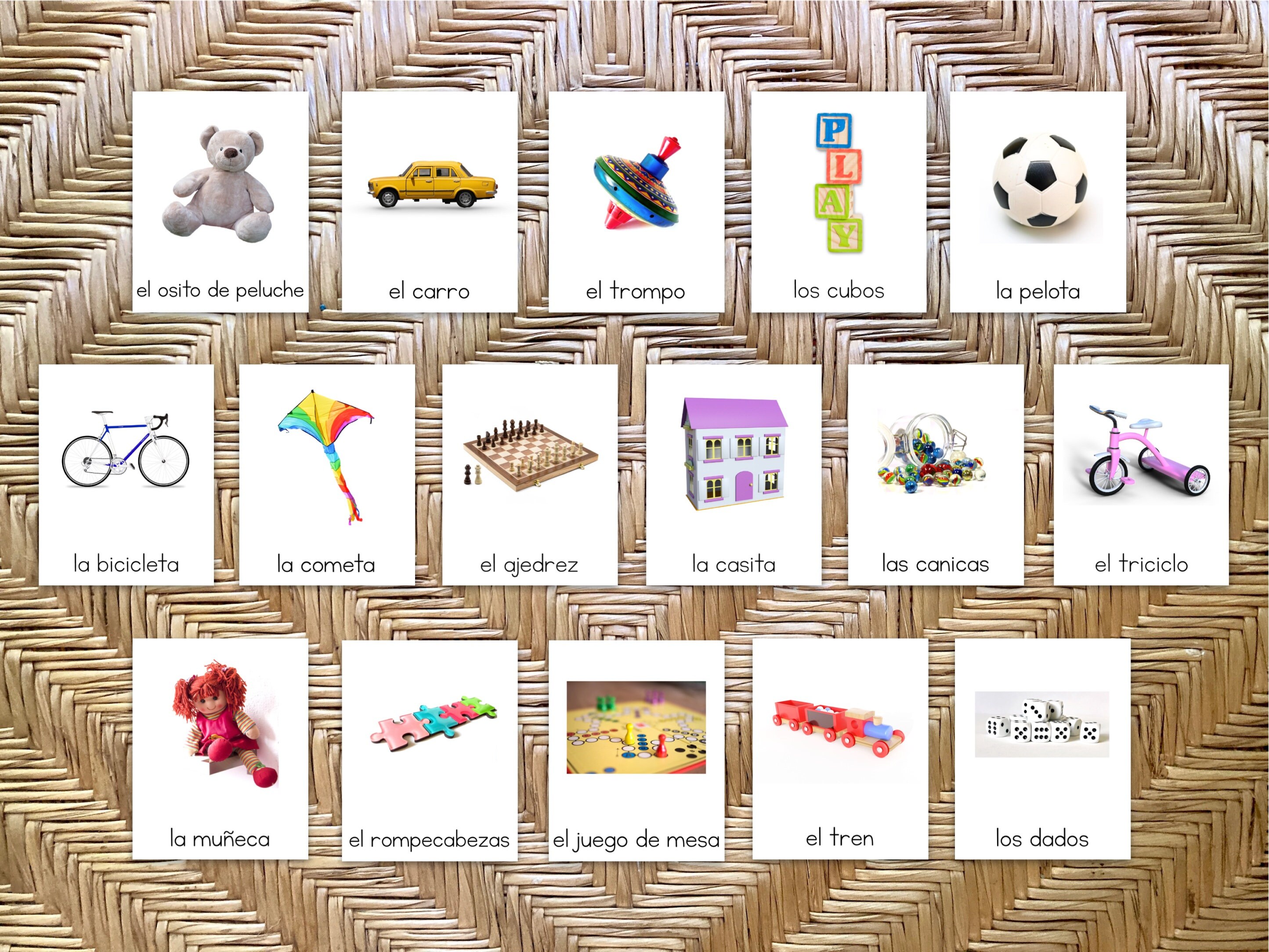
You might notice the flashcard uses el carro for "car" and los cubos for "blocks." Both are correct!
El cocheis more common in Spain, whileel carrois widely used in Latin America. Both are understood.Los bloquesandlos cubosboth mean "blocks."
For simplicity, we'll stick with el coche and los bloques, but it's good to recognize the alternatives.
To see these words in a simple list, you can refer to the following resource.
Essential Spanish Vocabulary for Childcare Workers
The article 'Essential Spanish Vocabulary for Childcare Workers' has a helpful table that lists key playtime words. It's a quick way to review the vocabulary we're covering.
Scroll down to the section 'Spanish for Playtime: Toys, Games, and Activities'. Look at the table and find the words for Doll, Ball, Car, Blocks, and Book.
2. Seeing the Words in Action
Now that you've seen the words, let's see how they can be used in simple sentences. This will help you get a feel for how to use them in conversation.
40 Spanish Playtime Vocabulary Words: Make Learning a ...
The article '40 Spanish Playtime Vocabulary Words' provides great examples that put these words into context. This is perfect for your goal of building practical phrases.
Please read the short sections for 'El Bloque' (Block), 'La Muñeca' (Doll), and 'El Carrito' (Toy car). Notice the simple example sentences provided, like 'La muñeca tiene un vestido azul.' (The doll has a blue dress). 'Carrito' is the diminutive of 'carro', meaning 'little car', which is perfect for talking about toys!
The example sentences show how these words fit naturally into descriptions. You can start making your own simple sentences, too! For example, if you know the colors from a previous module, you could say:
La pelota es roja.(The ball is red.)El coche es azul.(The car is blue.)
3. Putting It All Together: A Playtime Scenario
Imagine you and your son are in his playroom. You can now use this new vocabulary with questions you already know.
- Pointing to a ball:
¿Qué es esto?(What is this?) ->Es **una pelota**.(It's a ball.) - Seeing he is playing with blocks:
¡Ah, **los bloques**!(Ah, the blocks!) - Asking about a doll:
¿Te gusta **la muñeca**?(Do you like the doll?) - Asking about the blocks:
¿Te gustan **los bloques**?(Do you like the blocks?)
Remember from our last lesson, we use gusta for a single item (la muñeca) and gustan for plural items (los bloques).
The image below is a "communication board." Therapists and teachers sometimes use these to help children express what they want. It's a great model for the kinds of simple, powerful phrases you can use during playtime.

Notice how you could point to the blocks and then to the word quiero to model the phrase Quiero los bloques (I want the blocks). This is a fantastic, practical way to communicate.
Test your understanding!
You see your son reading a book. How would you ask him, "Do you like the book?"
Show answer
You would ask: ¿Te gusta el libro?
(We use gusta because el libro is a single item.)
Conclusion
¡Buen trabajo! You've successfully taken the first step into our "Playtime" module. You can now confidently name five key toys in Spanish, which is a major step toward having playful conversations with your son.
Key Takeaways:
- The five key toy words are:
la pelota(ball)la muñeca(doll)el coche(car)los bloques(blocks)el libro(book)
- Remember to use the correct article (
el,la,los) as it's part of the word's identity. - You can immediately start using these words with phrases you already know, like
¿Qué es esto?and¿Te gusta...?.
Next Steps
Now that you can name some toys, the next logical step is to suggest playing with them. In our next lesson, we will learn how to suggest activities using the structure vamos a + [verb], such as vamos a jugar (let's play) and vamos a leer un libro (let's read a book).
¡Hasta luego