¡Hola! Welcome back.
In our first lesson, you mastered the five pure Spanish vowel sounds, which is the cornerstone of clear pronunciation. You learned that each vowel has one consistent sound, which makes Spanish very predictable.
Today, we'll build on that foundation by tackling the key Spanish consonants that differ most from English and French: h, j, ñ, ll, r, and the combination of z/c. By combining these new consonant sounds with the vowels you already know, you'll be able to pronounce a wide range of common Spanish words correctly. This will be invaluable as you start talking with your son about his day, his toys, and the world around him.
1. The Silent H and the Breathy J
Let's start with two letters that can be confusing for beginners. One is silent, and the other has the sound you might expect the first one to have!
-
The Silent
H: This is the easiest rule in Spanish. The letterhis always silent. You write it, but you don't say it. Think of the word you'll learn next lesson:hola(hello). It's pronounced o-la, not ho-la. -
The Breathy
J: The Spanishjproduces a sound similar to the English 'h' in "house," but it's made further back in the throat and is a bit more "raspy" or breathy. In chemistry, you might think of the subtle friction of a gas escaping a valve.
Let's hear these in action.
How to Pronounce Spanish Consonants - Spanish for Beginners
The video 'How to Pronounce Spanish Consonants' explains the sounds of 'j' and the silent 'h' very clearly. Listen for the contrast between them.
Watch the segment on the letter 'j' (la jota) from 06:30 to 07:39, and then immediately watch the segment on the silent 'h' (la hache) from 07:39 to 08:32. Notice how the 'j' sound is strong, while the 'h' disappears completely.
Practice: You already know the word hijo (son). Now you can pronounce it perfectly: the h is silent, the i is a clear "ee" sound, and the j is that breathy "h" sound. Try saying it: ee-kho.
2. The C and Z Puzzle
The pronunciation of c changes depending on the vowel that follows it. The letter z helps fill in the gaps. For simplicity, we'll focus on the standard pronunciation used in Latin America, which is the most widespread.
-
Hard
Csound (like 'k'): Beforea,o, andu, thecsounds like a 'k'.ca(like in casa - house)co(like in color - color)cu(like in cucharita - little spoon)
-
Soft
Csound (like 's'): Beforeeandi, thecsounds like an 's'.ce(like in cena - dinner)ci(like in el cielo - the sky)
-
The
Zsound (like 's'): The letterzis used beforea,o, anduto make the 's' sound.za(like in zapato - shoe)zo(like in corazón - heart)zu(like in azul - blue)
In short, for the 's' sound: za, ce, ci, zo, zu. For the 'k' sound: ca, que, qui, co, cu. Notice we need que and qui (with a silent 'u') for the 'k' sound with 'e' and 'i'.
How to Pronounce Spanish Consonants - Spanish for Beginners
Let's review this concept. This video breaks down the two sounds of 'c' and also explains what happens with 'que' and 'qui'.
Watch from 02:04 to 04:32. This covers the 'c' with its 'k' and 's' sounds, and the 'que'/'qui' rule. Then, skip to 16:00 and watch until 16:40 to hear the explanation of the 'z' sound in Latin America.
Test your understanding!
The number 5 in Spanish is cinco. How would you pronounce it?
Show answer
It's pronounced seen-ko. The first 'c' is followed by 'i', so it has an 's' sound. The second 'c' is followed by 'o', so it has a 'k' sound.
3. The Special Spanish Letters: Ñ and LL
These two represent sounds you won't find in English or French spelling.
-
The
Ñ(eñe): This letter has a distinct "ny" sound, similar to the middle of "canyon." This sound is crucial for a word you'll use constantly:niño(child/boy). -
The
LL(elle): While there are regional variations, the most common and standard pronunciation ofllis like the 'y' in "yes." Think of the coloramarillo(yellow), which is pronounced ah-mah-ree-yo.
How to Pronounce Spanish Consonants - Spanish for Beginners
Let's hear the 'ñ' and 'll' sounds. Pay attention to the regional variations mentioned for 'll', but focus on mastering the standard 'y' sound.
Watch from 08:54 to 10:37 for the 'll' sound. Then watch from 10:37 to 11:19 for the 'ñ' sound.
4. The Famous Spanish R: Flap vs. Trill
This is often the most challenging sound for learners, but with a little practice, you can master it. There are two 'r' sounds in Spanish.
-
The Soft
R(or "flap"): This occurs when a singleris between two vowels (e.g.,pero- but,caro- expensive). It's a very quick tap of the tongue against the roof of your mouth. You actually make this sound in English all the time! Think of how you say the 'tt' in "butter" or the 'd' in "ladder." -
The Hard
RR(or "trill"): This is the famous rolled 'r'. It occurs in two situations:- When you see a double
rr(e.g.,perro- dog,carro- car). - When a single
ris at the beginning of a word (e.g.,rojo- red,rápido- fast).
- When you see a double
To make the trill, rest your tongue against the ridge behind your top teeth and blow air over it to make it vibrate. It takes practice! Don't worry if you can't do it perfectly right away. The key is to try.
The following two resources give excellent, complementary tips for this.
How To Pronounce Letters In Spanish
First, let's learn the 'butter' trick for the soft 'r'. This video from The Language Tutor has a fantastic explanation that makes it click for most people.
Watch the segment from 08:18 to 10:33. Focus on the distinction between 'pero' (but) with the soft 'r' and 'perro' (dog) with the hard, trilled 'rr'.
For a written summary and more examples, this guide provides clear rules for when to use the soft 'r' and when to use the hard 'r'.
Please read the section 'Consonant r in Spanish'. It clearly lays out the rules for the 'soft/simple r' and the 'hard/multiple r (rr)'. This is a great reference to come back to.
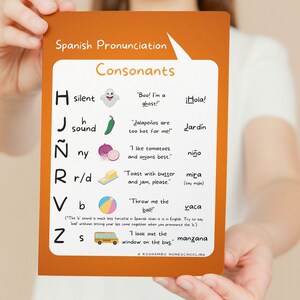
Visual Summary
This chart is a fun, visual way to remember some of these key sounds. It's perfect for a quick review, and you could even show it to your son!
Key Takeaways
Great job! You've just tackled the trickiest sounds in Spanish.
His always silent (hola-> o-la).Jis a breathy 'h' sound from your throat (rojo-> ro-kho).Csounds like 'k' beforea, o, u(casa) and like 's' beforee, i(cinco).Zsounds like 's' (zapato-> sa-pa-to).LLsounds like 'y' (amarillo-> a-ma-ri-yo).Ñsounds like 'ny' (niño-> nee-nyo).Rhas two sounds: a soft flap between vowels (pero) and a hard trill at the start of a word or when written asrr(perro,rojo).
Next Steps
Now that you have the building blocks of both vowels and consonants, you are ready to start speaking! In our next lesson, we will put it all together to learn and practice the most essential greetings and pleasantries: hola, adiós, buenos días, gracias, por favor. You'll be able to greet your son's teachers with confidence. ¡Muy bien