¡Hola! Welcome to our next lesson.
In our last session, you learned essential greetings and noticed a small but important detail: we say buenos días but buenas tardes. This was your first glimpse into a core concept of the Spanish language: grammatical gender.
Today, we're going to dive into that concept. The goal of this lesson is to learn how to recognize and use el and la with common nouns. These two small words both mean "the" in English. Knowing when to use el versus la is a fundamental step toward building sentences and will be incredibly useful as you start talking with your son about the world around you, from el libro (the book) he's reading to la casa (the house) you live in.
1. Grammatical Gender: The Rule of 'O' and 'A'
In Spanish, every noun—every word for a person, place, or thing—has a gender. It is either masculine or feminine. This is a grammatical rule and doesn't always relate to the object itself. For example, a chair isn't inherently feminine, but the word for it is.
The great news is that there's a very reliable pattern for this:
- Nouns that end in -o are usually masculine. We use the article
el(the) with them. - Nouns that end in -a are usually feminine. We use the article
la(the) with them.
For example:
niño(boy) ends in -o, so it'sel niño(the boy).casa(house) ends in -a, so it'sla casa(the house).
Let's watch a short video that explains this concept clearly.
Definite and Indefinite Articles in Spanish | The Language Tutor *Lesson 11*
This video from The Language Tutor provides a straightforward explanation of how to use el and la based on noun endings. Pay close attention to the examples he uses.
Watch the video from 00:49 to 03:00. The instructor will explain the difference between el and la using the examples libro (book) and mesa (table).
As the video explains, everything has to match. This concept of "agreement" is a cornerstone of Spanish grammar.
2. Building Your Vocabulary: Family and Everyday Objects
Now, let's apply this rule to words that are directly useful for your conversations with your son.
Family Members (La Familia)
Since one of your main goals is to talk about family, let's look at these essential words. Notice how el is used for male family members and la for female ones.
el padre- the fatherla madre- the motherel hijo- the sonla hija- the daughterel abuelo- the grandfatherla abuela- the grandmother
You can explore more family terms in the resource below. Don't worry about memorizing them all now; just notice the el/la pattern.
Family In Spanish: How To Talk About Your Loved Ones
The article 'Family In Spanish' from Babbel provides a great list of family-related vocabulary. It clearly shows the gender of each noun.
Quickly scan the list of terms under the heading 'Terms For Talking About Family In Spanish'. Focus on the singular nouns like 'mother', 'father', 'son', and 'daughter' and see how they are paired with la or el.
School and Playtime Objects
Here are some common objects you might talk about when your son comes home from school or during playtime.
el libro- the bookel lápiz- the pencilla mochila- the backpackla silla- the chairla mesa- the table
This vocabulary is especially useful for asking questions like "Where is the book?" which we'll cover in a future lesson.

Test your understanding!
Based on the -o and -a rule, add the correct article (el or la) to the following words:
... puerta(door)... zapato(shoe)... plato(plate)... ventana(window)
Show answer
lapuerta(ends in -a)elzapato(ends in -o)elplato(ends in -o)laventana(ends in -a)
A Quick Note on Exceptions
While the -o for masculine and -a for feminine rule is very reliable, Spanish does have some common exceptions. For example, the word for "hand" is mano, which ends in -o but is feminine: la mano. You'll also find masculine words that end in -a, often of Greek origin, like el problema (the problem) or el mapa (the map).
Don't worry about memorizing these exceptions now. The best way to learn them is through exposure over time. For now, trust the -o/-a rule as your guide.
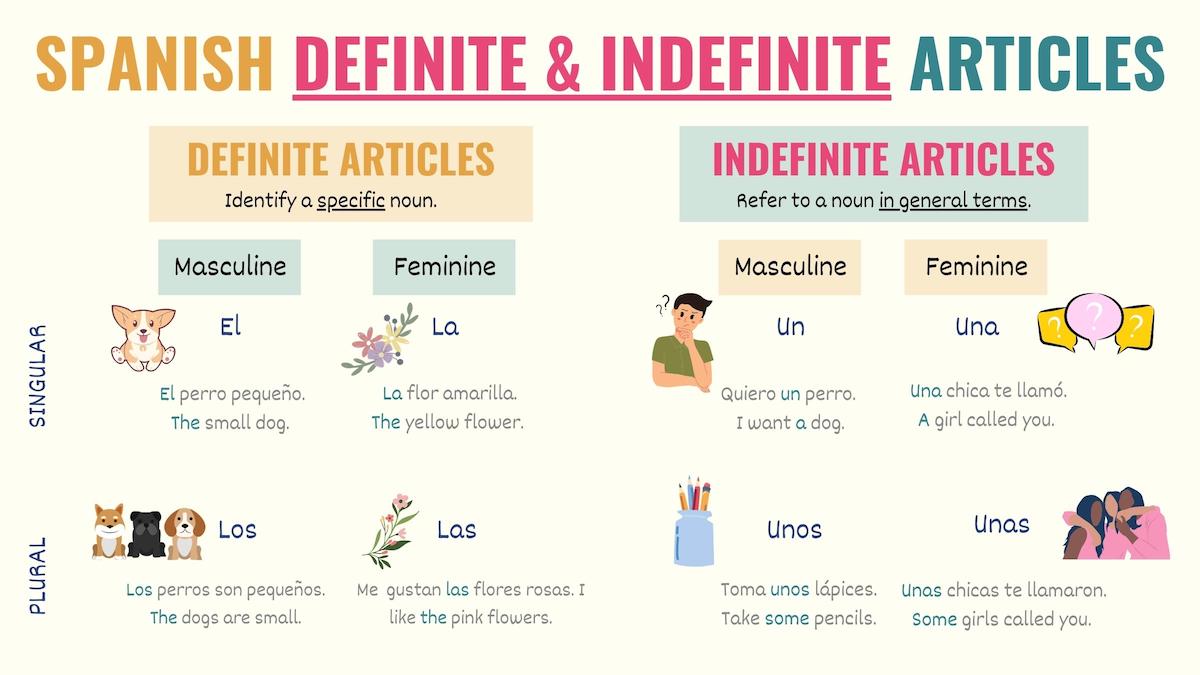
Summary Chart
This infographic is a great visual summary of the concept. For today, focus on the top two boxes for "Definite Articles": el and la.
Key Takeaways
¡Muy bien! You've just learned one of the most important rules in Spanish.
- All Spanish nouns have a gender: masculine or feminine.
- The word for "the" changes to match the noun's gender:
elfor masculine andlafor feminine. - A reliable shortcut is to look at the ending: nouns ending in -o are usually masculine (
el libro), and nouns ending in -a are usually feminine (la casa).
Start noticing these articles everywhere. When you see an object, try to think of its name in Spanish with the correct article. This simple practice will make the concept second nature.
Next Steps
In our next lesson, we will put this new knowledge into action. You will learn how to introduce yourself and your child using "Me llamo..." and "Se llama...". You'll be able to say simple but powerful sentences like, "Hola, me llamo [Your Name]. Él es mi hijo. El niño se llama [Son's Name]." (Hello, my name is... He is my son. The boy's name is...).
¡Hasta la próxima