Welcome to your fourth lesson. In our previous sessions, we've built a foundation for effective two-way communication. You first learned how to express your own needs and boundaries through assertive communication, and then you explored how to understand others' perspectives through active listening.
Today, we will connect these skills by exploring the concept of emotional intelligence (EQ). Active listening, which you practiced in the last lesson, is a cornerstone of EQ. Understanding emotional intelligence will provide you with a powerful framework for navigating the complex human dynamics of any workplace, which is especially critical in the highly collaborative and often high-pressure environments of the tech and AI industries.
Your goal for this lesson is to be able to describe the four components of emotional intelligence and explain their crucial role in effective communication. This framework will serve as a map for the more specific skills we'll develop throughout the rest of this course.
What is Emotional Intelligence?
At its core, emotional intelligence is the ability to perceive, understand, and manage your own emotions, while also recognizing, understanding, and influencing the emotions of others. While your technical skills in areas like AI and Python are the "what" of your future career, EQ is the "how"—how you collaborate, how you persuade, and how you lead.
The concept was popularized by psychologist and science journalist Daniel Goleman. His model breaks down this complex idea into four distinct, yet interconnected, domains.
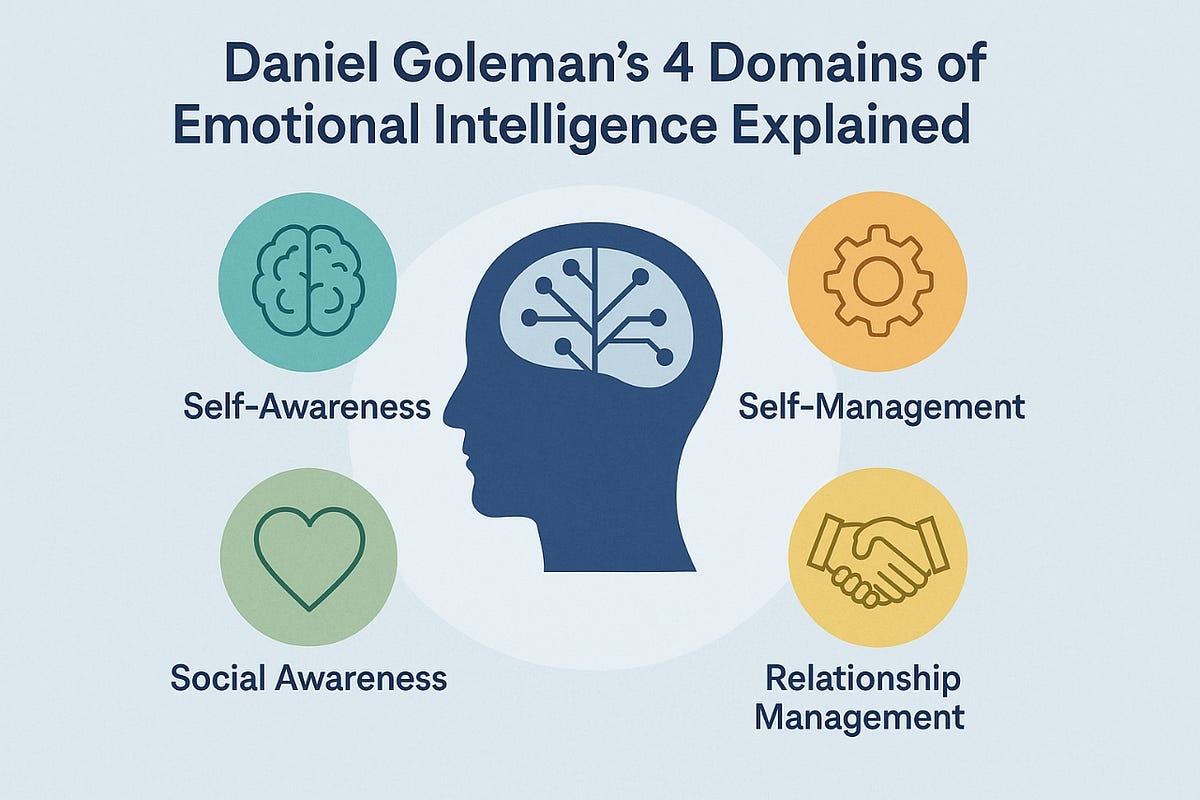
To begin, there is no better person to introduce this framework than Daniel Goleman himself.
Daniel Goleman: The 4 domains of emotional intelligence | Daniel Goleman for Big Think+
This video from Big Think features Daniel Goleman explaining his model of emotional intelligence. Hearing the originator of the theory explain it in his own words is the best possible introduction.
Please watch the following segments: Introduction to the four domains Self-Awareness Self-Management Social Awareness (Empathy) Relationship Management Pay close attention to how each domain builds on the previous one.
The Four Domains and Their Competencies
As you heard from Goleman, the four domains are not just abstract concepts. They are composed of specific, observable, and learnable competencies. Think of the domains as categories and the competencies as the individual skills within them.

Let's look at each domain in turn.
1. Self-Awareness
This is the foundation of emotional intelligence. It is the ability to recognize and understand your own emotions, moods, motivations, and their effect on others. It's about having a clear picture of your strengths and weaknesses. In the video, Goleman calls it a "diagnosis of where am I right now." Without this internal clarity, it's nearly impossible to manage yourself or understand others effectively.
2. Self-Management
Building directly on self-awareness, this domain is about using that awareness to manage your emotions and impulses. It's the ability to control disruptive emotional responses, stay calm under pressure, adapt to changing circumstances, and maintain a positive outlook. It is the practical application of self-awareness, allowing you to choose your response rather than being driven by pure reaction.
3. Social Awareness
This domain shifts the focus from yourself to others. The primary competency here is empathy—the ability to understand the emotional makeup of other people and to treat them according to their emotional reactions. The active listening skills you practiced in the last lesson, such as asking open-ended questions and paraphrasing, are the primary tools for developing and demonstrating empathy. As Goleman explained, this isn't just one thing; it includes:
- Cognitive empathy: Understanding someone's perspective.
- Emotional empathy: Feeling what they feel.
- Empathic concern: Caring about them and wanting to help.
4. Relationship Management
This is the culmination of the other three domains. It's the application of your emotional understanding to build and maintain healthy relationships, communicate clearly, inspire and influence others, manage conflict, and work well in a team. This is the most visible domain of EQ, as it's where your internal understanding translates into effective interpersonal action. Skills we will cover later in this course, like persuasion and conflict resolution, all fall under this umbrella.
Why EQ is a Differentiator in Tech
Your goal is to move into the tech and AI field, an area often perceived as purely logical and analytical. However, as projects become more complex and collaborative, EQ becomes a powerful differentiator. The following article is written specifically for technical professionals and provides excellent context.
Emotional Intelligence for Technical Professionals - Al-Mithaq Institute
This article from the Al-Mithaq Institute bridges the gap between the theory of EQ and its practical application in a technical work environment.
Please read the following sections: Start with the definition and the list of the four components. Then, skip down to the section "EQ in Action: Technical Scenarios" and carefully review the three scenarios comparing Low EQ vs. High EQ approaches. As you read the scenarios, think about times in your own experience when you have seen or used either the low or high EQ approach.
The scenarios in the article are powerful because they illustrate how the same technical feedback or disagreement can be handled in profoundly different ways, with dramatically different outcomes for team morale and project success. A high-EQ approach doesn't change the technical facts, but it respects the human element, leading to more constructive collaboration.
Conclusion
In this lesson, we have defined emotional intelligence and mapped out its core structure using Daniel Goleman's widely-accepted four-domain model. You've seen how these abstract domains are made up of concrete skills that are essential for effective communication and professional success.
Key Takeaways:
- Emotional intelligence is the ability to understand and manage your own emotions and to understand and influence the emotions of others.
- The four domains of EQ are Self-Awareness, Self-Management, Social Awareness (empathy), and Relationship Management.
- These domains are hierarchical: self-awareness is the foundation upon which the other skills are built.
- In technical fields, EQ is not a "soft skill" but a critical factor for effective collaboration, stakeholder communication, and leadership.
You've now moved from learning discrete communication techniques to understanding the psychological framework that powers them. In our next lesson, we will begin to apply this framework by focusing on the first two components of EQ. You will learn how to identify your personal emotional triggers and apply techniques for responding constructively under pressure, a direct application of Self-Awareness and Self-Management.