Hello! Welcome back to our module on Algebraic Equations and Expressions.
In our last session, we built a solid method for translating word problems into linear equations—equations where the variable's highest power is 1. We saw how a systematic approach is key to solving them accurately.
Today, we're taking the next logical step up in complexity. We will explore quadratic equations, where the variable's highest power is 2. The learning outcome for this lesson is to be able to solve quadratic equations and apply the discriminant to analyze the nature of their roots. For a time-sensitive exam like the CAT, being able to quickly determine the type of solutions an equation has—without fully solving it—is a critical shortcut.
1. From Linear to Quadratic
A quadratic equation is any equation that can be rearranged into the standard form:
where is the variable, , , and are known numbers, and most importantly, . The values of that satisfy the equation are called its "roots" or "solutions".
While you might be familiar with solving these by factoring, there's a universal tool that works for every quadratic equation: the quadratic formula.
The roots of the equation are given by:
This formula is your key, but memorizing it isn't enough. The most powerful part of this formula, especially for competitive exams, is the expression under the square root sign.
2. The Discriminant: A "Crystal Ball" for Roots
Let's focus on the expression . This is called the discriminant, often denoted by or the Greek letter delta, .
Why is it so important? The value of the discriminant tells you the "nature" of the roots before you do the full calculation. Since you have a background in computer science, you can think of the discriminant as a quick check that determines which logical path to follow, much like an if-else statement. It tells you if the roots will be real numbers, if there will be two distinct roots or just one, or if there are no real roots at all.
This visual summary is an excellent reference for the concept.
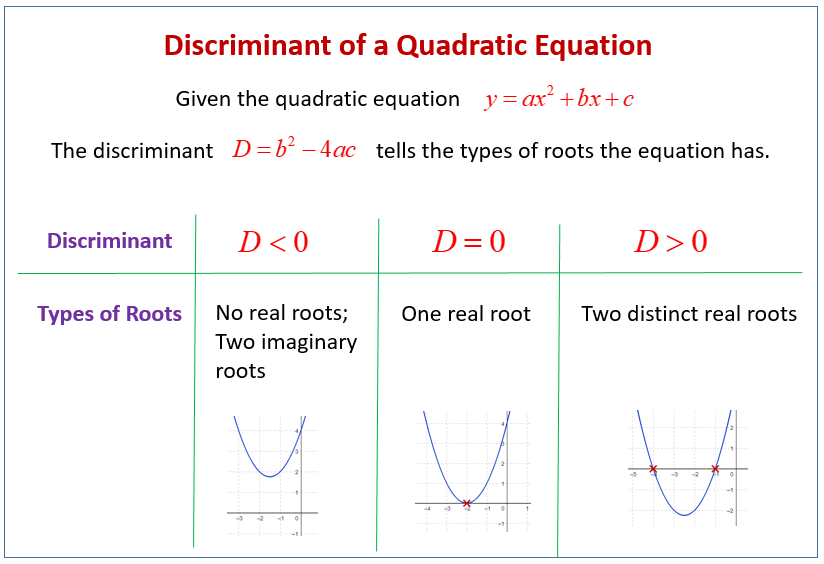
Let's break down the conditions.
Nature of Roots of a Quadratic Equation: Formula, Examples
To understand these conditions in detail, let's turn to the article 'Nature of Roots of a Quadratic Equation' from Embibe. It provides clear explanations with helpful graphical illustrations.
Please read the sections titled 'Nature of the Roots of Quadratic Equation Notes', 'Two Distinct Real Roots', 'Two Equal Real Roots', and 'No Real Roots'. Focus on how the sign of the discriminant (D > 0, D = 0, D < 0) relates to the type of roots and the graph of the parabola.
Here is a summary of the rules, which are the core takeaway of this lesson:
For a quadratic equation with real coefficients:
-
If : The discriminant is negative.
- You would be taking the square root of a negative number.
- Nature of roots: There are no real roots. The roots are imaginary or complex.
- Graphically: The parabola does not intersect the x-axis.
-
If : The discriminant is zero.
- The formula simplifies to .
- Nature of roots: There are two real and equal roots (or you can think of it as one distinct real root).
- Graphically: The parabola touches the x-axis at exactly one point (its vertex).
-
If : The discriminant is positive.
- The part of the formula will generate two different values.
- Nature of roots: There are two real and distinct (unequal) roots.
- Graphically: The parabola intersects the x-axis at two different points.
- Further classification (very useful for CAT):
- If is a perfect square (like 1, 4, 9, 49...), the roots are rational.
- If is not a perfect square (like 3, 12, 32...), the roots are irrational.
Test your understanding!
Without solving the equation, determine the nature of the roots for .
Show answer
- Identify coefficients: , , .
- Calculate the discriminant (D):
- Analyze the discriminant:
- , which is greater than 0 (). This means there are two real and distinct roots.
- Furthermore, 16 is a perfect square (). This means the roots are also rational.
- Conclusion: The equation has two real, distinct, and rational roots.
3. Applying the Discriminant to CAT-Style Problems
CAT questions often test this concept in more indirect ways. You might be asked to find the value of a coefficient for which the roots have a certain property (e.g., "find such that the roots are equal").
The following resource provides excellent worked examples that mirror the type of questions you can expect.
2.6 Nature of roots | Equations and inequalities
The webpage 'Nature of roots' from Siyavula provides step-by-step solutions to typical problems involving the discriminant. These examples are perfect for seeing the theory in action.
Please study the three worked examples: 'Worked example 13', 'Worked example 14', and 'Worked example 15'. Pay close attention to how the problem's goal is translated into a condition on the discriminant (D).
Let's review the logic from those examples:
-
"Show that the roots of are irrational." (from Worked example 13)
- Goal: Show roots are real, unequal, and irrational.
- Condition: This requires the discriminant to be positive () but not a perfect square.
- Execution: Calculate .
- Conclusion: 32 is positive but not a perfect square, so the roots are indeed real, unequal, and irrational.
-
"For which value(s) of will the roots of be real and equal?" (from Worked example 14)
- Goal: Find that makes roots real and equal.
- Condition: This requires the discriminant .
- Execution:
- First, rearrange the equation to standard form: .
- Identify coefficients in terms of k: , , .
- Set up the discriminant equation: .
- Solve for : or .
-
"Show that the roots of are real for all real values..." (from Worked example 15)
- Goal: Show roots are always real.
- Condition: This requires proving that the discriminant is always greater than or equal to zero ().
- Execution:
- Expand and rearrange: .
- Calculate .
- Simplify to a form where its sign is obvious: .
- Conclusion: Since a square of any real number is always non-negative (), is the sum of two non-negative terms, which must also be non-negative. Therefore, , and the roots are always real.
This last example is a great demonstration of how algebraic identities you've learned previously can be used to prove a property.
Conclusion
Today, we've unlocked a powerful analytical tool for quadratic equations. Instead of always defaulting to the full quadratic formula, you can now use the discriminant as a fast, first-step analysis. This is exactly the kind of strategic thinking that saves precious seconds in the CAT exam.
Key Takeaways:
- The discriminant, , determines the nature of the roots of .
- No real roots.
- One distinct, real root (or two equal real roots).
- Two distinct, real roots.
- If is a perfect square, the roots are rational.
- If is not a perfect square, the roots are irrational.
- Many CAT problems are reverse-engineered: you are given the nature of the roots and must find a missing coefficient by setting up an equation or inequality with the discriminant.
Preview of the Next Lesson:
We will continue with quadratic equations, but explore another set of powerful shortcuts related to the sum and product of roots. You'll learn how the coefficients , , and directly relate to the sum () and product () of the roots, allowing you to answer questions without ever finding the roots themselves.