Hello! Welcome to the fifth and final lesson in our Arithmetic Foundations module.
In the last session, we mastered the techniques for finding the number, sum, and product of a number's factors, all stemming from prime factorization. Today, we'll tackle another classic question type that relies on pattern recognition rather than heavy calculation.
Our goal for this lesson is to learn how to determine the unit digit of large exponential expressions using the concept of cyclicity. This is a high-frequency question in exams like the CAT, and mastering this shortcut will save you valuable time.
1. The Core Idea: What is Cyclicity?
When you need to find the unit digit of an expression like , calculating the full value is impossible. The key is to realize that only the unit digit of the base matters. The unit digit of will be the same as the unit digit of .
But even is too large. Let's observe the pattern of unit digits for powers of 7:
- → unit digit is 9
- → unit digit is 3
- → unit digit is 1
- → unit digit is 7 (The pattern repeats!)
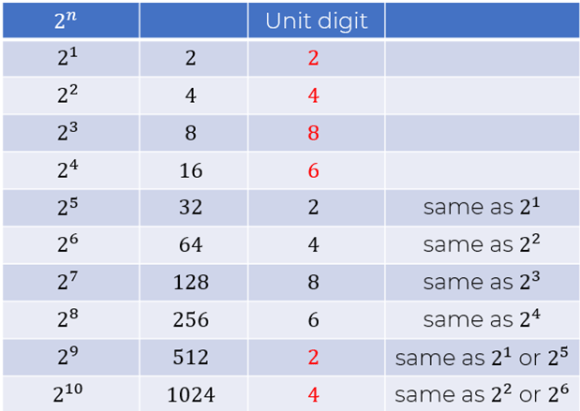
The sequence of unit digits is 7, 9, 3, 1. This pattern has a length of 4 and will repeat endlessly. This repeating nature is called cyclicity. For the number 7, the cyclicity is 4.
2. Cyclicity of All Digits (0-9)
To solve these problems quickly, we need to know the cyclicity of each digit from 0 to 9. We can group them into three simple categories.
To explore these patterns, I'd like you to read the following article from GeeksforGeeks. It provides a very clear breakdown.
Cyclicity of Numbers - Unit Digits in Powers
This article, 'Cyclicity of Numbers', organizes the digits 0-9 into three logical groups based on their cyclicity. This structure makes the patterns much easier to remember.
Read the sections titled '1. Digits 0, 1, 5, and 6', '2. Digits 4 and 9', and '3. Digits 2, 3, 7, and 8'. Focus on understanding the repeating pattern for each group.
Here is a summary of those patterns, which you should aim to commit to memory:
Group 1: Cyclicity of 1
- Digits: 0, 1, 5, 6
- Rule: The unit digit is always the digit itself, regardless of the power.
- Example: The unit digit of is 5.
Group 2: Cyclicity of 2
- Digits: 4, 9
- Rule: The unit digit alternates based on whether the power is odd or even.
- For 4: ,
- For 9: ,
- Example: The unit digit of (even power) is 6. The unit digit of (odd power) is 9.
Group 3: Cyclicity of 4
- Digits: 2, 3, 7, 8
- Rule: The unit digit follows a four-step cycle.
- 2 → (2, 4, 8, 6)
- 3 → (3, 9, 7, 1)
- 7 → (7, 9, 3, 1)
- 8 → (8, 4, 2, 6)
This table provides a great quick reference.

Test your understanding!
What is the unit digit of ?
Show answer
- For : The last digit is 9 and the power is 100 (even). The rule is . So the unit digit is 1.
- For : The last digit is 6. The rule is that the unit digit is always 6.
- Combine: The unit digit of the sum will be the unit digit of .
3. The General Method for Cyclicity 4
For the digits in Group 3 (2, 3, 7, 8), we need a systematic process. Since your background is in Computer Science, you can think of this as a simple algorithm using the modulo operator.
The 4-Step Algorithm:
- Identify the unit digit of the base number. Let's call it .
- Identify its cyclicity, which is 4 for this group.
- Find the remainder when the exponent is divided by 4. Let's call it . So, .
- The required unit digit is the same as the unit digit of .
The Most Important Special Case: Remainder is 0
If the exponent is perfectly divisible by 4 (i.e., the remainder is 0), you do not use a power of 0. Instead, you use a power equal to the cyclicity itself (which is 4).
This video clearly demonstrates this method and the crucial "remainder 0" rule.
Aptitude Made Easy – Easy way of finding unit digit? - Common topic in Bank exam,Math tricks
This video from the 'Jobs & Careers' channel provides a very practical, step-by-step guide to applying the cyclicity method, including the important exception when the remainder is zero.
Watch the segment from 01:55 to 04:32. The first part (01:55 - 03:29) demonstrates the standard method with a non-zero remainder. The second part (03:29 - 04:32) explains what to do when the remainder is 0.
Let's walk through an example: Find the unit digit of .
- Unit Digit (L): 8
- Cyclicity: 4 (from the pattern 8, 4, 2, 6)
- Remainder (R): We divide the exponent 98 by 4. with a remainder of 2. So, .
- Result: The unit digit is the same as . The unit digit is 4.
Now, let's try an example with a remainder of 0: Find the unit digit of .
- Unit Digit (L): 7
- Cyclicity: 4 (from the pattern 7, 9, 3, 1)
- Remainder (R): We divide the exponent 100 by 4. with a remainder of 0.
- Result: Since the remainder is 0, we use the cyclicity as the power. The unit digit is the same as . The unit digit is 1.
4. Handling Complex Expressions
CAT problems often involve expressions with multiple terms connected by addition, subtraction, or multiplication. The strategy is to find the unit digit of each part separately and then perform the final operation.
Let's watch a video that works through some of these more complex examples.
Find UNIT DIGIT of LARGE EXPRESSIONS in 3 Seconds
This video from Suresh Aggarwal shows how to break down complex expressions and solve for the final unit digit. Pay attention to how he handles multiplication and subtraction.
Watch the section from 02:03 to 03:58. The first example (02:03 - 03:25) involves multiplication and reveals a useful shortcut with 5. The second example (03:25 - 03:58) involves subtraction.
Example: Find the unit digit of .
-
Part 1:
- Unit digit is 3 (cyclicity 4).
- Remainder of is 3.
- Unit digit is that of , which is 7.
-
Part 2:
- Unit digit is 7 (cyclicity 4).
- Remainder of is 1.
- Unit digit is that of , which is 7.
-
Combine: We need the unit digit of , which is 0.
Test your understanding!
Find the unit digit of the expression: .
Show answer
-
For :
- Unit digit is 2 (cyclicity 4).
- Remainder of is 2. (Because is divisible by 4).
- Unit digit is that of .
-
For :
- Unit digit is 3 (cyclicity 4).
- Remainder of is 1. (Because is divisible by 4).
- Unit digit is that of .
-
Combine: We need the unit digit of , which is 2.
Conclusion
Congratulations on completing the "Arithmetic Foundations" module! You've built a strong base in number theory, from divisibility and prime factors to remainders and now cyclicity.
Key Takeaways:
- To find the unit digit of , you only need the unit digit of .
- Digits can be grouped by their cyclicity:
- Cyclicity 1 (Always the same): 0, 1, 5, 6
- Cyclicity 2 (Odd/Even power): 4, 9
- Cyclicity 4 (Remainder method): 2, 3, 7, 8
- For cyclicity 4, divide the exponent by 4. The unit digit is .
- Crucial Rule: If the remainder is 0, use the cyclicity (4) as the power, not 0.
In our next lesson, we will begin a new module: Commercial Mathematics. We'll start with the fundamental skill of performing rapid conversions between percentages, fractions, and ratios, a cornerstone for solving problems on profit & loss, interest, and more.