Hello! Welcome back to our course on quantitative aptitude for the CAT.
In our last lesson, we explored Arithmetic Progressions (AP), where each term is generated by adding a constant difference. Today, we build on that by exploring a different kind of sequence, fulfilling the learning outcome: Solve problems on Geometric Progressions (GP), including infinite GP sums.
We'll move from a constant difference to a constant ratio. This lesson will cover the core concepts of GPs, the formulas for finding any term, the sum of a finite number of terms, and the fascinating concept of summing an infinite series. We will focus on the formulas and the practical shortcuts essential for exam success.
1. From Common Difference to Common Ratio: What is a GP?
A Geometric Progression (GP) is a sequence where each term after the first is found by multiplying the previous one by a fixed, non-zero number called the common ratio.
- In an AP, we add/subtract: 2, 5, 8, 11... (common difference )
- In a GP, we multiply/divide: 2, 6, 18, 54... (common ratio )
Let's denote the first term by and the common ratio by . The sequence looks like this:
This pattern of multiplicative growth is something you've likely encountered in computer science, for instance when analyzing algorithms with complexities like where the problem size doubles at each recursive step.
Finding the nth Term
Just as with APs, we can find a formula for any term in the sequence.
- 1st term () =
- 2nd term () =
- 3rd term () =
- 4th term () =
The power of is always one less than the term number. This gives us the formula for the nth term:
To solidify these foundational concepts, let's watch a short, clear explanation.
Geometric Progression - Shortcuts & Tricks for Placement Tests, Job Interviews & Exams
This video from CareerRide clearly defines a Geometric Progression, explains the common ratio, and derives the formula for the nth term with a practical example.
Watch the segment from 00:27 to 04:53. Focus on how the common ratio is calculated and how the nth term formula is a direct consequence of the GP's structure.
Test your understanding!
A GP has a 4th term of 24 and a 9th term of 768. What is its common ratio ()?
Show answer
We have:
To find , we can divide the second equation by the first:
Since , the common ratio is 2.
2. The Sum of a Geometric Progression
Now, let's tackle the sum of the terms in a GP. There are two main scenarios: summing a finite number of terms and summing an infinite series.
Sum of a Finite GP
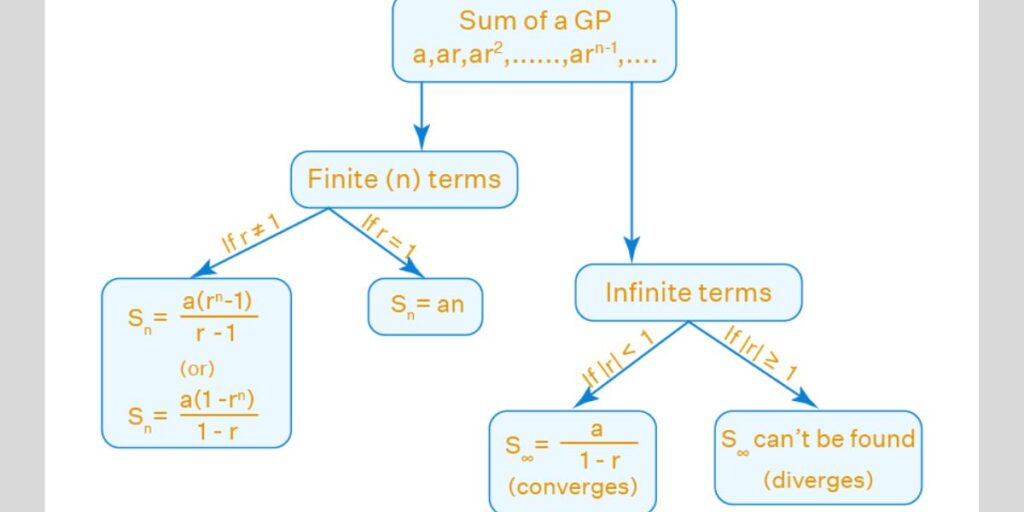
The formula for the sum of the first terms, , depends on whether is greater or less than 1. This is just to keep the denominator positive, but both forms are mathematically equivalent.
- If , use:
- If , use:
- If , the series is just and .
To understand where these formulas come from, which is key to avoiding confusion during an exam, let's see a quick derivation.
Geometric Progression - Shortcuts & Tricks for Placement Tests, Job Interviews & Exams
The same CareerRide video provides an excellent, step-by-step derivation of the sum formula. Understanding the 'why' will help you remember the 'what'.
Watch from 04:53 to 08:30. Pay attention to the clever trick of multiplying the entire series by 'r' and then subtracting the original series.
Sum of an Infinite GP
This is a fascinating and frequently tested concept. Can we sum a series that goes on forever? Yes, but only under one crucial condition: the common ratio must be between -1 and 1 (i.e., ).
Why? If is a fraction like 1/2, each term gets progressively smaller (e.g., 8, 4, 2, 1, 0.5, ...), eventually becoming so small that the sum approaches a finite limit. If , the terms either grow or stay the same size, and the sum would be infinite.
The formula is elegantly simple:
For a quick reference on all the sum formulas and the condition for the infinite sum, let's consult a text resource.
Geometric Progression (GP) - Formulas, nth Term, Sum
This article from Cuemath provides clear proofs and examples for both finite and infinite GP sums. It's a great written resource to complement the videos.
First, read the section 'Geometric Progression Sum Formula' for a text-based proof of both the finite and infinite sum formulas. Then, jump to the FAQ section and read 'How Do You Find the Sum of an Infinite Geometric Progression?' and 'Which Infinite Geometric Progression has a Sum?' to reinforce the all-important condition |r| < 1.
The following flowchart is an excellent summary to help you decide which formula to use in any given problem.
3. CAT-Specific Problems and Techniques
For the CAT, simply knowing the formulas isn't enough. You need to recognize problem patterns and apply efficient techniques.
Technique 1: Choosing Terms Strategically
If a problem gives you the product of three terms in a GP, don't assume them as . Instead, choose them as:
When you multiply these, the 's cancel out, leaving you with . This simplifies the problem immensely. The middle term is now 'a'.
The following video demonstrates this powerful technique.
Geometric Progression - 1 I Algebra for CAT I Quantitative Aptitude Preparation
This video from Rodha provides an excellent explanation of how to choose terms in a GP when their product is known—a very common CAT question type.
Watch from 08:03 to 12:00. Focus on the logic behind assuming terms as a/r, a, and ar, and see how it simplifies finding the value of 'a'.
Technique 2: The Bouncing Ball Problem
This is a classic application of the infinite GP sum. A ball is dropped from a height and rebounds to a fraction of its previous height. The total distance traveled is an infinite GP.
- Initial Drop:
- First Rebound (up and down):
- Second Rebound (up and down):
- ...and so on.
The total distance is
This is plus an infinite GP with first term and common ratio .
Total Distance = .
Let's watch a masterclass on solving this exact problem type.
Geometric Progression - Shortcuts & Tricks for Placement Tests, Job Interviews & Exams
The CareerRide video concludes with a brilliant, detailed breakdown of the classic 'bouncing ball' problem, explaining both the long method and a quick shortcut.
Watch from 59:42 to 1:07:30. First, understand the full derivation of the series. Then, pay close attention to the shortcut method derived at the end, as this is what you'll use in the exam.
Test your understanding!
A ball is dropped from 80 meters. Each time it hits the ground, it bounces back to 3/4 of its previous height. What is the total distance it travels before coming to rest?
Show answer
Here, and the common ratio .
Long Method:
- Initial drop: 80 m.
- First rebound (up and down): The ball goes up m and comes down 60 m. Total = 120 m.
- The rest of the bounces form an infinite GP with first term and ratio .
The sum of all rebounds is m. - Total distance = Initial drop + Sum of rebounds = m.
Shortcut Method:
Total Distance =
The shortcut formula is derived from .
Conclusion
Today we've unpacked Geometric Progressions, a vital topic for the CAT. You've learned to identify a GP, find any term, and calculate its sum, both for finite and infinite series. Most importantly, you've seen how these concepts are applied in exam-style questions.
Key Takeaways:
- A Geometric Progression (GP) has a constant ratio () between terms.
- The nth term is given by .
- The sum of a finite GP is .
- The sum of an infinite GP exists only if , and the formula is .
- For problems involving the product of terms, strategically choose them as .
- Recognize the "bouncing ball" problem as a classic infinite GP application.
Preview of the Next Lesson:
We will round out our study of fundamental series by learning how to apply formulas for the sum of first n natural numbers, their squares, and their cubes. These are special, fixed formulas that are incredibly useful as building blocks for solving more complex summation problems.