Hello! Welcome to the next lesson in our journey through the CAT quantitative syllabus.
In our last lesson, we wrapped up our study of 3D solids by learning how to calculate the surface area and volume of combined shapes. We focused on visualizing which surfaces were exposed and which volumes were additive.
Today, we transition from 3D mensuration to Coordinate Geometry. This topic bridges geometry and algebra, allowing us to solve geometric problems using coordinates and equations. For the CAT, these concepts often appear in standalone questions or are mixed with problems on triangles and quadrilaterals.
Our learning outcome for this lesson is to apply the distance and section formulas to solve problems on the coordinate plane. These two formulas are the absolute foundation of coordinate geometry, and mastering them is essential for everything that follows.
1. The Distance Formula: More Than Just a Formula
At its core, coordinate geometry is about locating points on a 2D plane using a pair of numbers, (x, y). The first fundamental question we can ask is: how far apart are two such points? The answer lies in the distance formula.
Let's say we have two points, A and B . The distance, , between them is given by:
This might seem like something new to memorize, but it's actually an old friend in disguise: the Pythagorean theorem.
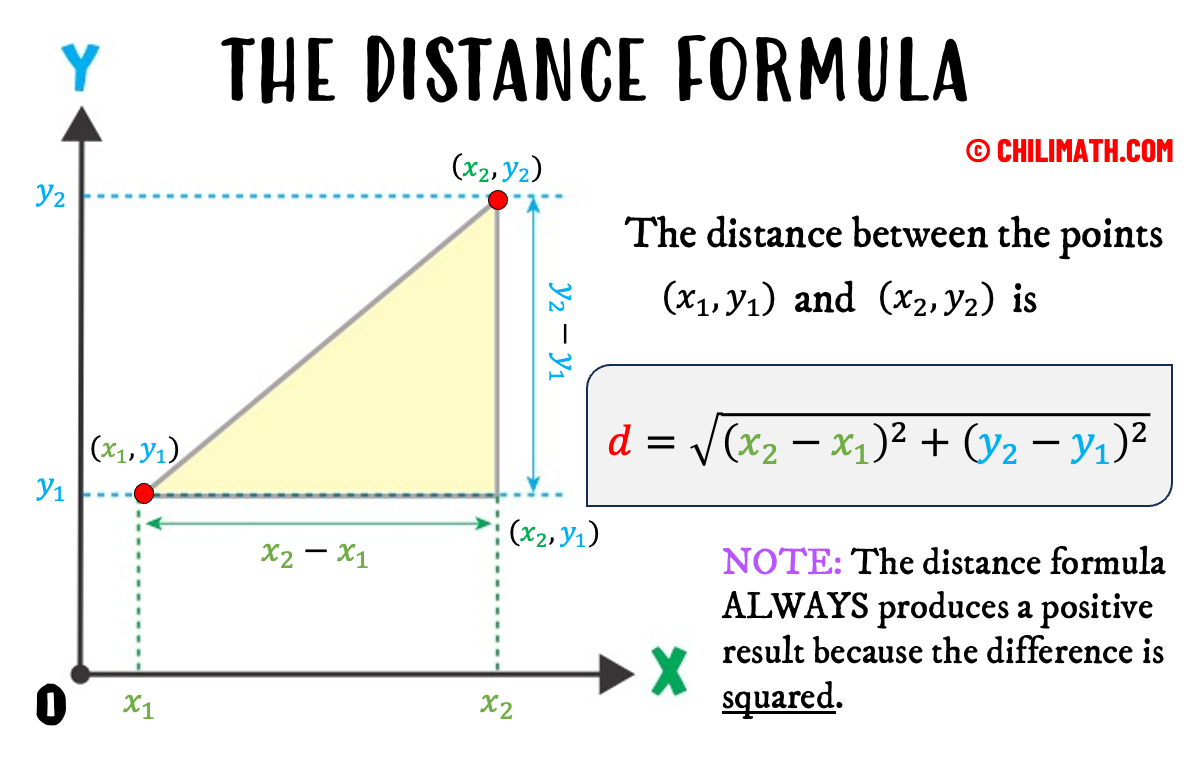
As you can see, the distance formula is simply applied to the coordinate plane. Understanding this connection is crucial because it helps you remember the formula conceptually, not just by rote.
Now, let's see how to apply this formula through some examples.
The article 'Distance Formula' from ChiliMath provides a clear derivation and some excellent, well-explained examples that are very relevant for the CAT.
First, read the introduction ('The Distance Formula' and 'Distance Formula as the Derivative of the Pythagorean Theorem') to solidify the connection we just discussed. Then, carefully work through 'Example 1', 'Example 2', 'Example 5', and 'Example 6'. Pay special attention to how Example 5 combines the distance formula with circle properties, and how Example 6 uses algebra to find a missing coordinate.
Let's summarize the key problem types from the reading:
- Direct Calculation: Finding the distance between two given points (Example 2).
- Application in Geometry: Finding the length of a diameter of a circle to determine its radius (Example 5). This is a classic application.
- Algebraic Problems: Finding a missing coordinate when the distance is known (Example 6). This requires you to set up the equation and solve for the variable.
Test your understanding!
A circle has its center at (2, 2). A point (5, 6) lies on the circumference of this circle. What is the length of the diameter of the circle?
Show answer
First, find the radius, which is the distance from the center (2, 2) to the point on the circumference (5, 6).
Using the distance formula:
The radius is 5 units. The diameter is twice the radius.
Diameter = units.
2. The Section Formula: Dividing a Line Segment
The next fundamental tool is the section formula. It helps us find the coordinates of a point that divides the line segment joining two other points in a specific ratio, say .
This is best understood as finding a "weighted average" of the coordinates of the endpoints.
Internal and External Division
There are two main scenarios:
- Internal Division: The point lies between points A and B.
- External Division: The point lies on the line extended beyond either A or B.
The following resource explains the formulas for both cases and also covers the important special case of the midpoint.
Section Formula - Definition, Formulas, Proof, Examples
The webpage 'Section Formula' from Cuemath gives a concise and clear explanation of the formulas for internal division, external division, and the midpoint. We'll use its definitions and examples.
Read the sections 'Internal Section Formula', 'External Section Formula', and 'Section Formula for Midpoint'. Focus on the formulas themselves and the accompanying diagrams. You don't need to memorize the derivation, but notice it uses similar triangles—a concept from a previous module. Finally, go through all three 'Examples Using Section Formula' to see how these are applied.
Let's summarize the formulas from the reading. For a line segment joining and divided in the ratio :
-
Internal Division Formula: The coordinates of the dividing point P are:
-
External Division Formula: The coordinates of the dividing point P are:
(Notice it's the same as the internal formula, just with negative signs.) -
Midpoint Formula: This is a special case of internal division where the ratio is 1:1 ().
You should memorize this one separately as it's used very frequently.
A Note on Application
A common CAT question type is the "reverse" problem, like Example 2 in the Cuemath article. You are given the dividing point and asked to find the ratio. The key is to set one of the coordinates (x or y) equal to the corresponding section formula and solve for the ratio .
Test your understanding!
Find the coordinates of the point that divides the line segment joining A(-1, 7) and B(4, -3) in the ratio 2:3 internally.
Show answer
Here, , , and .
Using the internal section formula:
The coordinates of the point are (1, 3).
Summary and Key Formulas
Today, we've added the two most fundamental tools of coordinate geometry to our arsenal. To help you consolidate, here is a handy visual summary of all the formulas we've discussed.

When tackling problems, always start by identifying which formula is needed:
- Are you asked for a length, distance, or side? -> Use the Distance Formula.
- Are you asked to find a point that divides a line segment or a midpoint? -> Use the Section/Midpoint Formula.
Conclusion
In this lesson, we established the groundwork for coordinate geometry. We learned that the distance formula is a direct application of the Pythagorean theorem and we mastered the application of the section formula for internal, external, and midpoint divisions.
Key Takeaways:
- Distance Formula: . Use it to find the length of any line segment on the coordinate plane.
- Section Formula (Internal): . Use it to find a point between two other points.
- Midpoint Formula: . It's the simplest and most common case of the section formula.
Preview of the Next Lesson:
With the distance and section formulas as our foundation, we are now ready to work with lines. In the next lesson, we will learn how to determine the equation of a line and use the concepts of slope, parallel lines, and perpendicular lines to solve a wider range of geometric problems.