Hello! Welcome to the first lesson in our module on Mensuration and Coordinate Geometry.
In our last lesson, we mastered the art of calculating the area and perimeter of 2D shapes. We saw how a few key formulas could help us measure flat surfaces. Now, we're going to take those concepts and add a third dimension: depth.
Today's goal is to learn how to calculate the surface area and volume of common 3D solids: cubes, cuboids, cylinders, cones, and spheres. Understanding these formulas is crucial, as questions on this topic are very common in the CAT exam. We will focus not just on memorizing the formulas, but on understanding the logic behind them, which will help you recall and apply them accurately under pressure.
1. From 2D Area to 3D Surface Area and Volume
Before we get to the formulas, let's clarify what we're measuring. Imagine a cardboard box.
- Surface Area is the total area of all the cardboard needed to make the box. It's like the "wrapping paper" concept—the sum of the areas of all its 2D faces. We measure it in square units (e.g., ).
- Volume is the amount of space inside the box. It's the "filling with water" concept—how much it can hold. We measure this in cubic units (e.g., ).
To get a formal handle on the terminology, let's consult a quick reference guide.
Mensuration 3D: Important Questions, Figures & Formulas ...
This resource, 'Mensuration 3D' from Testbook, provides a clear table defining the key terms we'll use throughout this module.
Please read the section titled 'Mensuration 3D in Maths- Important Terminologies'. Pay close attention to the distinction between Curved/Lateral Surface Area (CSA/LSA) and Total Surface Area (TSA).
In short:
- Lateral Surface Area (LSA) or Curved Surface Area (CSA) is the area of the sides only, excluding the top and bottom bases.
- Total Surface Area (TSA) is the LSA plus the area of the top and bottom bases.
2. Prisms: The Building Blocks (Cubes and Cuboids)
The most straightforward 3D shapes are prisms. A key principle for prisms that connects to our last lesson is:
- Volume = (Area of Base) Height
- Lateral Surface Area = (Perimeter of Base) Height
Let's see how this applies to cuboids and cubes.
Mensuration 3D: Important Questions, Figures & Formulas ...
The same Testbook article provides the specific formulas and properties for cubes and cuboids.
Review the sections 'Properties of Cube' and 'Properties of Cuboid'. Note how the formulas are applications of the general prism rules mentioned above.
Cuboid (like a rectangular box)
Let length = , breadth = , and height = .
- The base is a rectangle with area and perimeter .
- Volume: (Area of Base)
- LSA: (Perimeter of Base)
- TSA: LSA + 2 (Area of Base) =
Cube (a special cuboid where )
- The base is a square with area and perimeter .
- Volume:
- LSA: (Area of 4 side faces)
- TSA: (Area of all 6 square faces)
Test your understanding!
A swimming pool is 20m long, 15m wide, and 3m deep. What is the area of the five surfaces (bottom and four walls) that need to be plastered?
Show answer
This question asks for the Lateral Surface Area (the four walls) plus the area of the bottom. This is a common variation.
- Identify the shape and dimensions: It's a cuboid with , , and .
- Calculate the LSA (Area of four walls): LSA = m².
- Calculate the Area of the bottom: Area = m².
- Add them up: Total plastered area = m².
3. Circular Solids: Cylinder, Cone, and Sphere
Now let's move to solids with circular cross-sections.
Mensuration 3D: Important Questions, Figures & Formulas ...
Let's return to the Testbook guide to get the formulas for these three crucial shapes.
Read the sections on 'Properties of Cylinder', 'Properties of Cone', and 'Properties of Sphere'. As you read, try to see the connections between them.
Cylinder (like a can)
A cylinder is like a circular prism. We can apply the same logic. Let radius = and height = .
- The base is a circle with area and circumference .
- Volume: (Area of Base)
- CSA: (Perimeter/Circumference of Base)
- TSA: CSA + 2 (Area of Base) =
Cone (like an ice-cream cone)
A cone is related to a cylinder in a simple but crucial way: it has 1/3 the volume of a cylinder with the same base and height.
- Volume:
- For surface area, we need the slant height (), which is the distance from the tip of the cone down the side to the edge of the base. Using Pythagoras' theorem (from our geometry module), .
- CSA:
- TSA: CSA + (Area of Base) =
Sphere (like a ball)
The formulas for a sphere are best memorized.
- Volume:
- Surface Area: (Notice this is exactly 4 times the area of a circle with the same radius).
A Visual Relationship
To help remember the volume formulas for these three shapes, look at this interesting relationship. For a cone, sphere, and cylinder where the height of the cone and cylinder is twice the radius ():

This visual proof reinforces the fractions involved:
This shows how the factor for a cone and the for a sphere are connected.
4. Summary and Practice
Having a single reference sheet for all these formulas is invaluable for quick revision.
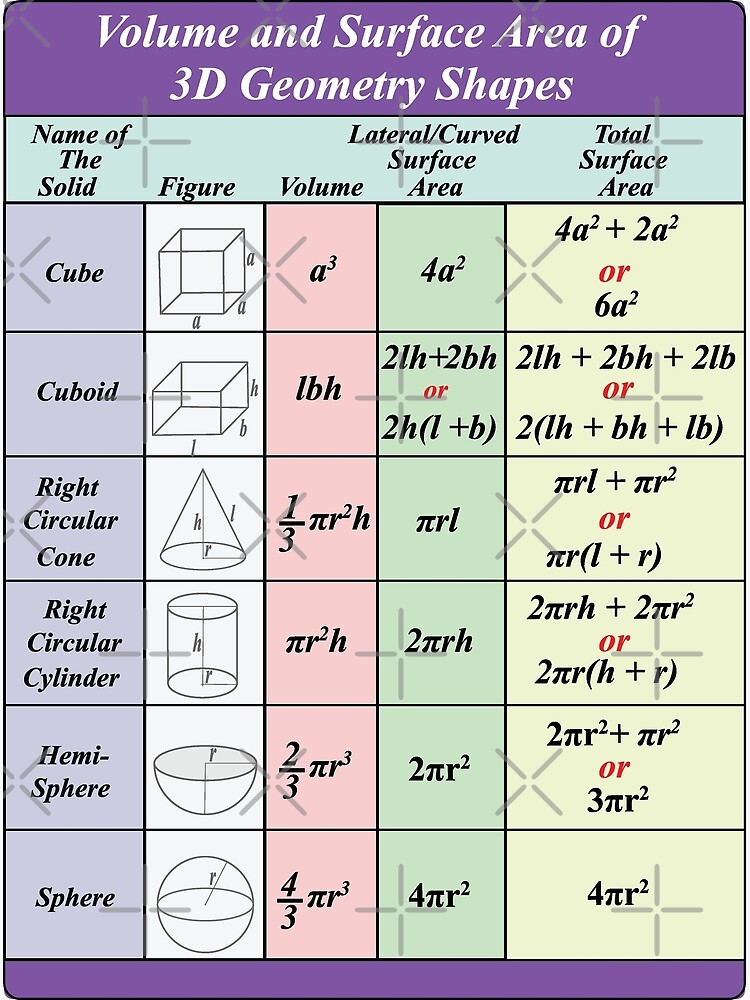
Save this image. Before any practice test, a quick glance at this will refresh your memory. Now, let's apply these formulas to a problem.
Problem:
Find the volume of a cone with a radius of 6 cm and a slant height of 10 cm. (Use )
Solution:
- Identify knowns and unknowns: We have and . To find the volume, we need the height, .
- Find the height (): We use the relationship .
cm. - Apply the volume formula: Volume = .
- Calculate:
Volume =
Volume =
Volume = cm³.
Test your understanding!
If the volume of a cube is 4913 cm³, what is its total surface area?
Show answer
This problem is solved in the 'Mensuration Solved Problems' section of the Testbook resource (LINK, section idx=9).
- Find the side length (a): Volume = . You need to find the cube root of 4913. You can estimate: , . The number ends in 3, so the cube root must end in 7 (since ). Let's try 17. . So, cm.
- Calculate TSA: TSA = .
- Final Calculation: cm².
Conclusion
In this lesson, we made the jump from 2D to 3D geometry. We've armed ourselves with the essential formulas for calculating how much space a solid occupies (volume) and the area of its exterior (surface area).
Key Takeaways:
- Volume is about capacity (cubic units), Surface Area is about covering (square units).
- Prism Logic: For cuboids and cylinders, the volume is simply the Area of the Base Height.
- Key Ratios: A cone's volume is 1/3 of a cylinder's with the same base and height.
- Formula Mastery: Use the summary image provided to memorize the formulas for all five shapes. Being able to recall them instantly is a significant advantage.
Preview of the Next Lesson:
Now that we can handle these shapes individually, the next logical step is to see how they fit together. In our next lesson, we will solve problems involving combinations of 3D solids, such as an ice cream cone (a cone topped with a hemisphere) or a storage silo (a cylinder topped with a cone). This will test our ability to apply today's formulas in more complex, exam-like scenarios.