Welcome back! In our previous lesson, we established the foundational architecture of an AI agent, centered on the Reason-Act-Observe loop. You learned how agents use tools to interact with the world and persistent memory to maintain context and learn over time.
Today, we'll zoom in on the "Reason" part of that loop: the Large Language Model (LLM) that powers the agent's thinking process. The choice of LLM is one of the most critical decisions in setting up an agent, as it dictates everything from its raw intelligence to its operational cost and security profile. Our goal is to analyze the trade-offs between using large, cloud-based models like those from Anthropic (Claude) and OpenAI (GPT), versus running smaller, open-source models locally. This is much like the classic infrastructure decision of using a cloud service provider versus maintaining on-premise servers—a landscape of trade-offs you're likely very familiar with.
The Core Architectural Choice: Centralized vs. Distributed
At a high level, the choice of an LLM backend presents two distinct architectural patterns. One relies on a powerful, centralized "brain" in the cloud, while the other uses a distributed network of smaller, specialized "brains" running locally.
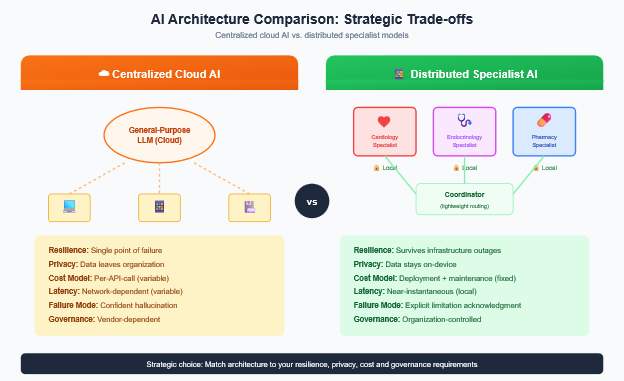
As the "AI Architecture Comparison" diagram illustrates, the trade-offs are significant:
- Centralized Cloud AI: Taps into a massive, general-purpose LLM. This offers state-of-the-art capability but introduces a single point of failure, network-dependent latency, and requires your data to be sent to a third-party vendor. The cost is variable, typically based on per-API-call usage.
- Distributed Specialist AI: Uses smaller, often specialized models that can run on-device or on a local server. This architecture offers resilience to internet outages, ensures data privacy by keeping information on-device, and provides near-instantaneous local latency. The cost model shifts from variable (OpEx) to fixed (CapEx for hardware and maintenance).
This choice is the foundation for all other considerations. Let's break down the most important factors: capability, cost, and privacy.
The Capability Gap: What Can They Actually Do?
The most significant difference between cloud and local models is their raw cognitive ability. While local models are improving at a staggering pace, a "capability gap" still exists for the most complex tasks.
The "Local vs Cloud LLM Decision Guide" provides a clear, honest breakdown of this reality. Please read the first two sections to understand the current state of this gap.
Local vs Cloud LLM: Complete Decision Guide for AI Engineers
This article from AI engineer Zen Van Riel offers a pragmatic framework for choosing between local and cloud LLMs.
Start by reading the section Capability Gap Reality Check to see what tasks each type of model excels at. Then, review the Quick Decision Table for a concise summary of the key factors.
As the article notes, local models are excellent for structured, high-volume, and privacy-sensitive tasks. Cloud models still dominate in complex reasoning, understanding long and nuanced contexts, and novel problem-solving.
For a concrete demonstration of this gap, the following video tests both local and cloud models on a challenging programming task.
Cloud vs Local LLMs for Codex/Claude Code - The Truth You Need To Know
In this video, Gary Explains pits local LLMs against a top-tier cloud model (GPT-5.5) to see if they can build a language interpreter from scratch.
Watch from the description of the task at the setup, where a frontier cloud model completes the complex job in just 6 minutes. Then, observe how the local models perform on the same task from the results—they get stuck in loops and fail. Finally, see how they fare on a much simpler version of the task from the simple test, where they succeed.
This video perfectly illustrates the trade-off: local models are not incapable, but their effective power is currently limited to less complex problems. For an agent like Hermes or OpenClaw, this capability gap often manifests in tool-calling quality. A model that struggles with complex reasoning may generate malformed tool calls, leading to errors, retries, and failed tasks.
Analyzing the Cost and Privacy Dimensions
Once you understand the capability trade-offs, the decision often comes down to cost and privacy.
Privacy: The Hard Line
For many use cases, privacy is a non-negotiable requirement. If your agent needs to handle personally identifiable information (PII), health records, or proprietary company data, sending it to a public cloud API may be unacceptable. In these scenarios, the choice is made for you.
The "Local vs Cloud LLM" guide outlines this clearly.
Local vs Cloud LLM: Complete Decision Guide for AI Engineers
Let's revisit the guide to focus on the security implications.
Read the section on Privacy and Compliance. Pay close attention to the list under "When local is mandatory."
If your data falls into these categories, a local LLM is the only path forward. This is the "distributed specialist" model shown in the architecture diagram, where data stays on-device.
Cost: CapEx vs. OpEx
If your data isn't sensitive, the decision becomes an economic one. Here, your infrastructure background provides a strong advantage in analysis.
- Cloud Models: Represent a pure operational expenditure (OpEx). You pay per token processed, which can be very cheap for light usage but can scale unpredictably with high volume.
- Local Models: Represent a capital expenditure (CapEx) upfront for hardware, followed by a smaller, predictable operational cost for electricity and maintenance.
To see what this looks like in practice, the "Best Hermes Agent Model 2026" article provides a detailed comparison of popular models. The pricing differences are stark.
Best Hermes Agent Model 2026: Claude vs DeepSeek
This article from Remote OpenClaw is specifically tailored to Hermes agent users and compares the most relevant models on the market.
Focus on the Model Comparison Table. Note the Input/Output (per 1M tokens) column. You'll see that a model like Claude Opus is over 15 times more expensive than a budget model like DeepSeek V4. Also, notice how local models like Qwen 3 8B are listed as "Free (local)," reflecting the shift from API costs to hardware costs.
To complete the picture, the "Local vs Cloud LLM" guide offers a framework for calculating these costs. You don't need to memorize the numbers, but understanding the components is key.
Local vs Cloud LLM: Complete Decision Guide for AI Engineers
Finally, let's look at the cost breakdown.
Quickly review the Cost Analysis section. This shows how to calculate both cloud API costs (based on token volume) and local costs (amortized hardware plus electricity).
The break-even point depends entirely on your usage patterns, but the core principle is the same as any cloud vs. on-premise decision: high, predictable volume favors local, while bursty, unpredictable traffic often favors the cloud.
Putting It All Together: A Practical Decision Framework
So, how do you choose? The best model is the one that fits your specific use case. The "Best Hermes Agent Model 2026" guide offers excellent, use-case-driven recommendations.
Best Hermes Agent Model 2026: Claude vs DeepSeek
This final reading provides concrete recommendations based on common priorities.
Read the section Recommended Stacks by Use Case. Then, look at the straightforward decision framework under How to Choose. This boils down the complex trade-offs into simple, actionable advice.
As the guide suggests, the optimal solution is often hybrid. You might use a powerful but expensive cloud model for complex, user-facing tasks, while offloading high-volume, simple, or privacy-sensitive tasks to a cheap or local model. Modern agent frameworks are being designed with this "intelligent routing" in mind.
Conclusion
Today we've dissected the crucial decision of choosing an LLM backend for your agent. This isn't just a technical detail; it's a strategic architectural choice with deep implications.
Here are the key takeaways:
- It's a Trade-off: The choice between cloud and local models is a multi-faceted decision balancing capability, cost, and privacy.
- Cloud for Capability: Centralized cloud models like Claude and GPT offer superior reasoning for complex and novel tasks but come with variable costs and require you to send data to a third party.
- Local for Privacy: Distributed local models running via a service like Ollama provide maximum data privacy and predictable costs, but they currently lag in capability for the most difficult tasks and require hardware management.
- Hybrid is the Future: The most effective and cost-efficient architectures often use a hybrid approach, routing tasks to the most appropriate model based on complexity, cost, and privacy requirements.
Now that you have a firm grasp of the architectural trade-offs between cloud and local backends, we are perfectly positioned for our next lesson. We will explore the practical security implications of these choices, focusing on how to audit an agent's permissions and configure guardrails to ensure it operates safely, regardless of the LLM powering it.