Hello. This module moves from recognizing and reducing the risk of keloids to comparing treatments a clinician may offer once a keloid has been identified. This lesson focuses on two related options: injecting a corticosteroid into the scar, and combining that corticosteroid with 5-fluorouracil (5-FU). The useful comparison is not simply “which works better?” It is what improvement each aims for, how many visits treatment may involve, and which unwanted skin changes matter when choosing between them.
What an injection is trying to change
A keloid is not just extra tissue sitting above the skin. Its scar-forming activity persists, so treatment aims to reduce thickness and firmness and, often, itching or tenderness. Flattening and symptom relief are meaningful results, but neither means the scar has been permanently removed.
Intralesional means that medication is placed within the scar, rather than applied to its surface. Triamcinolone acetonide, often abbreviated TAC, is a corticosteroid used for this purpose. It dampens inflammation and scar-producing activity. 5-FU inhibits the growth of actively dividing cells, including the fibroblasts involved in making scar tissue. Combining them gives a clinician another way to pursue flattening, but it also changes the balance of possible side effects.
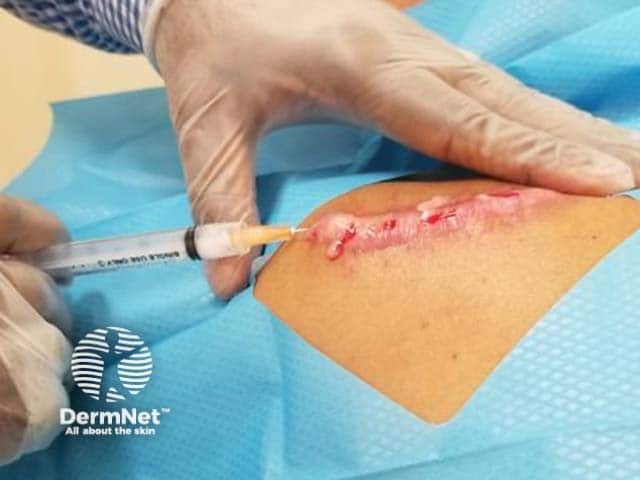
The following short video provides a clinician’s account of steroid injections. Watch for the distinction between early symptom improvement and the slower change in a scar’s height; the later segment discusses why follow-up matters.
Tips, tricks, and pearls for keloid scar steroid injections
Watch “Tips, tricks, and pearls for keloid scar steroid injections” from MDedge for a clinical view of corticosteroid treatment and its limitations.
Watch the treatment overview and expected changes. Then skip the procedural technique to repeat visits and risks. Focus on the expectation that treatment takes time and that thinning or lightening of nearby skin may become apparent after an injection; the video is not an injection guide.
A clinician normally assesses the scar between sessions rather than deciding from the outset that one injection—or a fixed number—will be enough. Visits create opportunities to check both whether the keloid is responding and whether the surrounding skin is developing side effects.
What a direct comparison found
One randomized trial compared TAC injections with TAC plus 5-FU injections in people with keloids or hypertrophic scars. Both groups received a course of injections every two weeks for six doses, with results assessed at week 12. That design is useful for comparing the two approaches within the trial: neither group was assigned a lighter visit schedule.
Read the trial by its research team to see what was given, what counted as improvement, and which adverse effects were recorded. Concentrate on the comparison rather than the injection technique or the detailed statistical tables.
In “2.5 Interventions,” read the treatment schedule. In “2.6 Outcome measurements,” read from the listed outcomes; these explain what the trial calls an improvement. In “3.1 Reduction in height,” read the height results, then continue from the group comparison through the end of that subsection. You can skim Table 1. Finally, in “3.5 Adverse effects,” read the safety findings. Keep the 12-week observation period in mind.
In that study, both groups improved. By week 12, average scar-height reduction was 54.2% with TAC alone and 77.7% with TAC plus 5-FU in the authors’ intention-to-treat analysis. The combination also reached a substantial height reduction sooner in this trial. These figures describe a measured change in scar height over 12 weeks—not the chance that an individual keloid disappears, or the chance it stays flat for years.
The adverse-effect results are just as important to interpreting the apparent advantage. Visible small blood vessels near the treated skin, called telangiectasia, were reported much more often with TAC alone in this trial. Darkening of the skin, or hyperpigmentation, occurred in both groups at similar reported rates. The trial did not observe ulceration, but that does not make ulceration impossible with a 5-FU combination. A study of 63 people over a limited period cannot establish every risk for every mixture or patient.
Notice one easily missed detail: the two trial groups received the same TAC concentration. It would therefore be wrong to explain this trial’s lower telangiectasia rate in the combination group simply by saying that its patients received a weaker steroid concentration. Injection formulations differ between studies, and observed differences do not by themselves prove a single mechanism.
Comparing the trade-offs, not just the average result
Another study examined keloids specifically and recorded local adverse effects in groups receiving TAC alone, 5-FU alone, or a combination. Its formulation and visit schedule differed from those of the first trial. Use it to broaden the picture of possible harms, not to calculate a single combined success rate from the two studies.
Read the study’s adverse-effect findings and the short discussion of why the drugs are combined. It helps show that adding 5-FU can introduce pain or ulceration even when some steroid-related effects are less frequent.
Under “RESULTS,” after Table 4, read from the adverse-effect paragraph, including its injection-pain comparison, then inspect “Table 5 · Summary of adverse effects” immediately below it. Under “DISCUSSION,” find the paragraphs beginning “Intralesional injection of triamcinolone acetonide (TAC)” and “5-fluorouracil is an antimetabolite.” Read the TAC explanation and the 5-FU explanation. Finish with the combination rationale. Treat that proposed rationale as an explanation, not a guarantee that side effects are avoided.
Skin atrophy means thinning of treated skin; it may leave an indentation, particularly if medication affects tissue beyond the thick scar. Corticosteroid injections can also cause lighter or darker pigmentation and visible small blood vessels. These outcomes matter even if the keloid becomes flatter: replacing a raised scar with an unwanted indentation or conspicuous color change may not meet someone’s treatment goal.
Adding 5-FU does not eliminate those steroid-related risks. It also brings possible local effects of its own, notably injection-site pain and breakdown of the skin into an ulcer. In the second study, ulceration was recorded in the combination group but not the TAC-only group, while atrophy and telangiectasia were recorded more often in the TAC-only group. Pain was reported per injection episode, whereas the other adverse effects were counted per patient; those numbers should not be treated as interchangeable probabilities.
The practical comparison is therefore:
| Consideration | TAC alone | TAC plus 5-FU |
|---|---|---|
| Main aim | Flatten and soften the scar; relieve symptoms | The same aims, using both drugs to affect scar activity |
| Visits | Usually a course with reassessment, not necessarily one injection | Also a course with reassessment; adding 5-FU does not automatically mean fewer visits |
| Important local risks | Skin thinning, pigment change, visible small blood vessels, injection discomfort | Those risks remain possible, alongside pain and possible ulceration |
| What the cited trials suggest | Improvement is possible | Some outcomes improved faster or further in the studied groups, but results depend on the regimen and follow-up |
For a raised bump after a piercing or tattoo, there is a step before this comparison: confirm what is being treated. A bump caused by irritation, infection, or another condition is not automatically a keloid, and an unexplained or actively inflamed lesion should be assessed rather than assumed to need scar injections. If treatment produces an open sore or worsening redness, pain, or drainage, the treating clinician should assess it.
Choosing an appropriate expectation
The two studies answer a relatively narrow question: what happened to measured scars during particular injection courses and observation periods? They do not establish that every combination formula is superior, that one injection is sufficient, or that a flatter scar will never grow again. A clinician can weigh the scar’s size and site, symptoms, prior treatment, skin changes you particularly wish to avoid, and suitability for 5-FU when discussing options.
The key takeaway is that TAC alone and TAC plus 5-FU pursue similar goals, but have different risk profiles; both commonly require repeat visits and monitoring. The combination showed stronger short-term flattening in the direct comparison studied, while ulceration and injection pain remain relevant considerations. Next, the module will compare these injections with silicone, pressure therapy, cryotherapy, and laser treatment—options with different practical burdens and limitations.