Welcome! In our past few lessons, we have walked step-by-step through the profound archetypes of the Major Arcana, culminating in the powerful cards of Judgement and The World. You've learned the individual meanings of all 22 cards, from the innocent leap of The Fool to the ultimate completion of The World.
Today, we will zoom out and see the whole picture. The learning outcome for this lesson is to summarize the complete narrative arc of the Fool's Journey as a model for personal growth. We will weave the individual cards you've learned into a single, cohesive story. Understanding this narrative arc is one of the most powerful tools in tarot, as it transforms the deck from a collection of symbols into a map of the human experience.
For your goal of using tarot for personal reflection, this lesson is key. The Fool's Journey is a mirror for our own lives, reflecting the cycles of learning, challenge, and growth we all undergo.
Let's begin our journey, this time from a bird's-eye view.

What is the Fool's Journey?
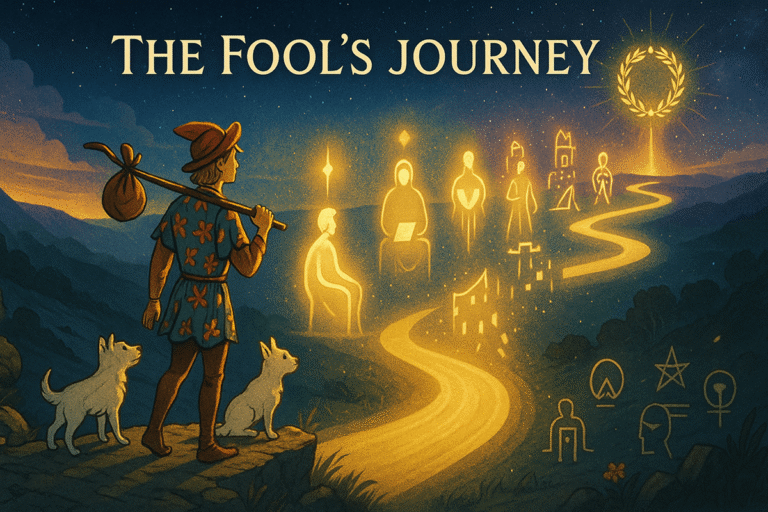
The Fool's Journey is the story told by the 22 cards of the Major Arcana. It is a metaphor for the journey through life, starting from the innocence of the number 0 (The Fool) and moving through life's experiences and lessons until reaching a state of completion and wholeness with card 21 (The World).
The "Fool" is not a foolish character; rather, they represent each of us. They are the protagonist of this story, encountering archetypal teachers, challenges, and moments of revelation that shape their understanding of themselves and the world.
To get a full sense of this narrative, the following video provides an excellent and concise telling of the entire story. As you watch, notice how each card we've studied becomes a "character" or a "chapter" in the Fool's life.
The Journey of the Tarot How Major Arcana Mirrors the Soul: The Fool's Journey
Watch this video, 'The Journey of the Tarot' from The Soul Files, for a complete walkthrough of the Fool's Journey from start to finish. It elegantly connects each card to the next, forming a coherent narrative.
Please watch the entire video (from 00:00 to 16:39). Pay attention to how the Fool's understanding evolves with each encounter. Don't worry about memorizing every detail; focus on the overall flow of the story.
As the video illustrates, the journey is not just a random sequence of events. It has a clear structure that mirrors the stages of human development, from childhood awareness to adult responsibility and, finally, to spiritual enlightenment.
The Three Acts of the Journey
To make the 22-card journey easier to understand, it's helpful to divide it into three "acts" or lines of seven cards each, with The Fool standing outside as the protagonist who moves through them all.
Act I: The Outer World and Building the Self (Cards 1-7)
This first act is about our development in the external world. It covers childhood, education, and becoming a functional member of society. The Fool learns about the fundamental forces and figures that shape our conscious reality.
- The Magician (I) & The High Priestess (II): The Fool first encounters the conscious, active principle (Magician) and the unconscious, intuitive principle (High Priestess). These are the fundamental building blocks of reality: will and potential, action and mystery.
- The Empress (III) & The Emperor (IV): Next, the Fool meets the archetypal parents. The Empress represents unconditional love, nature, and nurturing, while The Emperor represents structure, rules, and authority. The Fool learns about both care and discipline.
- The Hierophant (V): The Fool moves into the wider society, learning from tradition, education, and belief systems. This is about finding one's place within a group.
- The Lovers (VI): The Fool learns about relationships and making choices that align with personal values. This is the first major test of individual identity.
- The Chariot (VII): Having built a sense of self, the Fool now exerts their willpower to achieve success in the world. This card represents the peak of ego development and worldly control.
Act II: The Inner World and Turning Inward (Cards 8-14)
After achieving worldly success with The Chariot, the Fool realizes there is more to life. This second act is a journey into the subconscious to find deeper meaning.
- Strength (VIII) & The Hermit (IX): The journey inward begins. The Fool learns that true strength is not about force, but about courage and compassion (Strength). They then retreat from the world to seek inner wisdom and guidance (The Hermit).
- Wheel of Fortune (X) & Justice (XI): The Fool begins to see the bigger picture. They understand the cycles of life and destiny (Wheel of Fortune) and learn to take responsibility for their actions and choices with clarity and fairness (Justice).
- The Hanged Man (XII) & Death (XIII): This is the heart of the inner journey. The Fool must surrender control and see things from a new perspective (The Hanged Man). This surrender leads to the shedding of the old self to make way for the new (Death).
- Temperance (XIV): After the upheaval of Death, the Fool finds balance, harmony, and moderation. They integrate the lessons learned and find a middle path, achieving a new sense of inner peace.
Act III: The Spiritual World and Universal Consciousness (Cards 15-21)
In this final act, the Fool confronts the deepest, most universal aspects of existence, breaking free from final limitations to achieve true enlightenment.
- The Devil (XV) & The Tower (XVI): The Fool confronts their shadow self: their addictions, material attachments, and limiting beliefs (The Devil). This confrontation leads to a sudden, shocking destruction of the false structures they have built in their life (The Tower).
- The Star (XVII) & The Moon (XVIII): After the destruction, there is hope, healing, and renewed faith (The Star). The Fool must then navigate the final depths of the subconscious, facing their deepest fears and illusions (The Moon).
- The Sun (XIX): Emerging from the darkness of The Moon, the Fool experiences pure joy, clarity, and enlightened understanding. All is illuminated.
- Judgement (XX) & The World (XXI): The Fool answers a final call to awakening, forgiving the past and being reborn into their true self (Judgement). Finally, they reach the end of the journey, achieving a state of complete integration, fulfillment, and wholeness (The World).
The Journey as a Map for Personal Growth
Now for the most practical part: how do you use this story? The Fool's Journey is not just a tale about a mythical character; it's a map of your own life. You are The Fool. The challenges and triumphs you face can be seen through the lens of these archetypal stages.
- Are you starting a new project, full of optimism and a little naivety? You are The Fool.
- Are you trying to create a stable home life and provide for your family? You are in an Emperor phase.
- Are you feeling lost and questioning your life's purpose? You are on The Hermit's path.
- Are you celebrating the successful completion of a long and difficult project? You have reached The World.
The following resource frames the journey in exactly this way, describing the Fool as an "everyday, modern person trying to find their place." It is structured to help you apply each stage to your own life.
The Everyday Fool's Journey To Fulfillment
The resource 'The Everyday Fool's Journey To Fulfillment' by Julia Eve is designed to help you use this narrative for personal insight. It connects each Major Arcana card to a phase of personal development.
Please read the introduction (the first page, sections 'The Everyday Fool’s Journey To Fulfillment' and 'Contents') to understand the author's approach. Then, skim to the end and look at the section titled '22 ⋆ The Whole Picture' (page 27). This section provides a fantastic summary of how each card functions as a milestone on your personal path.
By identifying which "card" or stage you are currently experiencing, you can gain perspective on your situation, understand its purpose in your overall growth, and see what lessons it might be offering.
Test your understanding!
Think of a significant period of personal growth in your own life—perhaps your decision to study law, or another major life change. Can you identify three "chapters" from that experience that correspond to cards in the Fool's Journey?
For example:
- "My initial decision felt like The Fool—a leap of faith into a new field."
- "The long years of disciplined study and adhering to the rules of the university were my Emperor phase."
- "Finally passing my final exams and graduating felt like The World—the successful completion of that cycle."
There is no right or wrong answer; this is an exercise in personal reflection.
Show example answer
Another person might reflect on learning a new skill:
- "When I first started, I was trying to manifest my ideas and felt very powerful, like The Magician."
- "I hit a wall and had to take a break to really think about why I was doing this, which was my Hermit period."
- "Then, a sudden insight shattered my old approach and forced me to start over in a better way. That was a Tower moment."
Conclusion
Today we have woven the threads of the Major Arcana into the rich tapestry of the Fool's Journey. This narrative provides the foundational story of tarot and, more importantly, a powerful framework for self-understanding.
Key Takeaways:
- The Fool's Journey is the narrative arc of the 22 Major Arcana cards, representing a symbolic journey of life from innocence to enlightenment.
- The journey can be seen in three acts: developing in the outer world, turning inward for self-discovery, and finally achieving spiritual integration.
- Most importantly, the Fool's Journey is a model for personal growth. By identifying which archetypal stage you are in, you can gain perspective on your life's challenges and opportunities.
You have now completed your study of the Major Arcana! You understand each card's individual meaning and how they fit together to tell the grand story of life.
In our next lesson, we will begin exploring the Minor Arcana, starting with the Suit of Wands. If the Major Arcana cards are the major life chapters, the Minor Arcana are the day-to-day events, feelings, and thoughts that fill them. We will begin with the fiery, passionate energy of Wands, which govern creativity, ambition, and action.