Hello! Welcome to the final lesson of our module on the Court Cards.
In our last few lessons, we've gotten to know the sixteen personalities of the tarot's court—the Pages, Knights, Queens, and Kings. We finished by exploring the three primary ways to interpret them in a reading: as a specific person, as an energy or situation, or as an aspect of yourself.
Today, we'll focus deeply on that third interpretation. Since your goal is to use tarot for personal insight, this is arguably the most powerful way to work with these cards. Our learning outcome is to apply Court Cards to personal readings about self-development and inner dynamics. We will explore how these sixteen archetypes live within us as different personas, and how we can use them as a mirror to understand our own personalities, strengths, and areas for growth.
This lesson marks a major milestone. By its end, you will have a complete conceptual toolkit for all 78 cards. After this, we will move into the exciting practical work of performing and interpreting readings.
The Court Cards as Your Inner Cast of Characters
Think of the sixteen Court Cards as a cast of characters, but instead of existing outside of you, they represent different facets of your own personality. We all wear different "hats" depending on the situation. You might need the assertive, intellectual energy of the Queen of Swords when navigating a complex professional challenge, but embody the nurturing, empathetic spirit of the Queen of Cups with your loved ones. Tarot gives us a language to identify and consciously work with these inner personas.
This concept of "role-playing" is central to using the court for self-development.
The article 'Lesson 1 – Meet The Courts' from Truly Teach Me Tarot has an excellent section that explores this idea of embodying different personalities.
Please read the section titled 'Court Cards – Role Playing and Personas'. Focus on the idea that we project a 'myriad of personas' and that we can consciously call upon the energy of a specific suit or court card when needed.
As the text explains, we regularly access different elemental energies to navigate life. This isn't about being inauthentic; it's about being adaptable and whole. Recognizing which "persona" a situation calls for is a key self-development skill.
The Court Cards also provide a powerful lens for exploring parts of ourselves we might not always acknowledge, including our "shadow" aspects.
Court Cards in Tarot: How to Read Them
The article 'Court Cards in Tarot: How to Read Them' provides some practical ways to apply this concept for personal growth and self-discovery.
Please read the section 'Practical Application: Bringing Court Cards to Life'. Pay special attention to the concepts of 'Role-Playing for Empathy' and 'Shadow Work with Court Cards'.
By consciously "trying on" the energy of a Queen of Wands for a day, you can learn about your own capacity for confidence and passion. By reflecting on how the King of Pentacles might represent your tendency towards stubbornness (a shadow aspect), you can work to bring that trait into balance. This is the heart of using tarot for inner work.
The Significator: Choosing Your Representative
One of the most direct ways to apply this concept is by using a Significator. This is a card you intentionally choose from the deck to represent yourself in a particular reading or situation. It acts as your anchor, your avatar in the story the cards will tell.
Let's return to the 'Lesson 1 – Meet The Courts' article, which offers a detailed look at this technique.
Please read the section titled 'The Significator'. Notice the important distinction it makes: you can choose a card that represents your general personality, or you can choose a card representing the specific 'sub-personality' you need to embody for a particular situation (like choosing the Queen of Swords for a salary negotiation).
The idea of choosing a Significator based on the needs of the situation is a powerful strategic tool. Given your legal background, you can think of this as defining the "standing" or "capacity" of the main party (yourself) before examining the evidence (the other cards). Are you approaching this issue as the compassionate Queen of Cups or the action-oriented Knight of Wands? Defining this upfront brings immense clarity to a reading.
Test your understanding!
You are about to start a new creative hobby you've been dreaming of for years (like your cold ceramics), but you feel a bit intimidated and unsure where to begin. Which Court Card might you choose as a Significator for a reading about this new venture, and why?
Show answer
A great choice would be the Page of Wands. Pages represent the energy of a student or beginner—curiosity, enthusiasm, and a willingness to learn. The suit of Wands is associated with creativity, passion, and new sparks of energy. By choosing the Page of Wands as your Significator, you are setting the intention to approach this hobby with a playful, open, and passionate spirit, free from the pressure of having to be an expert right away.
Exercise: Create Your Court Card Map
In the last lesson, you did a brief exercise to associate the Court Cards with people you know. Now, let's take that to the next level with a structured method that can become a powerful tool in your tarot journal for understanding both your external world and your inner dynamics.
The Court Card Map - the best tool for reading tarot court cards for yourself
The video 'The Court Card Map' by Angie Green Tarot provides an excellent, step-by-step process for creating a personal map of the court cards. This is a very practical way to make these characters tangible and relevant to your life.
Please watch from 02:14 to 11:49. The presenter will guide you through creating a 'Court Card Map'. Follow her process: List your people: List the important people in your life. Sort by suit: Group them by their dominant energy (Cups-emotional, Pentacles-practical, Swords-intellectual, Wands-energetic). Match to cards: Start assigning people to the 16 court cards. Pay close attention to her advice on handling challenges (08:22), especially what it means when a card space is empty (it could be a role for you) or when one person fits multiple cards (they show different personas, just like you do).
This map is more than just a list of people. It's a snapshot of the energies present in your life. The empty spaces are particularly revealing for self-development. If your Knight of Swords slot is empty, it might mean you need to consciously cultivate that energy of decisive, swift action. If your Queen of Cups is empty, perhaps you need to practice more self-compassion and emotional nurturing.
I encourage you to create this map in your tarot journal. It’s a living document that you can update as your relationships and your own inner dynamics evolve.
Self-Development Prompts
To conclude, let's turn the focus entirely inward. The following exercises are designed for your tarot journal and will help you use the Court Cards as a dedicated tool for self-reflection.
The 'Lesson 1 – Meet The Courts' article provides a fantastic set of prompts to deepen your personal connection with these cards.
Please read the section 'Further Work with Court Cards and Significators'. I strongly recommend you take time to journal your responses to the list of prompts under 'Choose a Court Card that you:'. This is a profound self-reflection exercise.
Here are some of those key prompts to get you started:
- Which Court Card are you most like right now?
- Which Court Card do you wish you were more like?
- Which Court Card represents your public persona (e.g., at work)?
- Which Court Card represents your private persona?
- Choose a card to represent you as a child, an adolescent, and a young adult. How has your core energy changed over time?
Working through these questions will build a rich, personal understanding of how these archetypes operate within you.
Conclusion
In this lesson, you've moved beyond general meanings and learned how to apply the Court Cards as a sophisticated tool for self-awareness and personal growth.
Key Takeaways:
- The sixteen Court Cards can be viewed as an inner cast of characters, representing the different personas we adopt in life.
- A Significator is a card chosen to represent you or the energy you need to embody in a specific situation, bringing focus and intention to a reading.
- Creating a Court Card Map helps you identify the energies in your life and, crucially, reveals which archetypes you may need to cultivate within yourself.
- Using journaling prompts to relate the Court Cards to your past, present, and desired future self transforms them into a powerful tool for self-development.
You have now completed your survey of the entire tarot deck. You have the foundational knowledge for every single card. The next step is to put it all together.
Preview of the Next Module:
Our next module, "Foundations of Tarot Reading," is where the practice truly begins. In the very next lesson, you will learn to create a personal ritual for shuffling, drawing cards, and setting intentions. We'll then move on to formulating effective questions and performing your first one-card and three-card readings. The theoretical foundation is built; it's time to become a tarot reader.
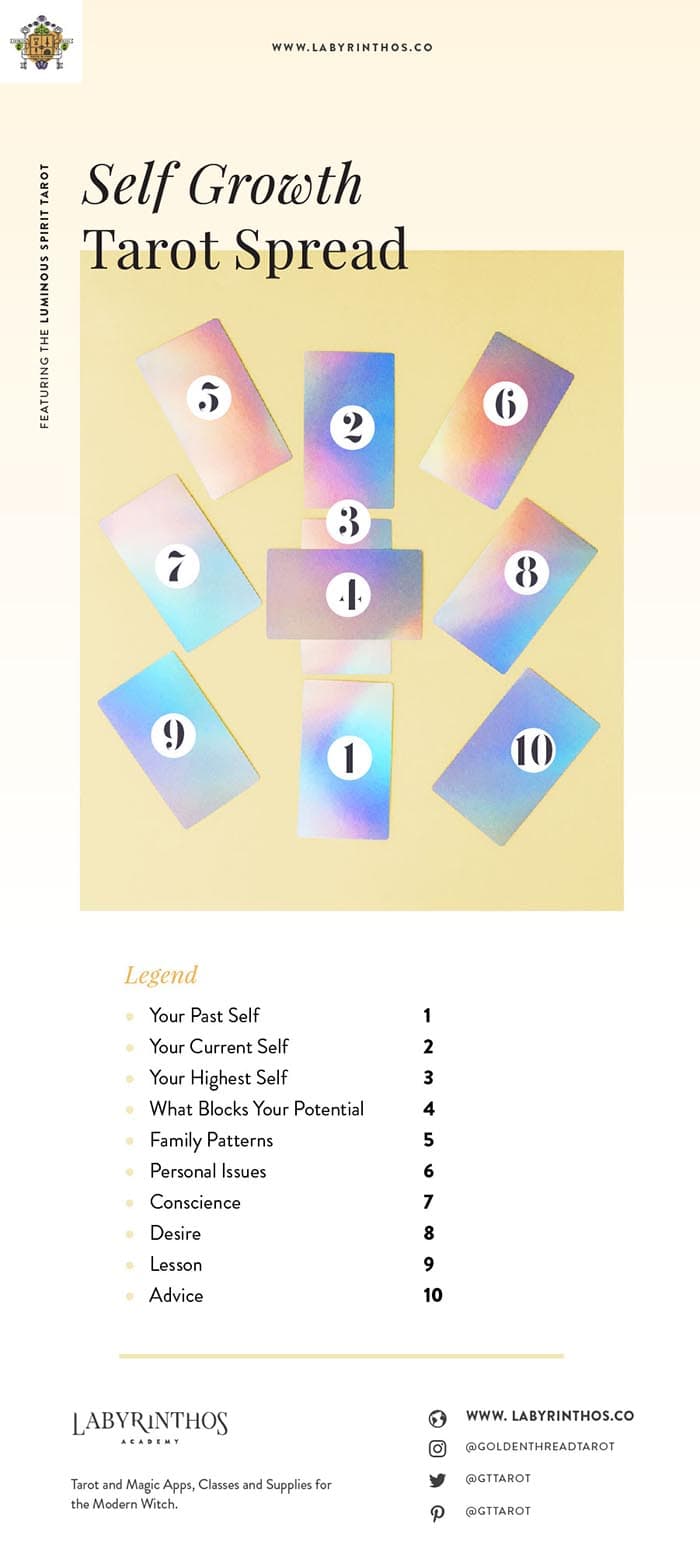
To give you a glimpse of where we're heading, take a look at the image below. This is a "Self Growth Tarot Spread."