Hello! Welcome to the final lesson of our first module, "Tarot Fundamentals."
In our last three lessons, we've built a complete theoretical blueprint of a tarot deck. You've learned to distinguish between the Major and Minor Arcana, explored the four suits and their elemental connections, and unpacked the narrative roles of the numbered and Court Cards.
Today, we'll use that foundation for a very important and personal task. Our learning outcome is to select an appropriate tarot deck for personal practice based on art style and symbolism. Think of this as choosing your primary tool. Just as a lawyer selects specific legal texts for their clarity and relevance, a tarot reader chooses a deck that speaks to them and facilitates insight. This choice is a key step in preparing you for the practical work of reading the cards, which we will begin in the next module.
The Three Main Tarot "Systems"
While there are thousands of tarot decks, most of them fall into one of three major traditions or "systems." Understanding these systems is the first step in making an informed choice. The main difference between them lies in how the Minor Arcana are illustrated.
Let's watch a video that introduces and compares the three most influential systems: the Rider-Waite-Smith, the Tarot de Marseille, and the Thoth Tarot.
Rider-Waite-Smith vs. Thoth vs. Marseille vs. Lenormand - What's the difference?
The video 'Rider-Waite-Smith vs. Thoth vs. Marseille vs. Lenormand' from the Angie Green Tarot channel offers an excellent overview of the key differences. We will focus on the three main tarot systems.
Please watch the segments covering the three systems from 01:35 to 09:51. As you watch, pay close attention to the descriptions of the Minor Arcana cards in each system and the overall 'feel' or complexity of the deck.
To summarize the key distinctions you saw in the video:
-
The Rider-Waite-Smith (RWS) System: This is the most popular system in the English-speaking world. Its defining feature, revolutionary for its time (1909), is that all 78 cards, including the Minor Arcana, have full pictorial scenes. These images tell a story, making the card meanings easier to learn and interpret intuitively. For this reason, it is almost always the recommended system for beginners.
-
The Tarot de Marseille System: This is an older tradition, and its decks often have a historic, woodcut feel that may appeal to your interest in history. However, its Minor Arcana numbered cards are not illustrated with scenes. Like playing cards, the Four of Cups simply shows four cups. This means interpretation relies more heavily on numerology and abstract pattern recognition, which can be challenging for a beginner.
-
The Thoth System: Developed by the occultist Aleister Crowley, this system is visually and symbolically dense. The artwork is abstract and packed with complex astrological, alchemical, and Kabbalistic symbolism. While powerful, the meanings are often less direct and narrative than in the RWS system, making it better suited for more advanced students.
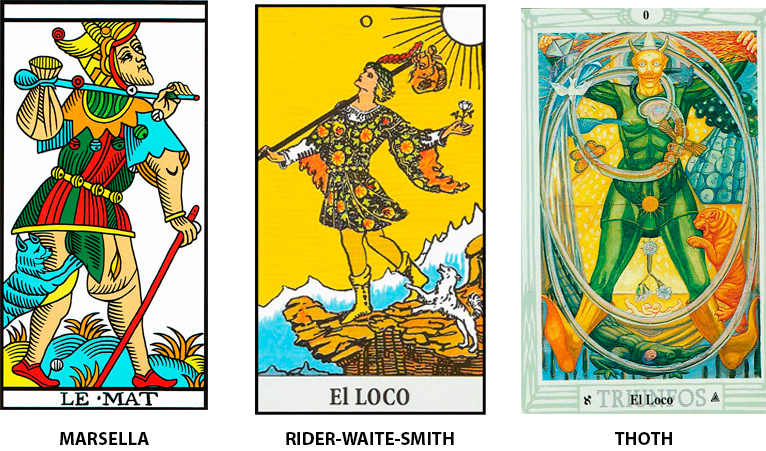
For your goal of learning tarot for practical self-reflection, a deck based on the Rider-Waite-Smith system is the most direct path. The narrative images provide immediate entry points for interpretation, which will help you build confidence and a personal connection to the cards.
Exploring the Rider-Waite-Smith Family
Within the RWS system, there's a huge variety of choice. We can group these decks into three categories. The following video gives a great visual tour of these categories.
How to Choose Your First Tarot Deck | Beginner’s Guide 🔮✨
In 'How to Choose Your First Tarot Deck' from The Tarot Shop UK, the presenter clearly walks through the different types of RWS-style decks available.
Please watch from the beginning until 07:29. Notice the distinction she makes between 'clones' (same art, different color) and 'RWS-based' decks (same scenes, different theme/art).
As you just saw, the RWS family includes:
- The Original RWS Deck: The classic 1909 deck illustrated by Pamela Colman Smith.
- RWS "Clones": These decks use Smith's original line art but are re-colored or given a different texture (e.g., Radiant Wise Spirit Tarot, Universal Waite Tarot). The underlying symbolism is identical.
- RWS-Based or "Inspired" Decks: This is the largest category. These decks follow the RWS structure and card meanings but are re-imagined with a different artistic style or theme (e.g., cats, witches, sci-fi, art deco). The scenes are recognizable but rendered in a new way. The Light Seer's Tarot and Everyday Witch Tarot are popular modern examples.
This means you can choose a deck that uses the beginner-friendly RWS system but also has an art style that you personally find beautiful and inspiring.
A Practical Guide to Choosing Your Deck
Now that you understand the landscape of tarot decks, how do you choose the one that is right for you? The most important factor is personal connection. A deck is a tool for dialogue with yourself; you should choose one that you feel drawn to and will enjoy using.
The following article provides a superb, step-by-step framework for making this choice. It is quite comprehensive, so we will focus on the core principles.
How to Choose The Right Tarot Deck For Yourself
The article 'How to Choose The Right Tarot Deck For Yourself' by Athena Man on Medium is an excellent, practical guide that covers the key considerations when selecting a deck.
Please read the article starting from the heading '#1 Tarot System' to the end. The author breaks the process down into four key considerations: System, Theme, Clarity, and Style. As you read, think about your own preferences in art and symbolism.
Let's synthesize the excellent points from that article into a checklist you can use.
Your 4-Point Checklist for Choosing a Deck:
-
System: As we've discussed, starting with a Rider-Waite-Smith based deck is highly recommended. This ensures you'll have a wealth of learning resources available and that the imagery will directly support your learning process.
-
Theme & Art Style: This is where your personal taste is paramount. Do you prefer modern art, classical paintings, or cartoons? Are you drawn to nature, mythology, history, or fantasy? The article showcases a vast array of themes. A theme that resonates with you will make the symbolism more potent and the readings more engaging.
-
Clarity: A beautiful deck that doesn't "speak" to you won't be a useful tool. When you look at images of a deck online (Pinterest and YouTube "walkthrough" videos are great for this), ask yourself the questions from the article:
- What is my immediate reaction to the cards?
- Do the images trigger ideas, feelings, or stories?
- Or do they leave me feeling blank and confused?
Trust your gut feeling. A good deck for you is one whose visual language you find clear and expressive.
-
Practicality: Don't forget the physical aspects of the deck!
- Size: Standard tarot cards are about 2.75" x 4.75". If you have smaller hands, you might prefer a "pocket" or "travel" edition.
- Cardstock: Do you prefer a glossy finish or a matte one? Thicker cardstock tends to be more durable.
- Guidebook: Does it come with a guidebook? Is it a small paper insert or a more substantial book? This can be very helpful when you're starting out.
Test your understanding!
Imagine you are looking at two RWS-based decks online.
- Deck A has stunning, abstract, minimalist artwork that you find very beautiful, but when you look at the Five of Swords, you can't figure out what story it's telling.
- Deck B has a pleasant, cartoony art style that is less "fine art" but not unappealing. When you look at its Five of Swords, you immediately see a character slinking away from two dejected figures, and the theme of a hollow victory clicks instantly.
Based on the criteria of Clarity, which deck would likely be a better choice for you as a beginner?
Show answer
Deck B would likely be the better choice. While Deck A may be more aesthetically pleasing in one sense, its lack of clear, narrative imagery (Clarity) would make it much harder to learn with. The primary goal for a first deck is for it to be an effective learning tool. Deck B, whose images clearly communicate the traditional card meaning, would serve this purpose far better. You can always acquire the more abstract Deck A later, once you have mastered the fundamentals.
Conclusion and Next Steps
This lesson concludes our "Tarot Fundamentals" module. You now have a complete map of the territory: you understand the deck's structure, the roles of all its components, and you have a clear framework for choosing the deck that will be your partner in this practice.
Key Takeaways:
- Most tarot decks belong to one of three systems: Rider-Waite-Smith (RWS), Marseille, or Thoth.
- The RWS system, with its fully illustrated Minor Arcana, is the recommended starting point for beginners.
- There is a vast family of RWS-based decks, allowing you to find a style and theme that you personally connect with.
- Choosing a deck is a personal process guided by four key factors: System, Theme, Clarity, and Style.
A Note on Buying Your Deck: There's no rush to buy a deck immediately. Take your time exploring online. Look at blogs, watch review videos, and see what calls to you. For the next several lessons, the images of the classic RWS cards will be provided, so you'll have everything you need to start learning the meanings.
This brings us to our next module, "The Fool's Journey: Major Arcana Part I." Now that our foundational work is complete, we will dive right into interpreting the cards. In our next lesson, we'll begin by exploring the powerful narrative concept of the Fool's Journey and start learning the meanings of the first three cards: The Fool (0), The Magician (I), and The High Priestess (II).