Hello! Welcome to the last lesson of our "Foundations of Tarot Reading" module.
In our previous lesson, you mastered the art of weaving the meanings of individual cards into a single, cohesive story. You took the three chapters of a Past-Present-Future spread and created a narrative that offered insight and advice. This was the final step in conducting a complete reading.
Today, we address a crucial part of building a sustainable and meaningful tarot practice. Our focus is on how to capture, learn from, and build upon the insights you receive. The learning outcome for this lesson is to record and reflect on readings in a tarot journal to track patterns and personal growth.
A journal is more than just a diary; it's your personal database, a case file of your journey with the cards. For someone with a background in law, you'll likely appreciate the structured process of recording evidence (the cards and your interpretations) and reviewing it over time to identify patterns and build a stronger case for your intuition.
1. Why Keep a Tarot Journal?
Before we get into the "how," let's establish the "why." A tarot reading can provide powerful insights, but they are often fleeting. A journal anchors these insights, transforming them from a single event into an ongoing conversation that deepens over time.
To start, let's explore the core benefits of this practice.
How to Keep a Tarot Journal (Without Overcomplicating It)
The article 'How to Keep a Tarot Journal' by Tarot with Gord clearly outlines the practical advantages of journaling. It frames the journal as a tool for accelerated learning and self-awareness.
Please read the section titled 'Why Bother With a Tarot Journal?'. As you read, notice how journaling helps you: Remember Your Readings: To avoid losing valuable insights. Learn Tarot Faster: By building a personal library of meanings. Notice Patterns Over Time: To understand recurring messages. Turn Insights into Action: To make your practice a tool for transformation.
Beyond these practical benefits, journaling also cultivates a deeper, more intuitive connection with your cards. The following short video offers a personal perspective on this.
How To Start a Tarot Journal (part one)
In 'How To Start a Tarot Journal (part one),' creator Dawn Michelle shares what her journal does for her practice. This will give you a feel for the more personal, reflective side of journaling.
Please watch from 00:11 to 01:33. Notice how she describes her journal as a space to 'gain perspective,' 'cultivate intuition,' and 'connect with my authentic self.'
2. The Anatomy of a Journal Entry
Now that we understand the purpose, let's establish the practice. A consistent structure for your entries will ensure you capture all the essential information for later reflection. Think of this as the standard format for filing a report on each reading.
The following resources provide a clear, practical list of what to include.
Tarot Journaling: What to record
The article 'Tarot Journaling: What to record' by Theresa Reed (The Tarot Lady) provides a fantastic, no-nonsense checklist of what to include in each entry.
Read the numbered list from 1 to 10. This gives you a concise breakdown of the key components of a thorough journal entry.
Combining the key points from that list and other best practices, here is a reliable structure for every tarot journal entry:
-
The Context:
- Date and Time: Essential for tracking events.
- Your Question: What prompted the reading? Be specific.
- The Deck & Spread: Note which deck you used and the name of the spread (e.g., "Past-Present-Future").
-
The Data:
- Cards Drawn: List each card and its position in the spread.
-
The Initial Analysis:
- First Impressions: Before looking up any meanings, what was your gut reaction? What did you notice in the imagery? This is a crucial step for developing intuition.
- Detailed Interpretation: This is where you write out the synthesized narrative you learned to create in our last lesson. Connect the cards and tell the story.
-
The Conclusion:
- Key Takeaway / Actionable Step: What is the single most important message or piece of advice from this reading? What will you do with this information?
- Space for Future Reflection: Leave a small section at the bottom of the entry to add notes a few weeks or months later. This is where you can write "Looking back, this reading was about..." or "This is how the situation resolved."
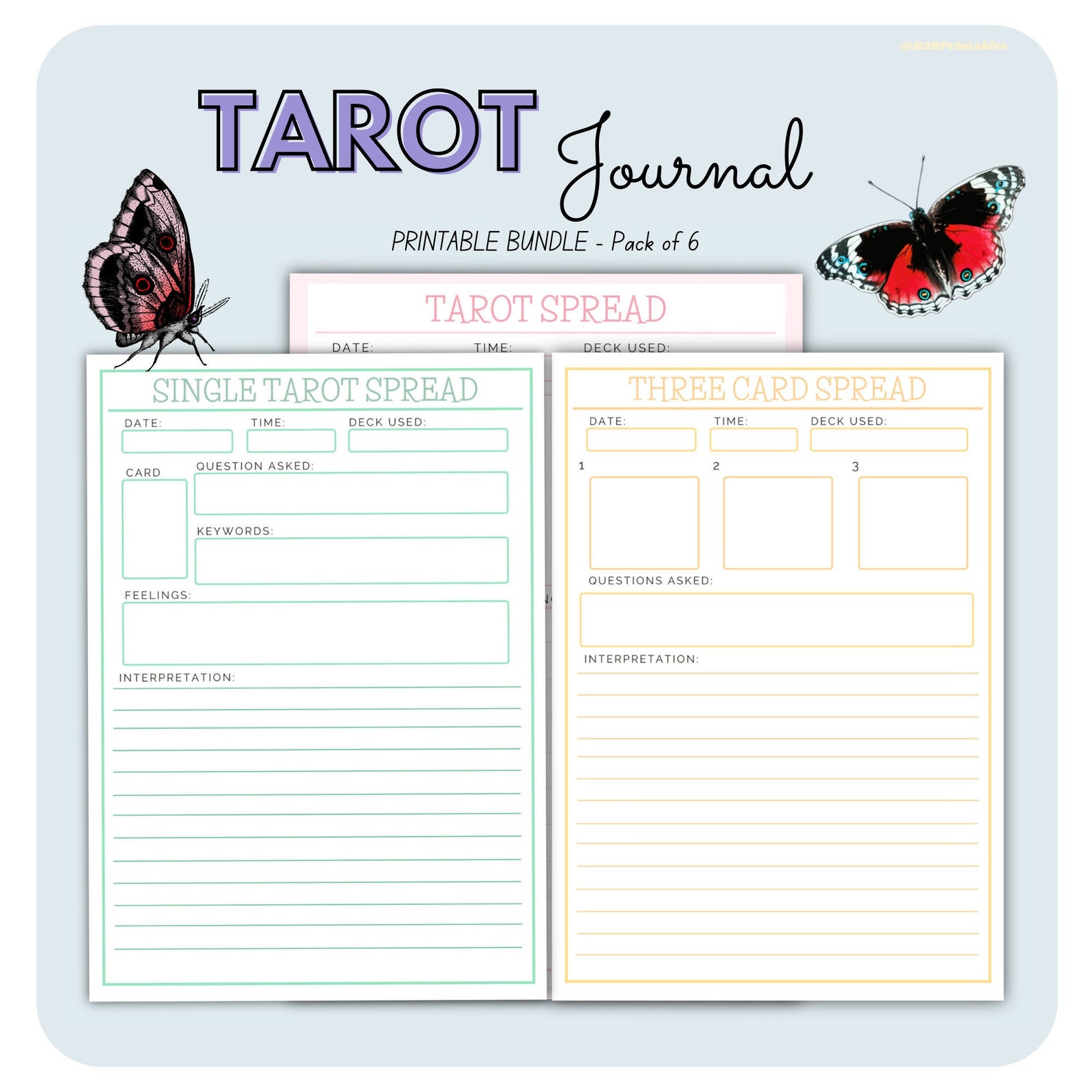
Here are a couple of examples of how these elements can be laid out on a page. These are just templates; your own journal can be as simple or creative as you like.

Test your understanding!
You've just done a reading but are short on time. Which two elements of a journal entry are the absolute most critical to jot down so you don't lose the core of the reading?
Show answer
The Question Asked and the Cards Drawn. With this core information, you can always go back later to reconstruct your interpretation. Without the question, the cards have no context, and without the cards, you have no data.
3. Choosing Your Journaling System
With a clear idea of what to record, the next question is where to record it. There is no single "best" way; the ideal system is the one you will actually use. The main choice is between a physical and a digital journal. The article from Tarot with Gord that you looked at earlier has an excellent summary of the pros and cons under the heading "Paper vs. Digital Tarot Journals."
Beyond that, you can also consider different types of journals. Some people have one book for everything, while others maintain a whole "ecosystem." The following video explores several common approaches.
How To Start a Tarot Journal (part one)
Let's return to the 'How To Start a Tarot Journal' video. This segment explores different categories of tarot journals you can keep.
Please watch from 03:33 to 14:28. The creator discusses: Reading Journal: A simple log of your readings. Practice Journal: Combines tarot with other spiritual or personal growth practices. Deck Study Journal: For in-depth exploration of a single deck. Commonplace Journal: A catch-all book for everything. Pay close attention to her description of the commonplace journal. She recommends this as an excellent, low-pressure way to start, which I think is great advice.
For a beginner, starting with a simple Reading Journal or a Commonplace Journal is perfect. You can use any simple notebook or a digital document. The key is to start, not to find the perfect system first.
As you become more advanced, your system might evolve. The creator Tarot Magpie, for example, uses a multi-book "ecosystem." In her video "My tarot journal ecosystem," she shows a small notebook just for her one-card daily draws and a larger, flexible planner for more in-depth readings. This is a good example of how a practice can be adapted to fit different needs over time.
4. The Practice of Reflection: Tracking Growth
Your journal is a living document. Its greatest power is unlocked when you revisit it. Regularly reviewing past entries is how you track patterns and measure personal growth.
The article "How to Keep a Tarot Journal" offers great advice on this.
How to Keep a Tarot Journal (Without Overcomplicating It)
We'll consult the Tarot with Gord article one last time to focus on the long-term use of your journal.
Please read the section titled 'What to Do With Your Tarot Journal Over Time'. Focus on the practices of: Revisiting Past Readings: Looking back after a few months to see how events unfolded. Looking for Repeating Cards & Themes: Identifying messages the universe might be emphasizing.
Set a reminder for yourself to flip through your journal once a month or once a quarter. As you review, ask yourself:
- How accurate was my interpretation in hindsight?
- Did the actionable steps I wrote down lead to any changes?
- What patterns am I seeing? Am I repeatedly asking about the same topics or pulling the same cards? This is valuable evidence about your current life lessons.
5. Your Turn: Create Your First Entry
It's time to put this into practice. Take the three-card reading you interpreted in the last lesson. We are going to create your very first journal entry.
- Choose a medium. For now, just grab a blank sheet of paper, open a new Word document, or use a notes app. Don't worry about the long-term format yet.
- Title the entry with today's date.
- Write down your question for that reading.
- List the three cards you drew in their positions: Past, Present, and Future.
- Write your interpretation. Take the final narrative you crafted in the last lesson and write it down.
- Summarize your key takeaway. What was the single most important piece of advice from that reading?
- Leave space at the bottom and label it "Future Reflection."
That's it! You've just created a permanent record of your insight, ready to be revisited for deeper learning in the future.
Conclusion
Congratulations on completing the "Foundations of Tarot Reading" module! You now have a complete, foundational skillset: you can set an intention, ask a question, draw cards, interpret them individually, synthesize them into a story, and document your findings for future growth.
Key Takeaways:
- A tarot journal is a vital tool for remembering readings, learning faster, tracking patterns, and turning insights into action.
- A structured entry should include the date, question, cards, your interpretation, and an actionable takeaway.
- Start with a simple system (like a basic notebook or digital doc) that you will use consistently; you can always evolve it later.
- The real power of journaling comes from periodically reviewing past entries to reflect on your journey and identify recurring themes.
Preview of the Next Lesson:
With these foundational skills in place, you are ready to expand your practical toolkit. In our next module, "Intermediate Interpretation Techniques," we will begin by exploring new spreads for specific situations. Our first lesson will focus on how to Perform a decision-making spread (e.g., 'Two Paths') to compare potential choices. This will give you a powerful method for gaining clarity when you're at a crossroads.