Last lesson explained why clinicians use fluids to support the kidneys during rhabdomyolysis, and why the amount must be adjusted to the person’s response. Recovery requires the same kind of reassessment. Feeling better matters, but it does not show on its own whether muscle injury is subsiding or kidney function and electrolytes are safe.
This final lesson looks at how symptoms and repeat tests guide follow-up, why activity resumes in stages, and why no single return-to-exercise date fits everyone. Allow about 35–40 minutes for the readings and lesson.
Recovery is a pattern, not a single result
After exertional rhabdomyolysis, clinicians look for several changes together: muscle pain, swelling, and weakness improve; creatine kinase (CK), a blood marker of muscle injury, falls on repeat testing; kidney-function results remain stable or improve; and concerning electrolyte abnormalities resolve. A clinician may also repeat a urine test as part of a follow-up protocol.
These measures answer different questions. CK helps track muscle injury, while creatinine helps assess kidney function. Someone may feel substantially better while CK is still elevated. Conversely, a CK result that is falling does not, by itself, establish that the kidneys and electrolytes are safe. Comparing results over time is therefore more informative than treating one number—or one good day—as clearance to train.
The following guideline describes what a reassessment can involve. It was written for a military population; its follow-up intervals and numerical cutoffs are examples of a clinical protocol, not instructions for self-monitoring or universal return-to-sport rules.
Clinical Practice Guideline for the Management of ER
Read the guideline’s follow-up advice to see how clinicians combine symptoms, repeat blood tests, and complications when deciding whether recovery can continue outside hospital. Its recurrence-risk section shows why slow recovery may call for further evaluation.
Immediately before Section 11, “Profile and Follow-up,” begin with the paragraph that describes a follow-up evaluation within 24–72 hours. Read the reassessment guidance, paying attention to what happens if symptoms or results worsen. Then read Section 11, “Profile and Follow-up,” from its opening discussion of restricted activity through its recommendation for supervised reconditioning. In “Recurrence Risk Stratification at 2 weeks from Date of Injury,” read the first high-risk markers. Focus on the principle that persistent symptoms, CK elevation, or kidney impairment change the follow-up plan; the listed thresholds are specific to this guideline.
The distinction between a scheduled check and a reason to seek help sooner is important. Follow-up is not permission to ignore deterioration in the meantime. Worsening muscle pain or swelling, marked weakness, dark or reduced urine, or new concerning symptoms need prompt medical reassessment. Confusion or collapse calls for emergency care.
Why activity returns in stages
Rest during the early recovery period prevents another strenuous bout from adding to injured muscle. Once a clinician judges that recovery is progressing safely, a return usually starts with light activity, not an attempt to regain missed training. The next step depends on how the person responds: returning pain, swelling, or weakness is a reason to pause and be reassessed rather than push through.
The guideline’s appendix makes those decisions visible. Read it as an illustration of conditional progression: a phase lasts longer when its conditions have not been met.
Clinical Practice Guideline for the Management of ER
The appendix lays out a staged return for selected lower-risk people. Read it to notice which repeat-test findings and symptoms permit progression, and what happens when they do not.
On printed p. 15, find “Appendix 1. Return to Duty Guidelines for Physiologic muscle breakdown and Low Risk Warfighters with Exertional Rhabdomyolysis.” Read Phases 1, 2, and 3, beginning at the three phases; stop before “Algorithm II. Inpatient Management of Acute Exertional Rhabdomyolysis.” Focus on the repeat checks in Phase 1 and the absence of significant muscle symptoms required before regular training. Do not adopt the phase durations or CK cutoff as a personal exercise plan.
Notice that even this structured protocol is not simply a timetable. A follow-up test that remains abnormal can extend the restricted phase. Light activity is followed by a check for returning symptoms before more demanding activity. Supervision can help tailor the pace, especially when the initial episode was severe or recovery is uncertain.
There is also a difference between being well enough to leave hospital and being ready for strenuous exercise. A person may no longer need hospital treatment yet still need rest, repeat tests, and a restricted-activity plan.
Why there is no universal “safe after X days” rule
Clinical advice on returning to sport is not identical across sources. A review of exertional rhabdomyolysis notes that evidence-based return-to-activity guidelines are lacking and describes a more conservative expert approach: wait until symptoms have resolved and CK has normalized before restarting with light activity. Compare that with the staged, test-dependent protocol you have just read. Their details differ, but their shared principle is that time elapsed alone does not establish recovery.
Exertional rhabdomyolysis: physiological response or manifestation of an underlying myopathy?
Read the review’s return-to-sport discussion to compare expert advice with the staged guideline above. Focus on what must improve before exercise resumes and how activity increases afterward.
In “Step 4: when and how to recommence exercise and sporting activities?”, read the opening discussion from the evidence and advice. Then find the box “Guideline to restart exercise and sporting activities.” Under “Patients without suspicion of a genetic disorder,” read the gradual-return advice. You can stop before the separate advice for people with a suspected genetic disorder.
The flowchart below depicts another conservative approach: avoid exercise until symptoms have gone and CK is normal, then return gradually. It also shows why recurrent episodes or persistently elevated CK can lead to further investigation rather than an automatic training date. Its one-month recommendation is one published approach, not a deadline that overrides an individual clinician’s plan.
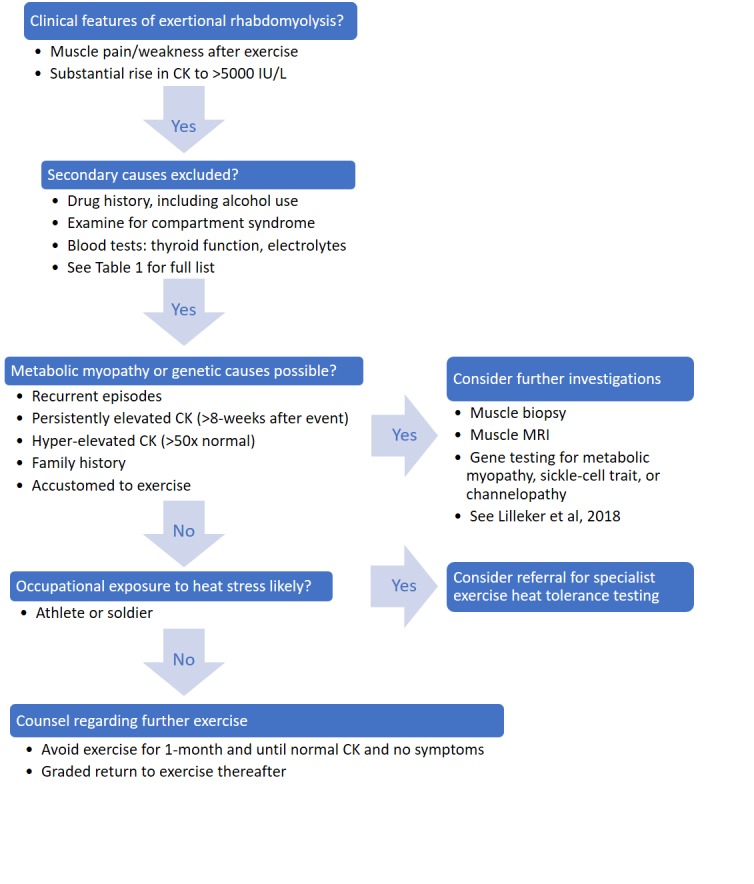
In practical terms, a clinician-supervised plan accounts for the severity of the episode, kidney and electrolyte results, how quickly symptoms and CK improve, and whether there are reasons to investigate an underlying susceptibility. It also accounts for what “return” means: an easy activity and a repeat of the workout that caused the injury are not equivalent demands on recovering muscle.
Key takeaways
Recovery is judged by improving symptoms together with repeat results, particularly the trend in CK and the state of kidney function and electrolytes. Feeling normal, having normal-looking urine, or reaching a date on the calendar cannot replace those checks. Once it is safe to resume activity, progression begins gently and depends on continued improvement; symptoms that return or results that remain concerning may delay it and prompt further assessment.
That completes the course’s path from muscle injury and kidney risk through recognition, treatment, and recovery. The central safety principle throughout is the same: suspected rhabdomyolysis needs clinical assessment, and the response should be guided by what the person and the tests show—not by symptoms or a fixed timetable alone.