Last time, you followed myoglobin from injured muscle into the kidney and saw how reduced blood flow can compound its effects. The next question is why a bout of exercise sometimes produces much more muscle injury—or greater kidney risk—than expected.
This lesson separates what raises the chance of muscle breakdown from what can worsen its consequences. The distinction matters: heat, dehydration, illness, medications, and individual susceptibility can overlap, but they do not all act in the same way. Allow about 35–40 minutes, including the two focused readings.
The workout is a dose relative to the person doing it
Exertional rhabdomyolysis is not limited to one sport or to people who are unfit. A central risk is a sudden mismatch between muscular demand and what the muscles are accustomed to handling. An intense first session, a sharp increase in repetitions, heavy work after a break, or repeated hard sessions with little recovery can all create that mismatch. A workload that is routine for one person may be unusually demanding for another.
The type of contraction matters, too. During an eccentric contraction, a muscle produces force while lengthening—for example, the thigh muscles controlling a downhill run or lowering a weight. Large amounts of unfamiliar eccentric work can cause substantial muscle damage. That does not mean downhill running or weight training normally causes rhabdomyolysis; it means novelty, volume, and intensity deserve attention together.
The infographic offers a useful starting distinction. Its two routes are exercise beyond usual limits and exercise in a person with increased susceptibility. Its lower row shows factors that may be present alongside either route.
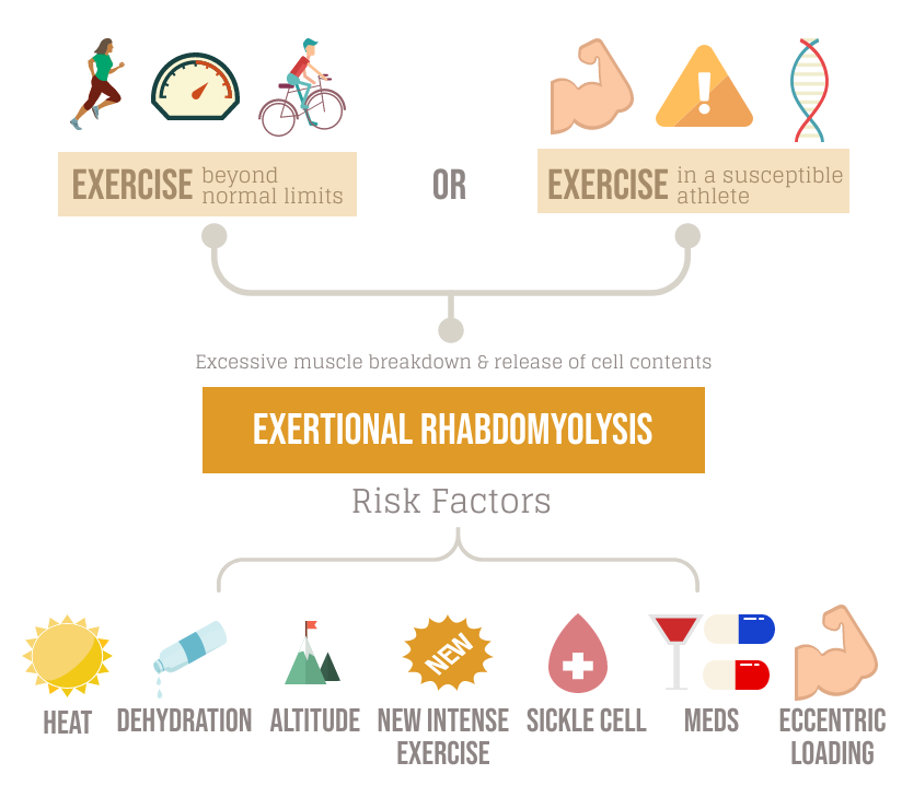
Notice that the graphic does not require every listed factor to be present. Rhabdomyolysis can occur without heat or dehydration, including after unusually demanding exercise indoors. Conversely, having a risk factor does not mean muscle breakdown will occur.
For a fuller account of how exercise demands combine with other circumstances, read the short cause-and-risk discussion in Exertional Rhabdomyolysis: An Underappreciated Concern in the Fire Service. Although the examples concern physically demanding work, the principles apply more broadly to strenuous exercise.
Exertional Rhabdomyolysis: An Underappreciated Concern in the ...
Read this discussion for its distinction between workload, individual circumstances, and environment. Focus on combinations of factors rather than treating any one item as a guaranteed cause.
On p. 3, in “What Causes or Exacerbates Exertional Rhabdomyolysis?”, read from the sentence beginning “ER is often caused by a combination” through the sentence ending “prevention and early detection efforts of ER”: causes and combinations. On p. 4, under “Types of risk factors,” read “Operational risk factors” and “Individual risk modifiers,” from “Operational risk factors include strenuous or prolonged operations” through “workload or training exceeds the physiological capabilities of the muscles”: workload and individual factors. Then read “Environmental risk modifiers,” from “Environmental risk modifiers include conditions or scenarios” through the concluding point that risk rises when muscular demand coincides with thermal strain and susceptibility: environmental factors.
The reading’s three categories are a way to organize a real situation, not separate boxes. A person returning from time off might perform an unfamiliar high-repetition workout while recovering from an illness, in a hot room. The workout places unusual demands on muscle; illness and heat can add strain. Looking only at the exercise—or only at the temperature—would miss the combination.
Heat and dehydration: related, but not identical, risks
Heat stress can arise from hot or humid weather, clothing that limits cooling, or sustained exertion that generates more heat than the body can readily shed. Overheating adds physiological strain and, in severe heat illness, can itself be associated with muscle and other organ injury. Heat also makes a demanding workout harder to tolerate. It is therefore more than a detail about the weather.
Dehydration means a shortfall in body water, often involving fluid lost through sweat. Its particular importance here is the kidney connection from the previous lesson: reduced effective circulating fluid can reduce kidney blood flow while the kidneys are handling material released from injured muscle. Fluid can also shift into extensively injured, swollen muscles. A person can therefore face a circulation problem for more than one reason.
Heat and dehydration often occur together, but neither is a prerequisite for the other. Nor does drinking water make an excessive workload harmless. The sound risk-reduction principle is to keep exercise demands appropriate, allow recovery, and avoid preventable heat and fluid strain—not to try to counter an extreme workout by drinking excessive amounts.
Altitude appears in the infographic as another possible contributor to exertional strain. Like heat, it is best understood in context: environmental conditions matter alongside workload, acclimatization, and individual susceptibility, rather than acting as a stand-alone prediction of rhabdomyolysis.
Illness, medicines, and underlying susceptibility
Recent or current illness can change the setting in which exercise takes place. Some infections can themselves affect muscle; fever, reduced intake, fluid losses, or poor recovery may add strain during exertion. Thus, the same hard session may pose a different risk when someone is ill than when they are well. Illness is a reason to reconsider strenuous exercise, not evidence on its own that rhabdomyolysis has developed.
Medications and other substances need a similarly careful reading. Statins are associated with muscle injury in some circumstances, although most people taking them do not develop rhabdomyolysis. Antipsychotic medicines and stimulants also appear among reported risk factors; stimulants can be especially relevant to exertion and heat. Some antihistamines may add difficulty in hot conditions. The point is not that everyone using one of these medicines must avoid exercise, or should stop a prescribed medicine independently. It is that medication and supplement use belongs in a clinician’s review when someone is planning unusually strenuous activity or is being assessed after it.
One distinction is especially useful: non-steroidal anti-inflammatory drugs (NSAIDs), such as ibuprofen, should not simply be described as a direct cause of exertional rhabdomyolysis. They may allow a person to keep exercising despite pain and can increase concern about kidney injury, particularly when circulation is strained. That is a different claim from saying they necessarily cause muscle-cell breakdown.
The clinical review How to do it: investigate exertional rhabdomyolysis (or not) discusses these distinctions, as well as sickle cell trait and other reported risk factors. Its discussion is written for clinicians, so read it for the pattern rather than trying to calculate a personal risk from its figures.
How to do it: investigate exertional rhabdomyolysis (or not)
Read the “Incidence and risk factors for exertional rhabdomyolysis” subsection for its account of eccentric exercise, heat loss, sickle cell trait, medications, and NSAIDs. Pay particular attention to the difference between factors associated with muscle injury and factors that may worsen kidney outcomes.
In “Incidence and risk factors for exertional rhabdomyolysis,” begin at “Risk factors for greater rises in serum CK after exercise include” and read through the paragraph listing antipsychotic medications and statins, stopping before the sentence about “Monday morning disease”: risk-factor discussion. The opening sentence concerns rises in CK after exercise; a CK rise is not, by itself, the same thing as a confirmed case of rhabdomyolysis.
Some people have a susceptibility that is not obvious from their fitness. Sickle cell trait is one recognized risk factor during strenuous exertion; it is distinct from sickle cell disease. Rare inherited disorders affecting how muscle uses fuel can also make muscle breakdown more likely, sometimes after exercise that seems modest. A prior episode or repeated unexpectedly severe reactions to exercise may prompt clinicians to consider such conditions. None of this makes genetic susceptibility necessary for rhabdomyolysis: an unusually demanding workout can affect someone without a known underlying condition.
Putting the factors together without turning them into a diagnosis
Consider two people doing the same high-repetition session. One has built up to it gradually and has recovered between workouts. The other is doing those movements for the first time after a break, while recently ill and exercising in heat. Their exercise on paper is identical, but their muscle demands and accompanying stresses are not. Fitness can offer some protection through adaptation; it is not immunity when the workload exceeds current capacity.
It helps to keep three questions conceptually separate:
- How much muscle stress is being imposed? Novelty, intensity, duration, eccentric loading, and inadequate recovery all matter.
- What other stresses are present? Heat, dehydration, illness, and some substances can add to the burden.
- What might make the consequences more serious? Reduced kidney blood flow, certain medication exposures, and delayed recognition can matter even when they are not the original cause of muscle injury.
These are ways to recognize higher-risk circumstances, not a score that confirms or rules out illness. A person with several factors may not develop rhabdomyolysis; someone without an obvious factor still can. If severe muscle pain or swelling, marked weakness, dark or reduced urine, confusion, or collapse occurs after exertion, seek urgent medical assessment; confusion or collapse calls for emergency care. Do not wait to see whether every factor on a list applies.
Key takeaways
Exertional rhabdomyolysis becomes more concerning when muscular demand greatly exceeds what is familiar, especially with abrupt increases in intensity or volume, unfamiliar eccentric work, or insufficient recovery. Heat, dehydration, and illness can add strain. Certain medications and underlying conditions can alter susceptibility, while factors such as NSAID use may be especially relevant to the severity of kidney risk. These circumstances often combine, but none is a diagnosis by itself.
Next, the course turns from risk circumstances to recognition: why ordinary post-exercise soreness can overlap with early rhabdomyolysis, and why symptoms—including the absence of dark urine—cannot reliably confirm or exclude it.