Welcome to the fourth lesson of our first module. Having established a strong foundation in German pronunciation, stress, and intonation, it's time to put those skills into practice. This lesson marks your first step into active conversation. Our goal is to learn how to use greetings and farewells appropriate to the time of day and formality level, such as Guten Morgen, Hallo, Tschüss, and Auf Wiedersehen.
In our last session, we explored the rhythm and melody of German. You learned that word stress typically falls on the first syllable (e.g., kommen) and that sentence intonation falls at the end of statements. Today, you'll see how these principles apply directly to the most common phrases you'll use every day in Germany. Think of this as moving from the physics of sound waves to the practical engineering of communication.
Part 1: Your First German Words: Greetings
Every conversation begins with a greeting. In German, the choice of greeting depends on two key factors: the time of day and your relationship with the person you are addressing. While this might seem complex, a few core phrases will cover most of your needs as you start out.
Let's begin with a visual overview of some common greetings you might hear.
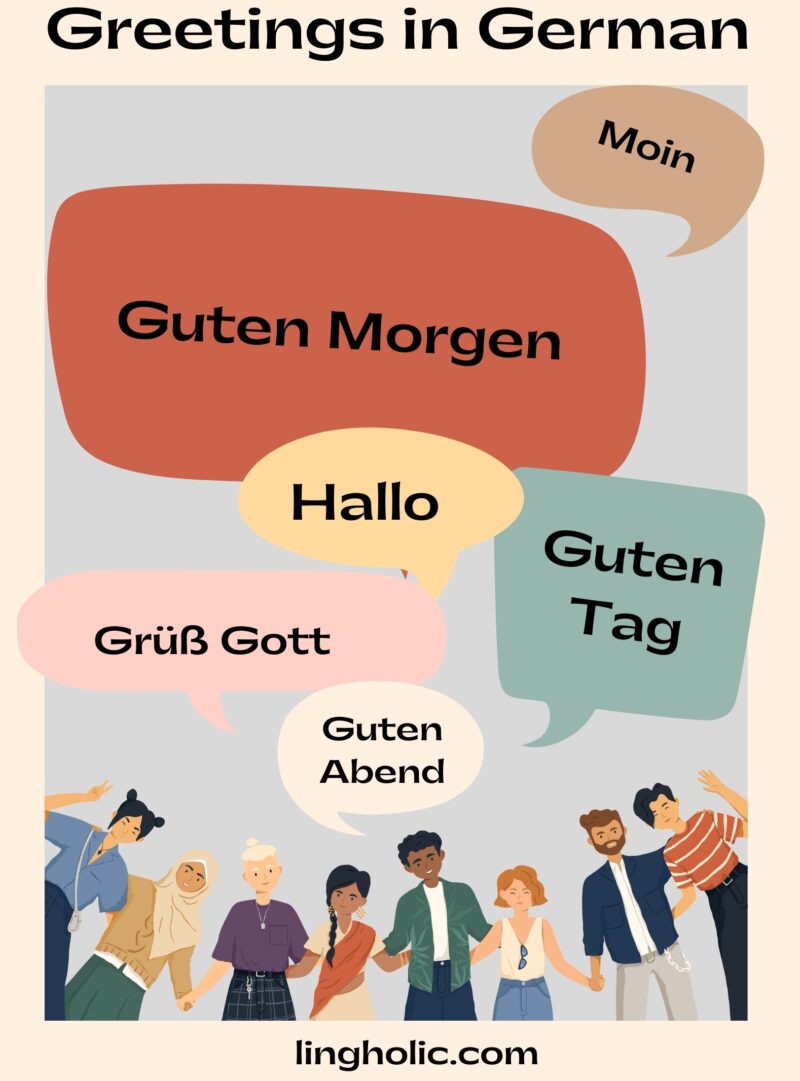
As you can see, there are many ways to say hello. For now, we will focus on the most essential and widely understood phrases.
The Go-To Greetings: Hallo and Guten Tag
If you learn only two greetings, these should be the ones.
- Hallo: This is the universal, all-purpose "hello." It's friendly and can be used at any time of day in most situations, from greeting friends to addressing a cashier in a supermarket. It strikes a good balance between formal and informal.
- Guten Tag: This literally means "Good day." It is the standard, polite, and more formal greeting used during the daytime (roughly from 11 a.m. to 6 p.m.). When meeting a professor, speaking with university staff, or addressing strangers, Guten Tag is always a safe and respectful choice.
Notice the stress pattern, which follows the rule from our previous lesson: **Gu**ten Tag.
To hear these greetings used naturally and to learn their most common farewell pairings, watch the following short clips from the Easy German channel. The speakers use a slow, clear pace perfect for beginners.
Learn Basic German Greetings & Farewells in Slow German | Super Easy German 274
This video provides excellent, real-world examples of the most common greetings and farewells in context.
Watch these two segments to hear the core phrases: First, watch the demonstration of the informal pairing, Hallo and Tschüss, from this section. Next, observe the more formal exchange using Guten Tag and Auf Wiedersehen from this part. Pay attention to how the speakers' tones differ between the informal and formal scenarios.
Part 2: Being Precise: Greetings by Time of Day
While Hallo is versatile, using a time-specific greeting shows more nuance and is very common in Germany. The structure is simple: Guten (Good) + [Time of Day].
- Guten Morgen: "Good morning." Use this from when you wake up until mid-to-late morning (around 10 or 11 a.m.).
- Guten Tag: "Good day." As we've seen, this is for the main part of the day.
- Guten Abend: "Good evening." Use this from around 6 p.m. onwards.
It's important to note Gute Nacht ("Good night"). This phrase is used only right before going to bed or leaving for the night, much like its English equivalent. It is a farewell, not a greeting.
The following resource provides a clear summary of these time-based greetings.
German Greetings: Learn Hello, Good Morning And More For A1 Level
This article clearly lays out which greetings to use during which parts of the day.
Please read the section German Greetings by Time of Day. Note the approximate time frames given for each greeting.
Part 3: The Formal/Informal Divide (Sie vs. du)
One of the most important cultural and grammatical concepts in German is the distinction between formal and informal address. This will be covered in detail in a later module, but it's crucial for greetings.
- Formal (
Sie): Use formal greetings (Guten Tag,Guten Abend,Auf Wiedersehen) when addressing people you don't know, authority figures (like professors), older people, and in professional or service settings (shops, offices). - Informal (
du): Use informal greetings (Hallo,Tschüss,Hi) with friends, family, children, and fellow students you know.
A crucial rule for your life in Germany: When in doubt, start formal. It is always better to be too formal than too informal. A German will typically invite you to switch to the informal du if they feel it's appropriate.
This article explains the distinction very well and provides practical context.
German Greetings: Learn Hello, Good Morning And More For A1 Level
This resource offers excellent advice on navigating the formal/informal distinction, which is a key part of German etiquette.
Read the sections under the heading Mastering Formal and Informal Hello in German and the "Too Casual Too Fast" point in the "Avoid These Hello Mistakes" section. This will give you a solid framework for choosing the right level of formality.
Part 4: How to Say Goodbye
Just as with greetings, farewells also depend on formality.
- Auf Wiedersehen: This is the standard formal goodbye. Literally, it means "until we see again" (
wieder= again,sehen= to see). It is the appropriate counterpart to Guten Tag. - Tschüss: This is the universal informal "bye." It's friendly, common, and can be used with friends, in shops, and in most everyday situations. It is the natural counterpart to Hallo.
A fascinating and logical distinction arises on the telephone. Since you cannot see the person, Auf Wiedersehen is replaced with Auf Wiederhören ("until we hear again," from hören = to hear). Your work creating audiobooks gives you a unique appreciation for this kind of precise, medium-aware language.
For a clear explanation and pronunciation guide, the "Learn German with Anja" video is excellent.
GERMAN LESSON 1: Learn German for Beginners - German Greetings 🤗
Anja breaks down the formal and informal goodbyes clearly, including the literal meaning of Auf Wiedersehen.
Watch the section from this point where she explains Auf Wiedersehen and Tschüss.
Beyond these two, a couple of other phrases are very common and useful:
- Bis bald: "See you soon."
- Bis später: "See you later" (typically on the same day).
This concise table from the UNA Pressbooks resource is a great summary to have.
1. Section 1-1: Greetings, Introductions, and Farewells
This table clearly lists the most common farewells and their level of formality.
Review the list under the heading Saying Goodbye.
Summary and Practice
Let's consolidate what you've learned. The choice of a greeting or farewell in German hinges on context. Always consider:
- Time of Day: Is it morning, daytime, or evening?
- Formality: Are you speaking to a friend or a professor?
A simple but essential cultural norm is to greet people when entering small, enclosed public spaces like a doctor's waiting room, a small shop, or an elevator. A simple Guten Tag or Hallo is expected and shows good manners.
Now, test your understanding. Based on what you've learned, what would be the most appropriate phrase in each scenario?
| Situation | Your Greeting/Farewell |
|---|---|
| 1. You enter a bakery at 9 a.m. | Guten Morgen |
| 2. You meet a fellow student for coffee. | Hallo or Hi |
| 3. You finish a meeting with your future professor. | Auf Wiedersehen |
| 4. You are leaving a friend's apartment in the evening. | Tschüss or Bis bald |
| 5. You are going to bed. | Gute Nacht |
Conclusion
Congratulations! You have just learned the fundamental phrases for starting and ending a conversation in German. You can now greet people and say goodbye with an awareness of time and social context, applying the pronunciation and intonation skills you've developed.
The key takeaways are:
- Use
HalloandTschüssfor informal, everyday interactions. - Use
Guten Morgen,Guten Tag,Guten Abend, andAuf Wiedersehenfor formal situations. - Always consider the time of day and the formality of the situation.
- When in doubt, always default to the formal option.
You've built the frame for your first conversations. In the next lesson, we will add the next essential piece: introducing yourself. You will learn how to state your name, where you come from, and what you do, allowing you to move from a simple greeting to a genuine, albeit basic, conversational exchange.