In our last lesson, you learned how to introduce yourself by stating your name, origin, and field of study. Now, we will complete that initial conversational sequence by learning how to ask the questions that prompt those answers. This lesson will turn your monologue into a dialogue, enabling you to engage in a simple, two-way exchange with a new acquaintance in Germany.
We'll focus on the essential questions: Wie heißen Sie? (What is your name?) and Woher kommen Sie? (Where do you come from?). A critical part of this is understanding when to use the formal "you" (Sie) versus the informal "you" (du), a distinction that shapes every German conversation.
1. The Art of Address: Formal Sie vs. Informal du
Before we can ask a question, we must decide how to address the other person. German makes a clear distinction between a formal and an informal "you."
- Sie (formal "you"): Used with strangers, people in authority (professors, university staff), older individuals, and in most professional or service contexts. It is always capitalized. This is your default, safe option for nearly all first encounters as a student.
- du (informal "you"): Used with friends, family, children, and peers you know well. In a university setting, students often switch to
duquickly, but it's polite to start withSieunless the context is clearly informal (like a student party).
The image below visualizes this difference. Think of it as choosing the appropriate level of social distance and respect for the situation.
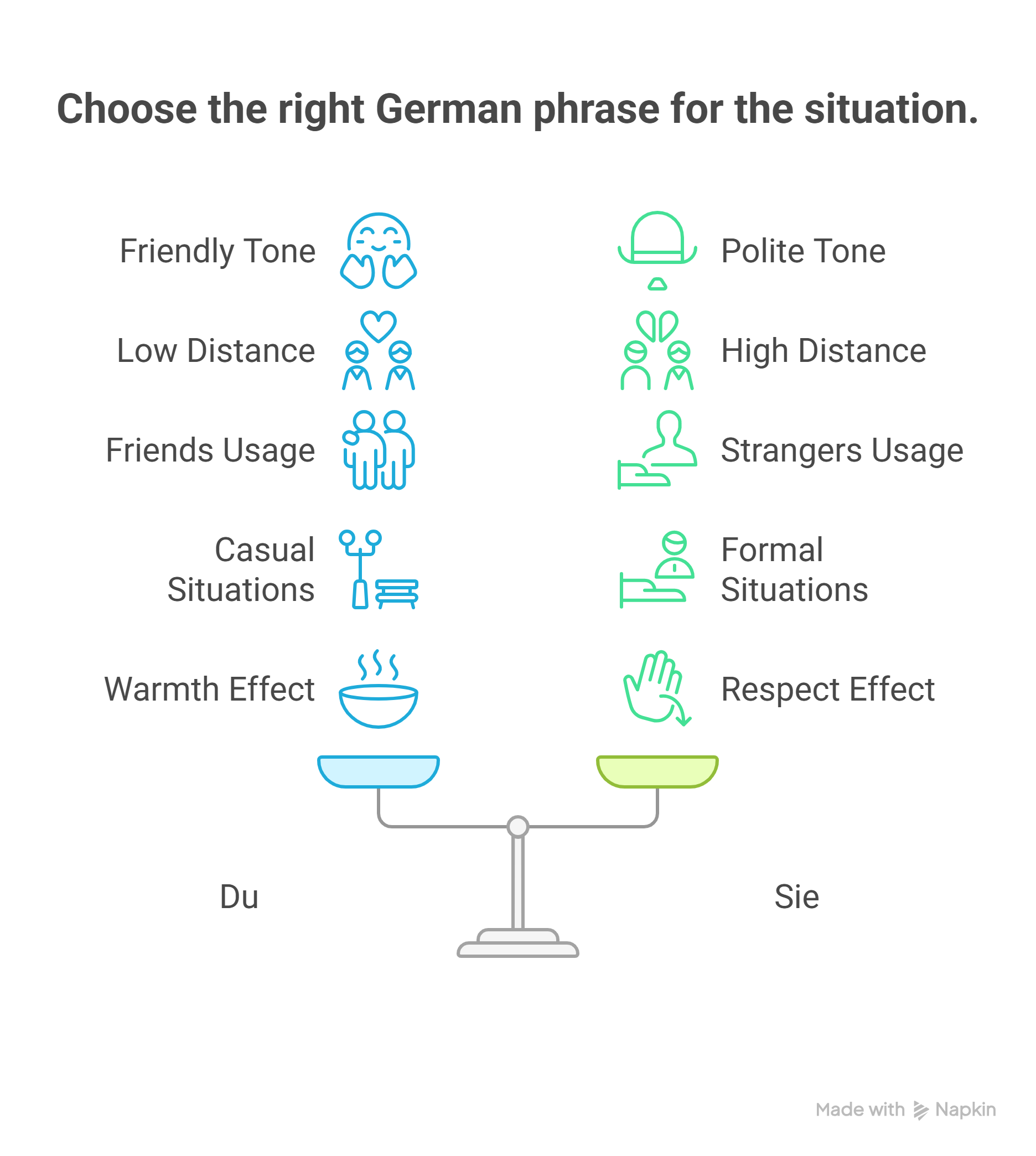
For the remainder of this lesson, we will focus primarily on the Sie form for questions, as it is the most crucial for navigating initial interactions in Germany. We will also introduce the du form so you can recognize it.
2. Asking for a Name: Wie heißen Sie?
In the last lesson, you learned to say Ich heiße.... The corresponding question is Wie heißen Sie?.
Let's break it down:
- Wie? — How?
- heißen — are called
- Sie? — you? (formal)
Literally, this means "How are you called?". This might seem slightly odd, but it's the standard way to ask for someone's name.
The informal version, which you might use with a fellow student you've just met in a casual setting, is Wie heißt du?. Notice the verb ending changes from -en to -t. We'll cover these verb conjugation patterns systematically in Module 4.
The following video provides a clear demonstration of how to ask for and state a name using both formal and informal address.
Learn How to Introduce Yourself in GERMAN - A1 [with Jenny]
This video from the lingoni GERMAN channel clearly demonstrates how to ask for a name formally and informally.
Watch from this segment to hear Wie heißen Sie? and Wie heißt du?. Then continue watching until this point to see the other ways of introducing a name that we covered in the last lesson.
The question word Wie (How) is versatile. You can learn more about its usage in the following article. For now, just focus on its meaning in the context of asking for a name.
Questions in German - Complete Beginner's Guide
This article from "Your Daily German" provides an in-depth look at German question words.
Read the section wie (how) to understand this fundamental question word. Don't worry about the comparison examples for now; just focus on its role in asking "how."
3. Asking for Origin: Woher kommen Sie?
To ask where someone is from, you use the question Woher kommen Sie?.
- Woher? — Where from?
- kommen — come
- Sie? — you? (formal)
The informal version is Woher kommst du?.
The question word Woher is a great example of German linguistic precision. It's a compound of:
- Wo (Where)
- her (indicating origin or movement from a place)
German often uses these small words, hin (to a place) and her (from a place), to be explicit about location and direction. This concept is fundamental to the language. Given your analytical background in physics and data science, you might find this logical structure quite satisfying.
The article from "Your Daily German" explains this distinction beautifully. Understanding this now will build a very strong foundation for later topics.
Questions in German - Complete Beginner's Guide
This section delves into the crucial distinction between location (wo), origin (woher), and destination (wohin).
Read the section titled wo (where). Pay close attention to the explanation of how her is added to wo to specifically ask about origin. This is the logic behind Woher kommen Sie?.
Now, let's see and hear this question in a practical demonstration.
Learn How to Introduce Yourself in GERMAN - A1 [with Jenny]
This clip from the same lingoni GERMAN video will show you how to ask about someone's origin.
Watch the section from this point. The presenter clearly explains the formal Woher kommen Sie? and the informal Woher kommst du?, and gives useful advice on when to use each.
4. Creating a Dialogue
You now have all the pieces for a simple, two-way introduction. A very common and efficient way to return a question is to use Und Sie? (And you?).
Here is a sample formal dialogue:
Person A: Guten Tag. Ich heiße Anna Schmidt. Wie heißen Sie?
(Good day. My name is Anna Schmidt. What is your name?)Person B: Guten Tag. Ich heiße Frank Bauer. Freut mich. Woher kommen Sie, Frau Schmidt?
(Good day. My name is Frank Bauer. Nice to meet you. Where do you come from, Ms. Schmidt?)Person A: Ich komme aus Österreich. Und Sie?
(I come from Austria. And you?)Person B: Ich komme aus Deutschland.
(I come from Germany.)
Let's read a similar dialogue to reinforce these structures.
1. Section 1-1: Greetings, Introductions, and Farewells
This textbook page includes a short, clear dialogue that models a first-time meeting.
Find the section titled Ex. G: Dialogue. Read the conversation between the Frau (woman) and Mann (man). Try to identify the questions and answers we've discussed. (Note: It also includes wohnen (to live), which we've seen but is not our focus today).
Finally, let's watch a complete, slow-paced conversation between two people. This video uses the informal du form, which is what you would likely use when speaking with another student your age after the initial Sie has been dropped.
Learn German Through SLOW German Conversations: Basic German Dialogue for BEGINNERS
This video from Daily Deutsch presents a very slow and clear introductory dialogue, perfect for beginners.
First, watch the conversation with English and German subtitles from the beginning. Focus on the exchange of name (Wie heißt du?) and origin (Woher kommst du?). Then, re-watch the same segment with only German subtitles from this point to test your comprehension.
Conclusion
In this lesson, you've learned to transform a simple self-introduction into a genuine conversation. You can now not only provide information about yourself but also ask for it from others, a foundational skill for any social interaction.
Key Takeaways:
- Formal vs. Informal: Use
Sie(formal) with strangers and in official settings. Usedu(informal) with friends and peers. When in doubt, start withSie. - Asking for a Name: The standard formal question is
Wie heißen Sie?. The informal isWie heißt du?. - Asking for Origin: The standard formal question is
Woher kommen Sie?. The informal isWoher kommst du?. - Dialogue Flow: Use
Und Sie?orUnd du?to efficiently return a question.
You have now completed the first module on basic greetings and introductions! In our next lesson, we will begin Module 2: Nouns, Articles & Basic Descriptions. We'll explore one of the most important concepts in German: grammatical gender. You will learn how to use the articles der, die, and das, which are essential for naming the objects, people, and places around you.