Welcome back! In the previous lesson, we demystified the final reconciliation step you performed in your past role. We saw that checking for perfect alignment between the MBL and HBL totals was a critical quality control measure to prevent costly errors from data entry mistakes, unit conversions, and inconsistent source documents.
Now, we move from the world of data and documents to the physical journey of the cargo itself. Your experience in Panama places you in a unique position to understand this lesson, as you were working within one of the world's most important logistics crossroads. Today, we will explore the concept of transshipment, using the very direct and practical analogy of a connecting flight to explain what it means and why hub ports are so vital to global trade.
What is Transshipment? Your Cargo's Connecting Flight
In an ideal world, every shipment would travel on a single vessel directly from its port of origin to its final destination. In reality, this is often not possible or economical, much like how you can't always find a direct flight to every city you want to visit.
Transshipment is the process of unloading cargo from one vessel and loading it onto another at an intermediate port (a "hub") to complete its journey.
Think of it exactly like booking a flight from a smaller city, say, Nashville, to an international destination like Frankfurt.
- You would likely fly from Nashville to a major hub airport like Chicago or New York.
- In the hub, you get off the first plane, and your baggage is transferred.
- You then board a second, larger plane that flies you across the Atlantic to Frankfurt.
Your cargo does the same thing. It takes a "connecting flight" on a different vessel.
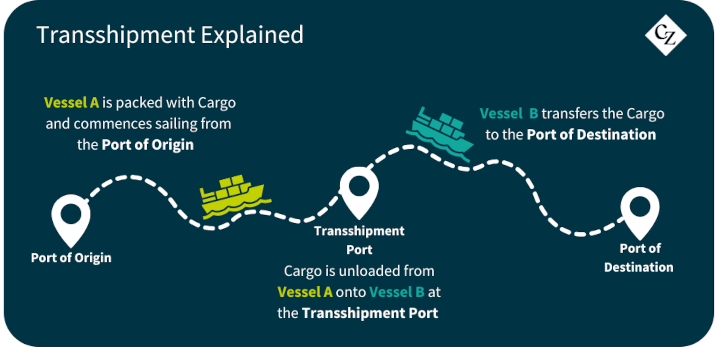
To get a more formal definition, let's watch a short video that breaks down the basics.
About Transshipment of Ocean Transportation. Explaining congestion of Hub Port.
This video from "Logistics YouTuber - IINO san" provides a clear, concise definition of transshipment and contrasts it with a direct shipment.
Please watch from the beginning of the definition at 00:58 to 01:18 to understand the fundamental difference. Then, continue watching the next segment from 01:38 to 02:16, which discusses the trade-offs: transshipment can offer lower freight rates but comes with longer transit times and increased risks of delays or damage.
The Role of the Hub Port: The "Chicago O'Hare" for Cargo
The intermediate port where cargo is transferred is known as a transshipment hub. These hubs are the lynchpins of the global shipping network. Just as airlines build their networks around major hub airports, shipping lines design their services around major hub ports like Singapore, Rotterdam, and, of course, Panama.
The main purpose of a hub is to consolidate cargo and enable efficient connections. Let's explore the airport analogy further to understand the logic.
United vs. Southwest Airlines’ Flight Planning Strategies, Explained | WSJ Booked
This Wall Street Journal video brilliantly explains the "hub-and-spoke" network model used by airlines. Though it discusses passengers, the logic is identical for cargo containers.
First, watch the explanation of the hub-and-spoke model from 00:28 to 00:53. Notice how smaller "spoke" cities feed traffic into a central hub for connections. Next, watch the segment on the advantages of a hub from 01:56 to 02:31. The video explains how hubs allow airlines to use larger aircraft for long-haul routes and provide more destination options, which directly parallels why shipping lines use hubs.
The video illustrates the core strategy. Instead of running inefficient, half-empty services from every small port to every other small port, shipping lines use a hub-and-spoke model:
- Feeder Vessels (The "Spokes"): Smaller ships collect cargo from various regional ports and carry it to a central hub. This is like the regional jet flying you from a smaller city to the major hub airport.
- Mother Vessels (The Hub-to-Hub Route): At the hub, cargo is consolidated and loaded onto massive container ships that travel on long-distance, high-volume routes to another major hub. This is your large, long-haul jet flying between continents.
- Distribution: At the destination hub, the process reverses, with feeder vessels distributing the cargo to its final regional ports.
This model is not just an analogy; it's the dominant operational strategy in modern container shipping.

Why the Hub-and-Spoke Model Makes Sense
You might wonder why the industry would add the complexity and risk of transferring cargo. The reasons are primarily economic and operational efficiency, just as with airlines.
Hub-And-Spoke Routing Comes To Container Shipping - Forbes
This Forbes article is particularly relevant as it directly discusses how container shipping lines like Maersk are explicitly adopting the airline industry's hub-and-spoke model to improve reliability and efficiency.
Start by reading the introduction, which frames the entire issue. It confirms that the industry is actively shifting to this model. Next, read the section Rotations suffer more. This part explains the operational benefit: using hubs "decouples" delays, making the entire network more robust. If one feeder vessel is late, it doesn't necessarily delay the massive mother vessel. Continue to the section on economic sense. This explains how the model allows carriers to aggregate demand and use their largest, most efficient ships on the longest routes, which is more cost-effective and environmentally friendly. Finally, read the section on efficient transshipment. This highlights how the success of the entire system depends on the efficiency of hub ports like Singapore and Tanjung Pelepas—or Panama, where you worked.
The Physical Process at a Hub
So what actually happens when your container arrives at a transshipment hub? It's a highly choreographed sequence of events:
- Vessel Arrival & Discharge: The first vessel (the "inbound" or "feeder" vessel) berths at the terminal. Cranes unload the transshipment container and place it in the container yard.
- Yard Staging & Sorting: The container is moved to a designated area in the yard. The port's Terminal Operating System (TOS) tracks its location and knows it is waiting for a specific connecting vessel.
- Waiting Period (Dwell Time): The container waits in the yard for the connecting vessel to arrive. This could be a few hours or several days. This waiting period is a key factor in the overall transit time.
- Loading onto Connecting Vessel: Once the second vessel (the "outbound" or "mother" vessel) is ready, the container is retrieved from the yard and loaded onto it.
- Vessel Departure: The connecting vessel departs, carrying the container on the next leg of its journey.
The efficiency and sophistication of the hub port in managing this process are critical. Congestion, labor shortages, or system failures at a major hub can cause significant delays that ripple across the entire global supply chain, as the IINO san video briefly mentioned.
Transshipment Hubs: Key to Flexible Container Networks - Sinay.ai
This article from Sinay.ai provides a great summary of the process and significance of hubs.
Please read the section under the heading Definition and its function in global shipping. This clearly lists the step-by-step process of how cargo moves through a hub. Then, read the following short section on Their significance in the maritime logistics network, which once again reinforces the airport analogy and the hub-and-spoke system.
Conclusion
Today we've connected your hands-on experience in Panama to the high-level strategy of global shipping networks. By using the "connecting flight" analogy, you can now confidently explain the logic behind transshipment and the critical role of hub ports.
Key Takeaways:
- Transshipment is like a connecting flight for cargo: It involves moving a container from one vessel to another at an intermediate hub port.
- Hub ports are the connection points: They serve as central consolidation and distribution centers, enabling the efficient hub-and-spoke model.
- The Hub-and-Spoke model prioritizes efficiency: Shipping lines use large mother vessels for long-haul routes between hubs and smaller feeder vessels to service regional ports, much like airlines.
- Hub efficiency is critical: The entire process relies on the hub port's ability to unload, sort, and reload containers quickly and accurately to avoid system-wide delays.
In our next lesson, we will build directly on this concept. Now that you understand what transshipment is, we will examine how a freight forwarder like your previous employer instructs agents to execute it using Routing Orders (RO) and Routing Order Instructions (ROI).