In our previous lesson, we established the crucial reason why your data entry work centered on the Master and House Bills of Lading: this data forms the legal basis for the Cargo Manifest submitted to customs. Today, we'll begin our deep dive into the Master Bill of Lading itself, decoding the specific data fields you entered every day. This lesson directly addresses Step 2 of your workflow, "Registering the Mother (MBL)."
By the end of our session, you'll understand the real-world significance of each of these core MBL data points: the MBL number, origin and destination ports, voyage number, ETD/ETA, vessel name, and the shipping line. We're moving from why this data is important to what each piece of data actually controls in the physical world of shipping.
The Anatomy of the Master Bill of Lading
Think of the Master Bill of Lading as the primary blueprint for an international shipment. Every box you filled in your Fenix ERP system corresponded to a field on a document like this one.
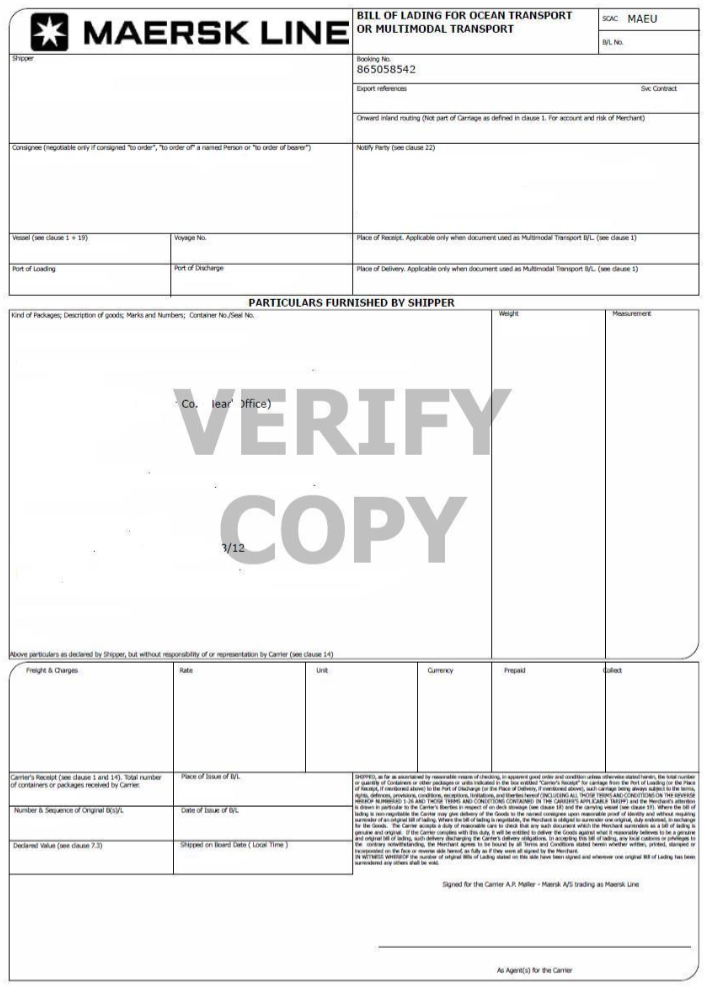
Let's break down the key fields you worked with, one by one.
1. Shipping Line and MBL Number
- Shipping Line: This is the vessel-operating common carrier (Vocc), the company that owns or operates the ships (e.g., Maersk, MSC, CMA CGM). This is the 'airline' in our airline vs. tour operator analogy. Identifying the shipping line defines the underlying service, terms of carriage, and the network of agents and terminals involved. In your role, this data point determined who your company (the NVOCC) had a primary contract with for that specific shipment.
- MBL Number: This is the shipping line's unique tracking number for the entire consolidated shipment. Just as an airline gives a single confirmation number for a group booking, the shipping line issues one MBL number for the container(s) your company booked with them. This number is the master key used by the carrier to identify the shipment in their system, from the port of origin to the port of destination.
2. Vessel Name and Voyage Number: The "Flight Number" for Cargo
These two fields work together to pinpoint a specific journey. It's not enough to know the vessel; you must know which trip it's on. This concept is perfectly analogous to air travel.
What's a Voyage Number? Vessel Name? Why Should You Care in ...
This short post on LinkedIn clearly explains the distinction between a vessel name and a voyage number using a simple analogy.
Read the two main sections, Vessel Name and Voyage Number. The author uses the analogy of a "flight number for a plane," which is a perfect way to understand this. Pay attention to how the voyage number often includes a directional code (like 'E' for Eastbound).
As the post explains:
- The Vessel Name is the permanent identity of the ship (e.g., Maersk Launceston). It tells you which physical asset is carrying the goods.
- The Voyage Number is the unique identifier for a specific trip (e.g., 305E). It's the "flight number." The same vessel will have a different voyage number for every trip it makes, even on the same route.
Entering both correctly is critical. An error in the vessel name could mean you're tracking the wrong ship entirely. An error in the voyage number could mean you're looking at last week's sailing or next month's, leading to incorrect ETAs and missed deadlines.
3. Ports of Loading & Discharge and ETD/ETA: The Route and Timeline
- Port of Loading (POL) & Port of Discharge (POD): These fields define the start and end points of the sea carriage contract. Their accuracy is absolute. Listing the POL as 'Shanghai' when the container was actually loaded in 'Ningbo' would create a massive contractual and customs discrepancy. For customs, the POL and POD define the jurisdiction for export and import declarations.
- ETD (Estimated Time of Departure) & ETA (Estimated Time of Arrival): These dates are the heartbeat of the logistics plan.
- ETD: This is not just an estimate; it's a critical deadline. Customs authorities, like U.S. Customs and Border Protection (CBP) with its "24-Hour Rule," require the manifest information (which you helped create) to be submitted a full 24 hours before the cargo is loaded onto the vessel at the foreign port. A wrong ETD could lead to a failure to meet this deadline, resulting in "Do Not Load" orders and fines.
- ETA: This date triggers a cascade of activity at the destination. Based on the ETA, your company (the destination agent/NVOCC) would start arranging for customs clearance, scheduling warehouse space for LCL de-consolidation, and coordinating with truckers for final delivery. An inaccurate ETA means all these downstream partners are working with bad information, leading to wasted resources, delays, and potential storage (demurrage) charges at the port.
The High Cost of Small Mistakes
You now see that each field you entered was a critical command that set a part of the global logistics machine in motion. A single typo wasn't just a clerical error; it was a faulty command with real-world financial and legal consequences.
The following reading powerfully illustrates what happens when this data is wrong. It serves as the "why" behind the immense pressure for accuracy in your former role.
The Consequences of a Single Mistake on a Bill of Lading
This LinkedIn post by a logistics professional provides a stark, practical summary of the fallout from B/L errors. It’s a perfect checklist of the risks you were mitigating with your careful data entry.
First, read the numbered list that explains what happens when there's a mistake. Notice how it mentions customs stops, rising bills (demurrage), and denial of insurance claims. Next, review the 7-point checklist. You can see that the fields mentioned—Shipper/Consignee, Ports, Container Numbers, Weight—are exactly the ones you were responsible for entering from the MBL and HBL. This was your core function: ensuring the B/L passed this "sanity check" before it went any further.
As the author highlights, an error isn't just an internal problem. It can lead to cargo getting stuck for days, claims being denied by insurance, and a fundamental breakdown of trust with the client—the "biggest currency" in this business.
Conclusion
In this lesson, we deconstructed the core data fields of the Master Bill of Lading that you handled daily. You can now see that these were not merely administrative details. They were the essential parameters that defined the who, what, where, and when of the entire shipping contract.
Key Takeaways:
- Vessel + Voyage = Journey: You need both the vessel name and the voyage number to uniquely identify a shipment's specific trip, just like an airline and a flight number.
- Ports Define Jurisdiction: The Port of Loading and Port of Discharge determine which customs authorities have control over the shipment.
- ETD/ETA Drive the Timeline: The ETD dictates critical customs manifest deadlines, while the ETA orchestrates all destination-side activities, from customs brokerage to trucking.
- Errors Have Ripple Effects: A simple typo in any of these fields can cause a chain reaction of customs holds, financial penalties (demurrage), and contractual disputes.
You weren't just copying data; you were programming the logistical instructions for a multi-thousand-dollar international movement of goods.
In our next lesson, we will continue our analysis of the MBL by examining two of its most important—and often confusing—fields: the Shipper and the Consignee. This will reveal a crucial piece of the puzzle: why your company, the NVOCC, was listed as both the sender and receiver of the cargo on the Master Bill of Lading.