Welcome back! In our last lesson, we prepared you to answer a critical interview question about the MBL-HBL relationship, solidifying your understanding of the NVOCC business model. We're continuing in that practical, interview-focused vein today.
This lesson tackles another key scenario you're likely to face, addressing the learning outcome: in a mock interview setting, explain the operational consequences of selecting an 'Original BL' release versus an 'Express Release'. In your past role, you entered these "cargo release" types into the Fenix system. Now, you will learn the strategic thinking behind those choices, empowering you to discuss them as a logistics coordinator, not just a data entry agent.
Setting the Scene: The Interview Question
Imagine the interviewer gives you this scenario:
"An important client calls you for advice. They are shipping a high-value container to a brand-new buyer they've never worked with before. They've heard about Express Release being faster and cheaper. What would you advise them to use: an Original Bill of Lading or an Express Release? Please walk me through the operational consequences of each choice."
This question tests your ability to manage risk for your client and your company. Your answer will reveal whether you understand that these documents are not just data fields, but powerful tools that control ownership and payment.
The Fundamental Difference: Title vs. Receipt
Before comparing them, we must understand the core distinction. You've encountered several Bill of Lading types, but the most important difference boils down to one function: whether the document acts as a document of title.
- An Original Bill of Lading (OBL) is a document of title. Think of it like the deed to a house or the title to a car. The physical, original paper represents ownership of the cargo.
- An Express Release (also known as a Sea Waybill) is not a document of title. It is simply a receipt for the goods and evidence of the contract of carriage. It does not confer ownership.
The video below from "Adrian The Logistician" uses a great analogy for the Original B/L.
Bill of Lading B/L : Types of Bill of Lading Explained For Beginner
This video explains the concept of an Original B/L in very practical terms.
Watch the section from "The Original Bill of Lading", where the presenter likens it to a "passport for your goods" and explains its role in claiming cargo.
This "passport" function is the key. Without the original passport, the cargo cannot be claimed. This gives the shipper who holds the document immense control.
This infographic provides a simple, high-level summary of the main release types and when to use them.

As the "Quick Tip" suggests, the choice between them is a classic trade-off between security and convenience.
Operational Consequences: A Head-to-Head Comparison
To advise your client properly, you need to explain this trade-off in practical terms. Let's break down the operational consequences of choosing an OBL versus an Express Release.
The table below starkly contrasts an Original B/L with a Surrender/Telex Release, which is the electronic version of the OBL process. The principles of low security and high speed apply even more so to an Express Release.
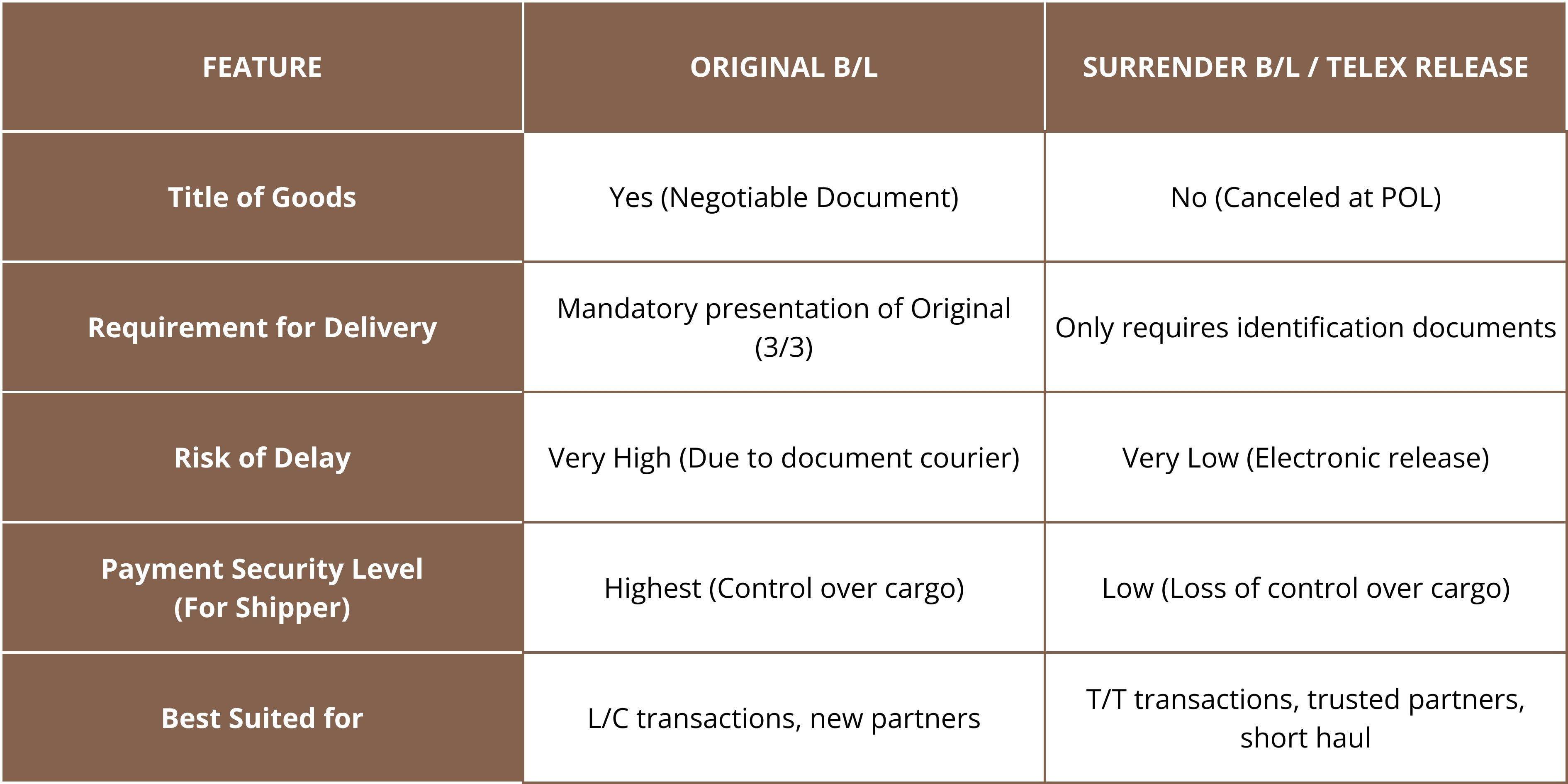
Let's dive deeper into what these differences mean in the real world.
1. Security and Control
-
Original B/L (High Security): The shipper holds the physical OBLs after the vessel sails. They will only send these documents to the buyer via courier (like DHL or FedEx) after they have received payment or are confident in the payment terms (e.g., under a Letter of Credit). The buyer cannot claim the cargo at the destination without presenting at least one of these original documents to the carrier. This gives the shipper ultimate payment security.
-
Express Release (Low Security): No original documents are even issued. Cargo is automatically released to the consignee named on the bill as soon as it's available at the destination. The shipper has zero control over the cargo release once it's been shipped. This method is built entirely on trust.
The following resource from Fanxstar provides an excellent in-depth analysis of these risks.
Bill of Lading (B/L) Guide: Original vs. Telex Release - Fanxstar
This article details the specific risks and appropriate use cases for each release type.
Please read the section "Risk Analysis: What Can Go Wrong" to understand the potential problems with both methods. Then, read the following short section, "The Express Release / Sea Waybill: When to Use It", to see when this trust-based method is appropriate.
2. Speed and Cost
-
Original B/L (Slow and Costly): This method introduces two major operational bottlenecks:
- Courier Cost & Time: The shipper must pay for an international courier, which can cost $50-$100 and take several days.
- Demurrage & Detention Risk: If the vessel arrives at the destination before the documents do (which is common on short sea routes), the container will be stuck at the port. The consignee cannot clear it, and it will start incurring expensive daily storage fees called demurrage and detention, which can quickly run into thousands of dollars.
-
Express Release (Fast and Cheap): This is the most efficient method.
- No Courier Costs: Everything is digital. No documents need to be mailed.
- Instant Release: As soon as the cargo is discharged and available, the consignee can begin the clearance process. There is no risk of demurrage due to waiting for paperwork.
The video below from "Logistics YouTuber - IINO san" clearly explains the speed advantage of electronic releases and the payment risk associated with a Sea Waybill (Express Release).
Explained about Type of B/L. What is the difference between Original B/L, Surrendered B/L, Waybill?
This video highlights the practical differences in speed and risk between the different B/L types.
Watch the section on Surrendered B/L to understand why speed is a factor, and then watch the section on the Seaway Bill to understand the trade-off between its speed and the payment collection risk.
Crafting Your Interview Answer
Now, let's synthesize this knowledge into a confident, structured answer to the interviewer's scenario.
Interviewer: "What would you advise your client shipping to a new buyer: Original B/L or Express Release? What are the operational consequences?"
Your Answer:
"For a shipment to a brand-new, un-vetted buyer, I would strongly advise the client to use an Original Bill of Lading. The primary reason is security.
The fundamental difference is that an Original B/L is a document of title—it's like the deed to the cargo. An Express Release is just a receipt.
The operational consequences break down into a trade-off between security and speed.
With an Original B/L, my client retains full control. They hold the physical documents until they receive payment from the new buyer. The buyer cannot get their cargo without presenting that original document at the destination. This protects my client from the risk of non-payment. The downside is that it's slower and more expensive. They have to pay for a courier, and more importantly, if the documents are delayed in transit, their buyer faces costly demurrage fees at the port.
With an Express Release, the process is much faster and cheaper since it's all digital. However, the cargo is released automatically to the consignee upon arrival. This means my client would have zero leverage if the new buyer decided not to pay. The risk of financial loss would be very high.
So, my advice is clear: the security of an Original B/L is non-negotiable for a new business relationship. We would only recommend an Express Release for shipments between trusted parties, like a parent and subsidiary company, or for long-term partners with a solid payment history."
This answer is direct, demonstrates a clear understanding of risk management, and correctly explains the pros and cons of each option in a business context.
Conclusion
You are now equipped to explain the critical differences between cargo release types, moving beyond the "what" of your data entry past to the strategic "why" of a logistics coordinator.
Key Takeaways:
- Original B/L = Control & Security. It is a document of title. Use it for new partners, high-value goods, or when payment is not yet secured. The main operational risks are courier delays and demurrage costs.
- Express Release = Speed & Trust. It is not a document of title. Use it for established, trusted relationships where payment risk is zero. The main operational risk is the complete loss of control over the cargo, leading to potential financial loss.
- The choice is always a trade-off between securing payment and ensuring a fast, low-cost delivery.
In our next lesson, we will tackle the final mock interview scenario, addressing a very common operational problem you mentioned from your workflow: what to do when the numbers don't add up. We'll explore how to respond when the total weight of the HBLs doesn't match the MBL.