Hello! We’ll begin with integers: whole numbers, zero, and their negative counterparts. They are the foundation for later work with fractions, equations, budgets, and data. This first lesson focuses on adding, subtracting, multiplying, and dividing positive and negative integers. Allow about 40 minutes, including time to pause the videos and check your understanding.
Adding integers: think about direction
On a number line, numbers increase as you move right and decrease as you move left. Start at the first number. Adding a positive means moving right; adding a negative means moving left.
For example, begin at . Adding moves three places right, so . Adding instead moves three places left, so . Notice that adding makes greater, even though the answer is still negative.
Integers | Adding, Subtracting, Multiplying & Dividing | Lesson + Practice
Watch “Integers | Adding, Subtracting, Multiplying & Dividing | Lesson + Practice” from Math with Mr. J for a step-by-step treatment of addition.
Watch integer addition. Pay particular attention to the examples near the end that cross zero: the number line helps you account for the movement on both sides of zero.
You can gradually replace the number line with a shorter method. If the signs match, combine the amounts and keep their sign: . If the signs differ, the positive and negative amounts offset each other. For , five of the eight negative units are offset, leaving . A quick check is to ask whether the result should be greater or less than your starting number.
Subtracting integers: add the opposite
Subtracting a positive number lowers the value. The image below starts at and moves three places left, reaching .
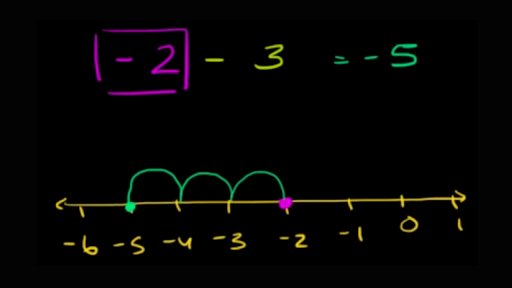
Subtracting a negative has the opposite effect: it raises the value. Think of removing a debt of from an account balance of ; the balance would be . Mathematically, .
The reliable rule is to subtract a number, add its opposite. Change the subtraction to addition and change the sign of the number being subtracted; leave the starting number alone:
For instance, , while . The minus sign in tells you what kind of number it is; the subtraction sign tells you what operation to perform. Keeping those roles separate helps prevent sign errors.
Integers | Adding, Subtracting, Multiplying & Dividing | Lesson + Practice
Continue the same Math with Mr. J lesson to see subtraction both as a change in value and as “adding the opposite.”
Watch integer subtraction. At the examples 6-(-4) and 2-10, check that you can explain both the direction of the change and the rewritten addition. If captions appear to give a different sign for -1-2, the correct answer is -3.
Multiplying and dividing: decide the sign first
For multiplication, a positive number of repeated negative changes is familiar: three losses of give . When both factors are negative, the result is positive. You can see the pattern in a sequence:
Each time the first factor decreases by one, the product increases by two. Division follows the same sign rules as multiplication because it reverses multiplication.
| Signs of the two numbers | Product or quotient |
|---|---|
| Same signs | Positive |
| Different signs | Negative |
Work in two stages: decide the sign, then calculate using the numbers without their signs. Thus is positive, and , so the answer is . For , the signs differ and , so the answer is . You can check division by multiplying: .
Integers | Adding, Subtracting, Multiplying & Dividing | Lesson + Practice
Continue to the multiplication and division portion of the same video. Use its examples to practise choosing the sign before calculating.
Watch products and quotients. Compare the examples with matching signs against those with different signs. Check the final division yourself: 33\div(-3)=-11, even if the captions render its answer incorrectly.
Zero needs two separate rules. Multiplying by zero gives zero, and zero divided by a nonzero number gives zero. Division by zero is undefined: there is no number you can multiply by zero to get a nonzero dividend.
Bring the four operations together
The key distinction is that addition and subtraction use direction or opposites, whereas multiplication and division use the pair of signs. Do not apply “same signs give positive” to addition: , not .
For a short practice session, use the questions at the end of the video. Pause while the questions are displayed, write down your answers, and then compare them with the review. If an answer differs, first check whether you chose the correct operation and sign; only then check the arithmetic.
Integers | Adding, Subtracting, Multiplying & Dividing | Lesson + Practice
Finish the Math with Mr. J video with its mixed practice and answer review.
View practice questions and pause to work them out at your own pace. Then use answer review to check your results.
You can now perform all four operations with signed integers. When adding or subtracting, picture the number line or rewrite subtraction as addition of the opposite. When multiplying or dividing, determine the sign first and then calculate.
In the next lesson, you’ll use these skills in numerical expressions with brackets, where deciding which operation to perform first becomes important.