Hello and welcome to your course on the foreign policy and security of China. I'm excited to guide you through this complex and fascinating subject.
Given your background in governance, diplomacy, and international relations, we will approach this course with a blend of theoretical framing and applied case studies, ensuring you gain both the 'why' and the 'how' of China's actions on the world stage.
Introduction
Today, we begin our first module, "Foundations of Chinese Foreign Policy." Our goal for this lesson is to explain how realist and constructivist concepts apply to China's strategic behavior.
Why start with theory? International Relations (IR) theories are like analytical lenses. They provide frameworks that help us organize complex information, identify patterns, and understand the deep-seated motivations behind a state's actions. Throughout this course, we'll see how these theoretical concepts play out in real-world scenarios, from the Mao era to the present day.
In this lesson, we will:
- Explore the Realist perspective, which views international politics as a competitive struggle for power and security.
- Examine the Constructivist perspective, which emphasizes the role of identity, history, and norms in shaping a state's interests and behavior.
- Synthesize these two approaches to build a more nuanced understanding of China's foreign policy.
Let's begin by defining our terms.
Theoretical Foundations
To start, I'd like you to read the introductory sections of a paper that succinctly defines Realism and Constructivism and proposes a way to combine them. This will establish the core concepts for our lesson.
[PDF] realist constructivism: understanding foreign policy intent
This reading from Paul Bleau's thesis, 'Realist Constructivism: Understanding Foreign Policy Intent,' introduces the core tenets of Realism and Constructivism. It's a useful starting point for understanding how these two major IR theories offer different explanations for state behavior.
Please read the following sections: 'THESIS INTRODUCTION' (starts on page 1) The 'Literature Review' section, focusing on the overviews of 'Realism', 'Constructivism', and 'Realist-Constructivism' (starts on page 4, ends on page 10). As you read, focus on the fundamental contrast: Realism's emphasis on power and anarchy versus Constructivism's focus on ideas, culture, and identity.
Now that you have a foundational understanding of these two theories, let's apply them directly to China.
The Realist Lens: A World of Power Politics
Realism, particularly the variant known as Structural Realism or Neorealism, argues that the international system's anarchic structure—the absence of a global government—is the primary driver of state behavior. In such a system, states can never be certain of others' intentions and must prioritize their own survival. The most reliable way to ensure survival is to accumulate power, especially military power.
From this perspective, China's domestic politics, culture, or ideology are of secondary importance. What matters is its rising material power and its position in the global balance of power.
To hear this argument from one of its most prominent advocates, please watch the following clips from a video featuring the influential realist scholar John Mearsheimer.
Structural Realism - International Relations (1/7)
In this video, 'Structural Realism - International Relations (1/7),' John Mearsheimer explains the core logic of his theory and applies it directly to the case of a rising China.
Please watch the following two segments: The Core of Structural Realism (00:07 - 05:30): Mearsheimer explains why states are driven to maximize power in an anarchic system. He contrasts his 'structural' view with 'human nature' realism. Applying the Theory to China (07:01 - 09:06): He uses his theory to predict that China's rise will not be peaceful, arguing it will inevitably lead to an intense security competition with the United States and its neighbors.
As Mearsheimer argues, a realist analysis leads to a stark conclusion:
- As China's economy grows, it will convert that wealth into military might.
- It will seek to become a regional hegemon in Asia, dominating its neighborhood to ensure its security, just as the U.S. has done in the Western Hemisphere.
- The United States, as the existing hegemon, will not tolerate a "peer competitor" and will work with China's neighbors (like Japan, India, and Vietnam) to contain its rise.
- The result is an unavoidable and intense security competition.
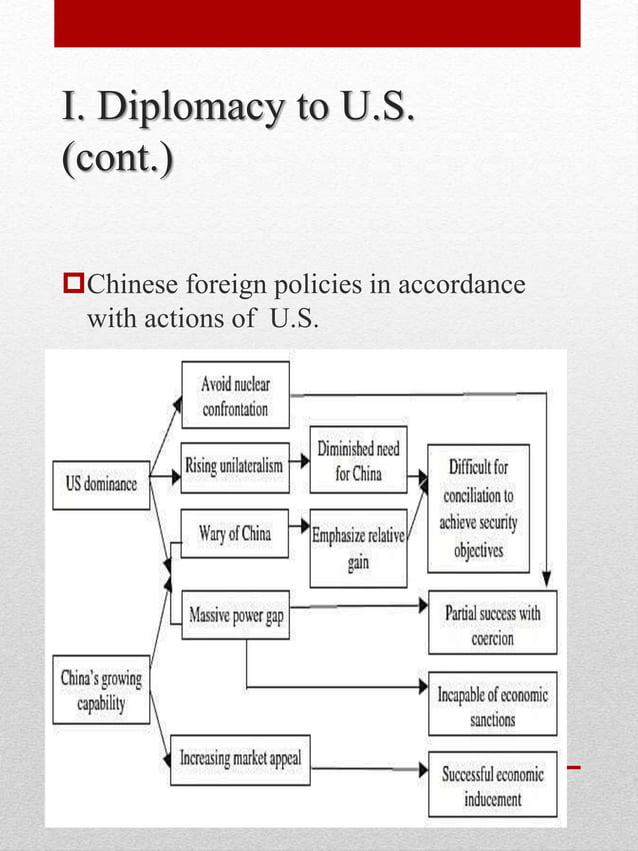
This flowchart visually summarizes the realist logic, showing how China's strategic choices are driven by its growing capabilities and its perception of U.S. dominance.
The Constructivist Lens: The Power of Identity and History
While Realism provides a powerful, parsimonious explanation, it doesn't tell the whole story. It explains that China seeks power, but it doesn't fully explain why it seeks power in particular ways or how it defines its national interests.
This is where Constructivism comes in. Constructivists argue that a state's identity, culture, and historical experiences are crucial. These ideational factors are not just "flavor"—they actively shape what a state considers a threat, what it values, and what it sees as its rightful place in the world.
For China, no historical narrative is more powerful than the "Century of Humiliation" (百年国耻, bǎinián guóchǐ). This period, stretching roughly from the First Opium War (1839) to the founding of the People's Republic of China (1949), saw the once-dominant Qing Dynasty repeatedly defeated, carved up, and subjugated by foreign powers.
This is not just dusty history for Beijing; it's a living memory that functions as a core part of China's national identity and strategic logic. The following video explains this brilliantly.
How the Opium War Still Controls China’s Foreign Policy | The Slow Report
The video 'How the Opium War Still Controls China’s Foreign Policy' from The Slow Report provides a compelling case for a constructivist interpretation of Chinese strategy. It argues that the 'Century of Humiliation' created a psychological and strategic template that remains operational today.
Please watch these key segments: Introduction to the 'Strategic Template' (00:00 - 02:01): This section explains how the Opium Wars are not a closed chapter but a living memory that shapes how Beijing interprets global power. The 'Operational Principles' (02:01 - 05:37): Focus on the four key lessons China derived from this period, such as 'weakness invites exploitation' and 'international law favors the strong.' Conclusion: 'The Memory Remains Operational' (20:43 - 22:43): This part summarizes how this historical memory shapes China's perception of everything from sanctions to military alliances.
From a constructivist viewpoint, the "Century of Humiliation" provides the essential context for China's actions:
- Its massive investment in a blue-water navy is not just a power play; it's a direct response to the historical trauma of being unable to defend its coastline.
- Its deep suspicion of the "rules-based international order" stems from the experience of having "unequal treaties" legally imposed upon it by force.
- Xi Jinping's goal of "national rejuvenation" is fundamentally about reversing the verdict of the Century of Humiliation and restoring China's perceived rightful status.
A "Chinese" View of World Order?
Going deeper, many Chinese scholars argue that China's unique philosophical traditions, particularly Confucianism, provide an alternative vision of world order. This has led to the development of a "Chinese School" of IR theory.
[PDF] World Order with Chinese Characteristics
The paper 'World Order with Chinese Characteristics' explores how traditional Chinese philosophy is being revived to create a distinct approach to IR. This provides a fascinating look into how some Chinese intellectuals and policymakers see their country's role.
Please read the section titled 'Hierarchy and Order' (starts on page 7, ends on page 12). Focus on how concepts from traditional Chinese thought, such as: Tianxia (天下): The idea of 'all-under-heaven' as a harmonious world system. Hierarchy: The belief that a stable order is based on a clear hierarchy, with responsibilities varying by status, rather than the formal equality of states in the Western 'Westphalian' system. Moral Authority: The idea that a leading state should rule through virtue and benevolence, not just coercion.
Synthesis: Realism and Constructivism Combined
So, which theory is right? The most sophisticated analysis uses both.
- Realism provides the engine: the relentless drive for security and power in an uncertain world.
- Constructivism provides the steering wheel and the roadmap: the identity, history, and cultural norms that direct that drive and define the destination.
This hybrid approach, sometimes called Realist Constructivism, argues that ideology and identity act as intervening variables. China's pursuit of power (a realist motivation) is shaped and justified by its historical identity and cultural worldview (constructivist factors).
Consider the South China Sea dispute, which we will study in detail later.
- A realist sees China building military bases on artificial islands to establish physical control, push the U.S. military out, and secure vital sea lanes.
- A constructivist adds that China's claims are rooted in historical maps and a narrative of restoring its former maritime tributary system, a key part of its identity.
- A realist constructivist would conclude that the drive to control the South China Sea is a function of power politics, but the justification for that drive, and the specific form it takes (appealing to history), is a product of China's unique identity. As the Bleau paper states, ideology helps explain "why a particular Realist pragmatic decision was made."
Conclusion
In this lesson, we have established two foundational theoretical lenses for analyzing Chinese foreign policy.
Key Takeaways:
- Realism emphasizes the structural pressures of the international system, predicting that a rising China will inevitably seek to maximize its power, leading to conflict with the established power, the United States.
- Constructivism highlights the importance of China's unique identity, shaped by the historical trauma of the "Century of Humiliation" and philosophical traditions like Confucianism. These factors define what China's interests are and what "national rejuvenation" means.
- The most robust analysis combines both theories. China's actions are driven by a realist logic of power and security, but this logic is filtered through and shaped by its distinct national identity and historical experience.
Preview of the Next Lesson:
Now that we have explored these high-level international theories, our next lesson will drill down to the domestic level. We will examine the key internal factors—such as the Communist Party's need for legitimacy, rising nationalism, and economic imperatives—that concretely shape and constrain China's behavior on the world stage.