Introduction
Welcome back. In our last lesson, we explored how China is developing a sophisticated deterrence posture that goes far beyond its nuclear arsenal. We introduced the concept of "strategic substitution," where China uses advanced conventional, space, and cyber weapons to create coercive effects and manage escalation below the nuclear threshold.
Today, we will analyze a core component of that strategy. This lesson focuses on the learning outcome: Assess China's anti-access/area-denial (A2/AD) strategy in the Western Pacific. We will dissect this critical military strategy, which is designed specifically to deter or defeat U.S. intervention in a regional conflict, most notably over Taiwan. We'll explore its strategic logic, the weapons systems that form its backbone, and the ways in which the United States and its allies are adapting to this challenge.
1. The Strategic Logic: Reversing the Geography of Power
To understand China's A2/AD strategy, we must first understand the geography of the Western Pacific. Since the Cold War, U.S. strategy has been heavily influenced by the "Island Chain Strategy," a concept that uses the archipelagos off the coast of mainland Asia as a series of defensive lines to contain potential adversaries.
For China, these island chains are not just lines on a map; they represent a geographic cage that restricts its navy's access to the wider Pacific Ocean and makes its coastal economic hubs vulnerable. China's A2/AD strategy is its answer to this dilemma—a way to turn this geography to its advantage by making it prohibitively dangerous for U.S. forces to operate within these chains.
To visualize this strategic chessboard, please watch the first part of the following video.
America's Plan to Checkmate China
This video, 'America's Plan to Checkmate China,' by The Military Show, provides an excellent visual introduction to the Island Chain Strategy and then explains how China's A2/AD strategy is a direct response to it.
Please watch from the timestamp 01:17 to 06:03. As you watch, focus on: The geographic layout of the First, Second, and Third Island Chains. Why the First Island Chain is so critical for containing China's maritime access. How the video defines A2/AD as a strategy to raise the costs for the U.S. to project power into this region.
As the video explained, A2/AD is not a single weapon but a complex system of systems. It is helpful to distinguish between its two core components:
- Anti-Access (A2): This involves long-range capabilities designed to prevent an adversary's forces from entering the operational area in the first place. Think of it as a barrier that keeps forces at a distance.
- Area-Denial (AD): This involves shorter-range capabilities designed to limit the freedom of movement and action of adversary forces once they are inside the operational area. Think of it as creating hazardous "no-go zones" within the theater.
The ultimate goal is not necessarily to win a decisive, head-to-head battle, but to alter the adversary's cost-benefit calculation. By making intervention so costly in terms of ships, aircraft, and personnel, China hopes to deter the U.S. from intervening in a regional crisis at all.
To deepen your understanding of this strategic logic, please read the following section from an academic paper on the topic. Your background in diplomacy and IR theory will be useful here, as the text frames A2/AD as a political tool as much as a military one.
[PDF] China's Evolving A2/AD Strategy from Defence to Coercion
The paper 'China's Evolving A2/AD Strategy from Defence to Coercion' provides a strong theoretical foundation for understanding the purpose of denial strategies.
Please read the section titled 'A2/AD AS A STRATEGIC TOOL OF INFLUENCE AND CONTROL' (starting on page 2). Focus on how the author explains A2/AD as a way to 'shape the operational and political environment' and 'alter adversary cost-benefit calculations.'
2. The A2/AD Arsenal: China's Layered Defense
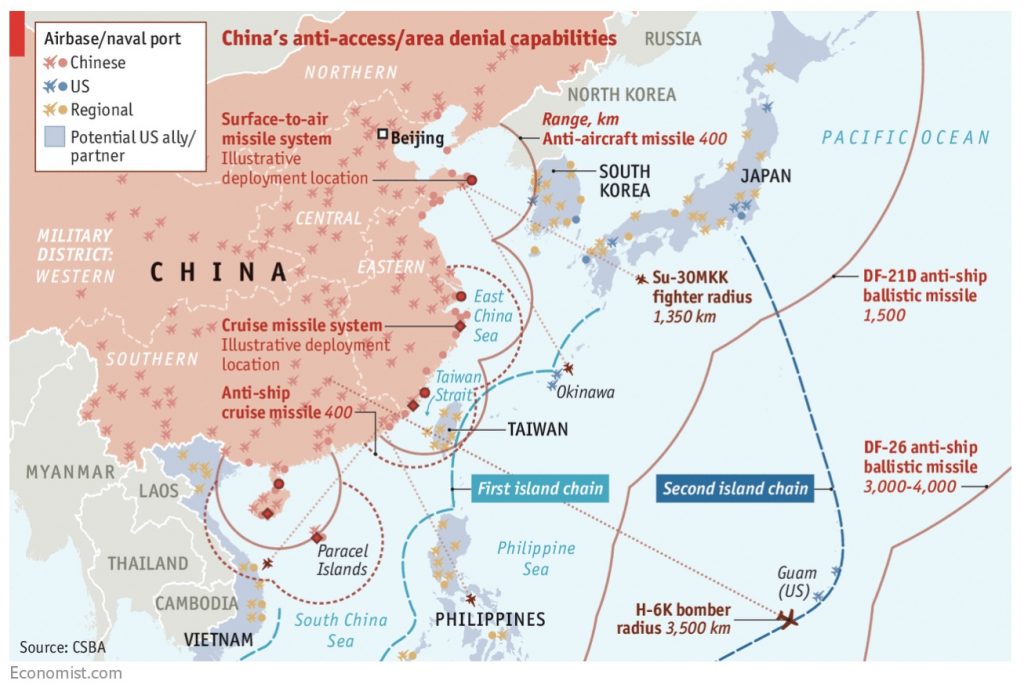
China's A2/AD strategy is built upon a vast and integrated arsenal of land, sea, air, space, and cyber capabilities. These systems are networked together to form a "kill chain" that can detect, track, and engage targets hundreds or even thousands of kilometers from China's coast.
The image below gives a sense of the scale and layered nature of these capabilities, showing the overlapping ranges of different missile and radar systems.
To get a more detailed breakdown of the specific components that make up this formidable network, please read the following article.
China's Anti-Access/Area-Denial Strategy
The article 'China's Anti-Access/Area-Denial Strategy' from The Defence Horizon Journal offers a clear and concise inventory of the key weapon systems involved.
Please read the sections titled 'China’s A2/AD Arsenal' and 'C3ISR'. Pay close attention to the different types of missiles (ASBMs vs. ASCMs) and the crucial role of the Command, Control, Communications, and ISR (Intelligence, Surveillance, Reconnaissance) network that connects them.
As you've now read, the key components include:
- Anti-Ship Ballistic Missiles (ASBMs): These are the cornerstone of the anti-access mission. The DF-21D is known as the "carrier-killer" for its ability to target large naval vessels, while the longer-range DF-26 is nicknamed the "Guam killer" for its ability to strike the key U.S. base in the Second Island Chain.
- Anti-Ship Cruise Missiles (ASCMs): A wide variety of missiles launched from aircraft, ships, submarines, and coastal batteries. They create the dense, shorter-range threat for the area-denial mission.
- Integrated Air Defense Systems (IADS): A network of advanced Russian (S-400) and domestic surface-to-air missiles (SAMs) that make it dangerous for non-stealth aircraft to operate near China.
- The PLA Navy (PLAN) and Air Force (PLAAF): A rapidly modernizing fleet of quiet submarines, advanced destroyers, and long-range bombers and fighters, all armed with ASCMs.
- C4ISR Systems: A vast network of satellites, over-the-horizon radars, and electronic warfare units that act as the "eyes and ears" of the A2/AD system, without which the "shooters" (the missiles) would be blind.
3. The Counter: Fighting Inside the Bubble
China's A2/AD strategy poses a profound challenge to the United States, which has based its military dominance for decades on the ability to project power freely across the globe. So, how is the U.S. adapting?
Rather than trying to brute-force its way through the A2/AD bubble, the U.S. military is developing new concepts designed to operate within it. The leading concept from the U.S. Marine Corps is known as Expeditionary Advanced Base Operations (EABO).
The core idea of EABO is to disperse small, mobile, and hard-to-detect units across the islands of the First Island Chain. These units, armed with their own anti-ship missiles and air defenses, would effectively turn China's strategy against itself—using the same island chain geography to deny sea control to the PLA Navy.
The following video provides an excellent summary of this new warfighting concept.
How the US Marines Plan to Fight Inside China’s Missile Range
This video from MGG Geopolitics, 'How the US Marines Plan to Fight Inside China’s Missile Range,' clearly explains the logic behind EABO and the changes the Marine Corps is making to implement it.
Please watch from the timestamp 01:57 to 06:44. Focus on: The central problem EABO is trying to solve. The shift from 'punching through' the missile envelope to operating 'inside it.' The new types of units (Marine Littoral Regiments) and equipment (Nemesis missile systems) being developed. The importance of exercises with allies like the Philippines and Japan in practicing this concept.
While innovative, concepts like EABO are not a silver bullet. China's A2/AD architecture is itself not flawless. To conduct a full assessment, we must also consider its vulnerabilities. For a final reading, let's return to the academic paper from earlier to analyze the inherent weaknesses of denial strategies.
[PDF] China's Evolving A2/AD Strategy from Defence to Coercion
This final reading will provide a critical perspective, highlighting the potential fragilities within China's A2/AD strategy.
Please read the section titled 'STRATEGIC AND OPERATIONAL FRAGILITIES OF DENIAL' (starting on page 16). Note the arguments about how China's assertiveness provokes counter-balancing alliances and how its fixed assets (like the artificial islands) can become liabilities in a conflict.
Conclusion
In this lesson, we have assessed China's A2/AD strategy, a cornerstone of its military modernization and a direct challenge to U.S. power projection in the Western Pacific.
Key Takeaways:
- A2/AD is a geographically-focused strategy designed to counter the U.S. Island Chain Strategy by raising the costs of military intervention.
- It is a multi-layered, multi-domain system integrating long-range ballistic missiles, cruise missiles, advanced air defenses, a modernizing navy, and a sophisticated C4ISR network.
- The primary goal is strategic deterrence: to shape an adversary's political and military decisions by making intervention seem too risky, potentially enabling a fait accompli in a crisis.
- The U.S. and its allies are adapting with new concepts like Expeditionary Advanced Base Operations (EABO), which aim to operate within the A2/AD bubble and turn China's denial strategy against itself.
- China's A2/AD system has inherent fragilities, including its reliance on fixed and vulnerable assets and its tendency to provoke regional alliances that work to counter its influence.
Preview of the Next Lesson:
The development of China's A2/AD capabilities and the U.S. response are a clear military manifestation of a much broader trend. Having now examined key aspects of China's military power, we will widen our aperture in the next module to the political and economic dimensions of its global relationships. We will begin by explaining the fundamental shift in U.S.-China relations from an era of engagement to one of strategic competition.