Introduction
Welcome back. In our previous lesson, we explored the deep historical and political roots of the Taiwan issue, dissecting the crucial differences between Beijing's "One China Principle" and Washington's "One China Policy." We saw how carefully constructed ambiguity has maintained a fragile peace for decades.
Today, we shift our focus from the political framework to the kinetic reality. This lesson addresses the learning outcome: Analyze the strategic signaling and escalation risks of China's military activities around Taiwan. We will examine the People's Liberation Army's (PLA) actions not as random acts of aggression, but as a form of high-stakes political communication—or coercive diplomacy. We will then assess the inherent dangers of this strategy and how it could spiral into conflict.
Your background in diplomacy and international relations provides a strong foundation for this topic, as it involves core concepts of deterrence, coercion, and escalation management that are central to the study of statecraft.
1. The Toolbox of Coercion: Deconstructing China's Military Signals
When analyzing China's military posture towards Taiwan, it's essential to view it as more than just preparation for war. Each exercise, flight path, and missile launch is a carefully calibrated signal sent to multiple audiences: Taiwan's leadership and public, the United States, the international community, and a domestic audience in China.
A prime case study is the series of large-scale military exercises that followed the 2022 visit to Taiwan by then-U.S. House Speaker Nancy Pelosi. To understand the specifics of what China did and what it signaled, please watch this expert discussion from the Center for Strategic & International Studies (CSIS).
The Military Dimensions of the Fourth Taiwan Strait Crisis
This segment from 'The Military Dimensions of the Fourth Taiwan Strait Crisis' provides a detailed breakdown of the PLA's unprecedented military actions in August 2022.
Please watch the analysis by M. Taylor Fravel from 02:44 to 08:23. As you watch, focus on the four noteworthy elements he identifies: location, activities, what was being exercised, and the norms that were broken.
As the analysis highlights, these were not just routine drills. They were a powerful demonstration of capability and intent, designed to change the strategic environment. Let's summarize the key signals:
- Location: The exercise zones effectively encircled Taiwan, demonstrating the PLA's ability to impose a blockade. Some drills were conducted within 10 nautical miles of Taiwan, a clear and intimidating message of proximity.
- Activities: The combination of live-fire strikes, amphibious assault drills, and missile tests showcased a multi-domain capability. The missiles fired over Taiwan into its eastern waters were a particularly sharp psychological signal, demonstrating an ability to strike anywhere on the island and to cut it off from outside help.
- Command Structure: The exercises tested the PLA's modernized joint-operations command structure, signaling to the US and Taiwan that its military is becoming more integrated and effective.
- Breaking Norms: The most significant long-term change was the deliberate and repeated crossing of the Taiwan Strait median line. This unofficial buffer had helped prevent miscalculation for decades. By erasing it, China is attempting to establish a "new normal" of a constant military presence much closer to Taiwan.
This map of PLA exercises from 2022 and 2024 vividly illustrates this strategy of encirclement and the violation of the median line.
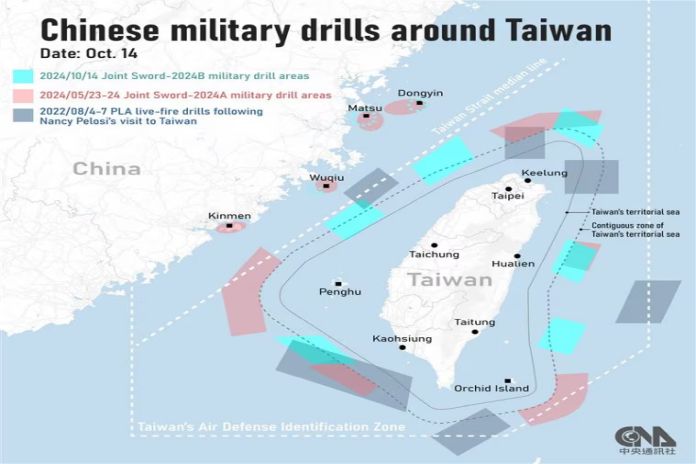
In essence, these actions are a form of coercive signaling intended to communicate displeasure, demonstrate capability, and gradually erode Taiwan's defensive space and psychological resilience, all while stopping just short of an act of war.
2. The Gray Zone: A Strategy of Paralysis
The military exercises we've just discussed are the most visible part of a much broader strategy that operates in the "gray zone"—the ambiguous space between peace and war.
Gray zone tactics aim to achieve strategic goals through coercion, intimidation, and pressure without triggering a conventional military response. This approach is designed to create ambiguity, making it difficult for the target and its allies to formulate a clear and unified reaction.
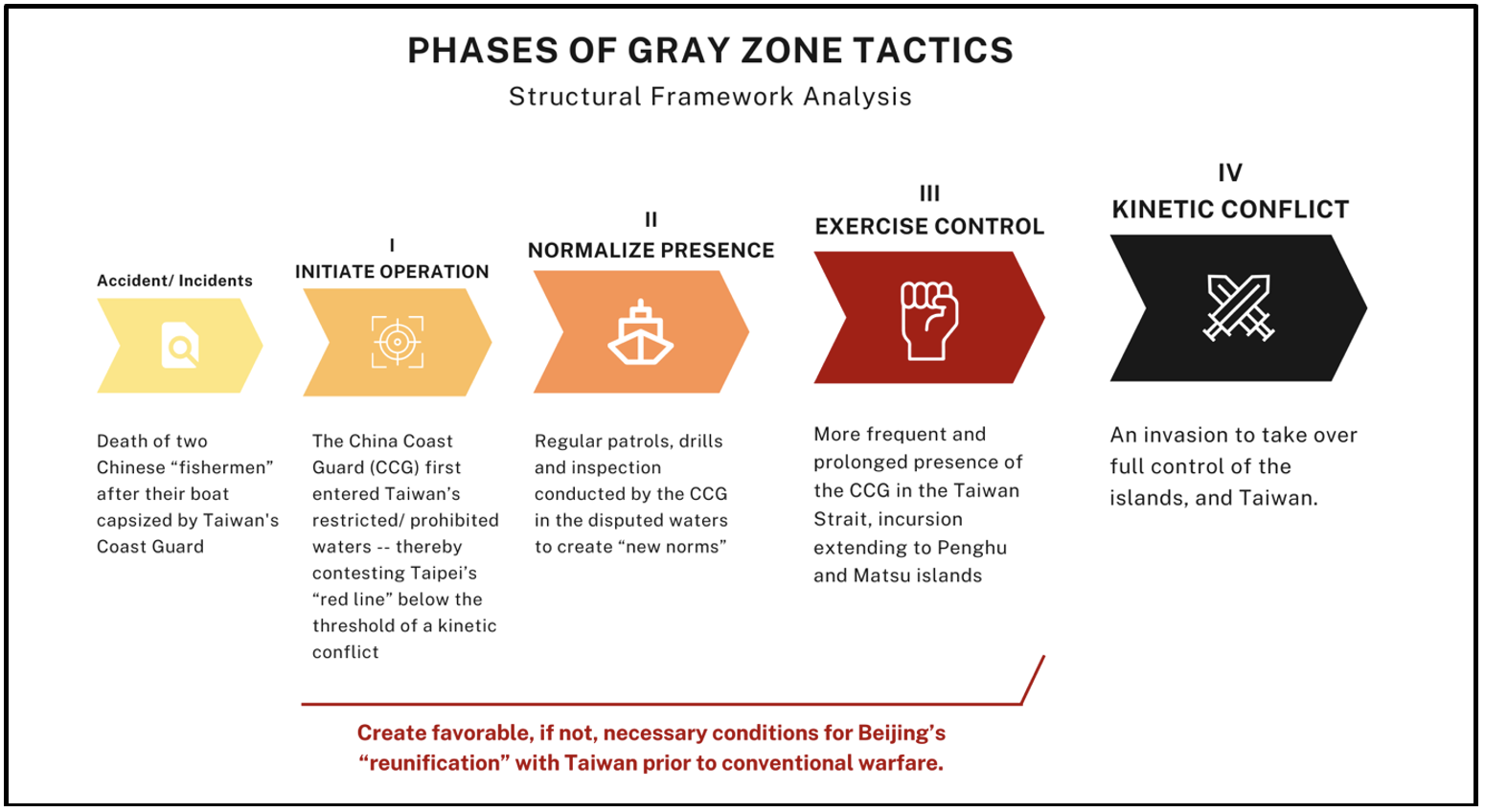
To better understand this concept and how China applies it to Taiwan, let's turn to a policy brief from the Royal United Services Institute (RUSI).
Taiwan’s Evolving Response to China’s Grey Zone Actions
This RUSI brief, 'Taiwan’s Evolving Response to China’s Grey Zone Actions', provides a clear definition of the gray zone concept and details the specific tactics China employs against Taiwan.
Please read the sections 'What is the Grey Zone?' and 'Taiwan’s Grey Zone Experience and Response'. Focus on the characteristics of gray zone activity and the list of specific PLA actions used to exert pressure on Taiwan.
As the article details, China's gray zone toolkit is extensive, including everything from cyber-attacks and disinformation to regular air and sea incursions. The goal is often to win without fighting by exhausting the adversary and manipulating their decision-making.
A particularly sophisticated and high-risk gray zone scenario is what some analysts call a "paralysis strategy," centered on a coercive quarantine. This is a concept that builds on the "lawfare" we discussed in the last lesson.
Deterrence Won't Fail in the Taiwan Strait — It Will Be Bypassed
This War on the Rocks article, 'Deterrence Won't Fail in the Taiwan Strait — It Will Be Bypassed,' explains how China could use a 'quarantine' to paralyze Taiwan without firing a shot.
Please read the sections that begin with 'A coercive quarantine achieves strategic effect...' and 'The distinction between a blockade and a quarantine is vital...'. Pay close attention to the legal distinction and why it's so strategically powerful for Beijing.
The distinction is critical:
- A blockade is an unambiguous act of war under international law.
- A quarantine, however, can be framed by Beijing as a domestic "law enforcement" action to inspect ships in its claimed territorial waters.
This legal ambiguity is a strategic weapon. It creates a dilemma for the United States and other nations: intervening to stop a Chinese Coast Guard vessel from "inspecting" a commercial ship could be framed as firing the first shot. This hesitation is precisely what the strategy aims to exploit, seeking to paralyze Taiwan's economy and isolate it politically before its allies can build a consensus to act.
3. Escalation Risks and Strategic Responses
China's coercive strategy is fraught with risk. The very nature of gray zone actions and intense military signaling creates multiple pathways to unintended escalation.
Key Escalation Risks:
- The Ratchet Effect: Having established a "new normal" with the 2022 exercises, Beijing must do something even more provocative the next time it wants to send a strong signal. Each crisis sets a higher baseline, pushing both sides further up the escalation ladder. This is discussed by panelists in the CSIS video (LINK) you watched earlier.
- Accident and Miscalculation: With dozens of PLA aircraft and ships operating near Taiwan daily, the risk of an accident—such as a mid-air collision or a confrontation at sea—grows significantly. An accident could quickly escalate if not handled carefully.
- The Response Dilemma: Taiwan and the US face a difficult choice.
- Under-reaction can be interpreted as weakness, emboldening Beijing to push further.
- Over-reaction risks falling into Beijing's trap, allowing China to paint Taiwan or the US as the "provocateur" and use it as a pretext for further escalation.
So, how does Taiwan respond to this immense pressure? It has adopted an asymmetric defense concept known as the "porcupine strategy."
Inside Taiwan’s NEW Strategy to DEFEAT a Chinese INVASION
This video explains the logic behind Taiwan's 'porcupine strategy' and the intelligence driving its urgency.
Please watch three short segments: From 01:37 to 02:27 to understand the core concept of the 'porcupine strategy.' From 11:03 to 12:00 to see the economic logic of asymmetric warfare. From 16:58 to 18:03 to understand the 'Davidson Window' and the 2027 timeline that is driving Taiwan's defense planning.
The porcupine strategy's goal is deterrence by denial. It aims to make a Chinese invasion so costly in terms of military assets and personnel that Beijing will deem the price of victory too high. By investing in large numbers of small, mobile, and lethal weapons (like anti-ship missiles, drones, and sea mines), Taiwan seeks to turn itself into an indigestible meal.
This creates a complex escalatory dynamic. While Taiwan's strategy is defensive, its acquisition of long-range missiles capable of striking mainland China introduces another layer of risk. Both sides are building capabilities that raise the potential costs of conflict, in the hope of preventing it, but also increasing the potential devastation if deterrence fails.
Conclusion
Today we've moved from the political maneuvering around the "One China" concept to the sharp edge of military coercion. We've seen that China's military activities are not just muscle-flexing but a sophisticated form of strategic communication with inherent and growing risks.
Key Takeaways:
- China uses military activities like encirclement drills, missile tests, and median line crossings as a form of coercive strategic signaling to intimidate Taiwan, deter U.S. intervention, and establish a "new normal" of increased pressure.
- These actions are part of a broader gray zone strategy that aims to achieve political objectives below the threshold of war. A high-risk variant of this is a "coercive quarantine," which uses legal ambiguity to paralyze Taiwan while placing the burden of escalation on its supporters.
- Escalation risks are significant, arising from the need for China to constantly up the ante (the ratchet effect), the increased chance of accidents from close-proximity operations, and the difficult response dilemma faced by Taiwan and the U.S.
- Taiwan's primary response is a "porcupine strategy" of asymmetric defense, aiming to deter an invasion by making it prohibitively costly.
Preview of the Next Lesson:
Having analyzed the military dynamics in the Taiwan Strait, we will now turn to another critical flashpoint. In the next lesson, we will explore China's strategy in the South China Sea, examining the basis of its controversial "nine-dash line" claim and its campaign of island-building and militarization.