Hello! Welcome back to our course. We are now moving into the second module, which focuses on the first era of the People's Republic of China.
Introduction
In our last lesson, we explored the "Century of Humiliation," the historical trauma that ended with the Communist Party's victory in 1949. We saw how this period shaped a powerful narrative of national rejuvenation that continues to influence Chinese policy today.
This lesson picks up right where we left off, on October 1, 1949. With the founding of the PRC, China entered a new and tumultuous phase under the leadership of Mao Zedong. Our goal is to address the learning outcome for this lesson: to explain the ideological foundations of Mao-era foreign policy, including revolutionary internationalism.
We will explore the core tenets of "Mao Zedong Thought" and see how this unique ideology, a potent mix of Marxist-Leninism and fierce Chinese nationalism, shaped China's view of the world. We'll examine how it translated into an initial alliance with the Soviet Union and a broader commitment to sparking revolution across the globe.
Mao's Worldview: A Revolutionary Synthesis
To understand China's foreign policy during this period, we must first understand the mind of its chief architect. Mao Zedong was not just a political leader; he was a philosopher who adapted Marxism to fit China's specific circumstances. His ideas, collectively known as Maoism or Mao Zedong Thought, formed the bedrock of state policy.
Let's begin by watching a video that breaks down the core philosophical components of Mao's ideology.
The video 'The Philosophy of Mao Zedong' by Agora provides a concise overview of the key ideas that distinguish Maoism from Soviet-style Marxism.
Please watch the following segments: 00:29 - 03:26: Focus on Mao's concept of contradiction as the engine of history and his action-oriented, less deterministic view of dialectics. 03:26 - 05:06: Pay attention to the idea of the unity of theory and practice and the "mass line" approach. 05:06 - 07:07: Understand Mao's emphasis on volunteerism—the power of human will and mobilization to overcome material obstacles. 09:21 - 11:23: This is a crucial section that connects directly to our last lesson. Note how Mao synthesized Marxism with Chinese nationalism, framing the revolution as a struggle for both class liberation and national sovereignty after the Century of Humiliation. These concepts will help you understand the 'why' behind the foreign policy decisions we'll be studying.
As the video illustrates, Mao's ideology was not a rigid dogma but a dynamic and militant worldview. Four key takeaways from this are:
- Constant Struggle: Mao believed that contradiction and struggle were permanent features of the world, both domestically and internationally. Progress could only come through confrontation, not compromise.
- Human Will over Material Conditions: Unlike orthodox Marxists who believed revolution depended on specific economic stages, Mao had immense faith in the power of a mobilized populace to achieve revolutionary goals through sheer willpower ("volunteerism").
- Theory Serves Practice: Ideology was a tool to guide and justify revolutionary action. This allowed for significant strategic flexibility.
- Nationalism and Internationalism Fused: The fight against global capitalism and imperialism was seen as inseparable from the struggle to restore China's national dignity and sovereignty.
The Initial Framework: "Leaning to One Side"
With the PRC established in 1949, Mao had to immediately position China within the new Cold War landscape. His ideology provided a clear, if stark, choice. The world was divided into two irreconcilable camps: the imperialist camp, led by the United States, and the socialist camp, led by the Soviet Union.
For Mao, there was no middle ground. This led to the first major foreign policy doctrine of his era: "Leaning to one side" (yibiandao, 一边倒).
The following reading explains the logic behind this initial alignment and how it laid the groundwork for what was to come.
[PDF] Chinese Foreign Relation Strategies Under Mao and Deng - SciSpace
Let's read a short excerpt from the paper 'Chinese Foreign Relation Strategies Under Mao and Deng' which details the 'leaning to one side' strategy.
Please read the section titled 'The yibiandao (leaning to one side) strategy'. Focus on Mao's justification for this policy and the understanding that this was an alliance of equals, not one of subordination, rooted in the need to guarantee China's security against the United States.
This strategy was a pragmatic application of Mao's ideological worldview. The US was identified as the primary imperialist threat—the main "contradiction"—so an alliance with the USSR was the only logical choice. This culminated in the 1950 Sino-Soviet Treaty of Friendship, Alliance, and Mutual Assistance, which would profoundly shape the first decade of the PRC's foreign relations.
Revolutionary Internationalism and the "Intermediate Zone"
While "leaning to one side" defined China's relationship with the superpowers, it was not the full extent of Mao's global vision. His true ambition was to position China as a leader of a worldwide revolution. This brings us to the central concept of revolutionary internationalism.
This doctrine held that China, having achieved its own revolution, had a duty to support the struggles of oppressed peoples and nations against imperialism and colonialism worldwide.
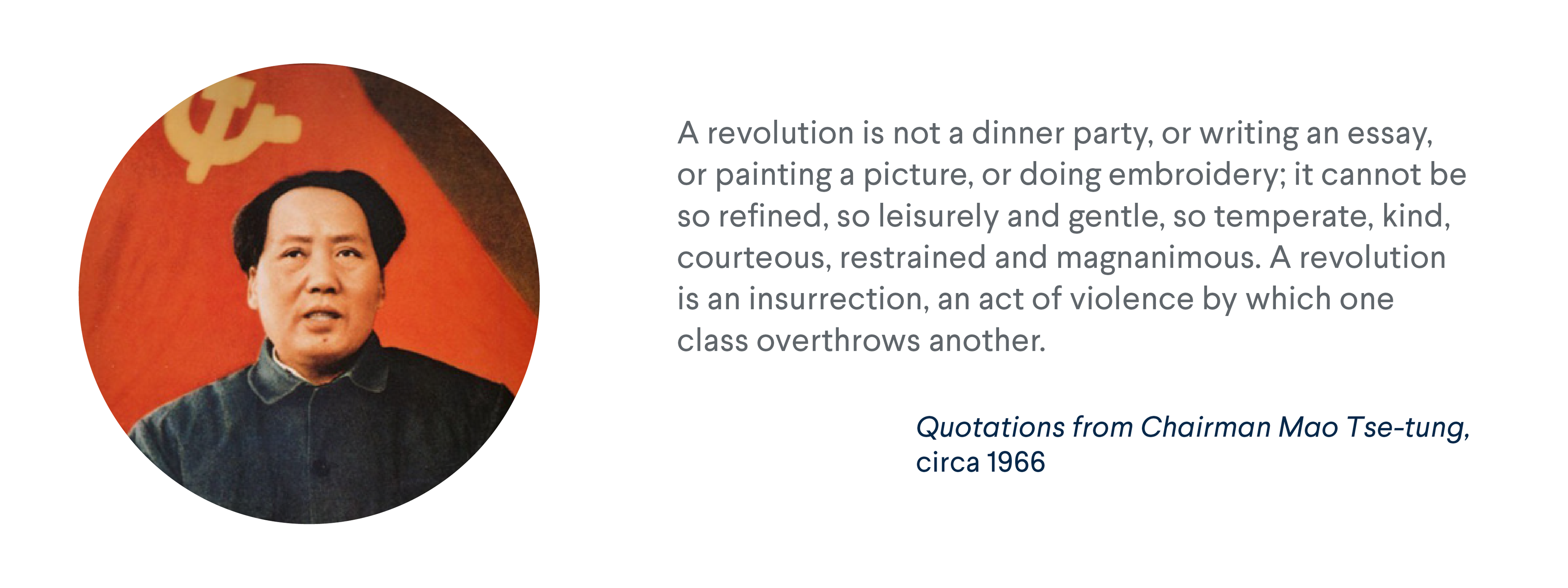
Mao did not see the world as a simple binary. He developed the concept of the "intermediate zone" (中间地带, zhōngjiān dìdài). This referred to the vast territories of Asia, Africa, and Latin America, which were not firmly in the US or Soviet camp. Mao saw this zone as the main battlefield where the forces of revolution and imperialism would clash, and where China could play a leading role.
The next reading traces the evolution of China's foreign policy from the simple "two-camp" theory to this more militant, revolutionary approach focused on what would later be called the Third World.
[PDF] Researchers in the West, preoccupied by the complexities of their own
The paper 'Diplomacy on a South-South Dimension' provides an excellent narrative of how Mao's foreign policy strategy evolved during this period. We will focus on the shift towards a revolutionary foreign policy.
Please read the sections 'Phase One: The Peaceful Coexistence Approach' and 'Phase Two: The Dominance of Revolution'. As you read, focus on: How the simple 'Two-World Theory' evolved into the concept of the 'intermediate zone'. China's diplomatic debut at the Bandung Conference in 1955, where it presented itself as a leader of this emerging bloc. The shift to a more militant, revolutionary strategy in the late 1950s and 60s, driven by the Sino-Soviet split and decolonization movements. The two components of this revolutionary approach: providing symbolic and substantive support for liberation movements, and advocating for self-reliance.
As the reading explains, this revolutionary foreign policy had two key elements:
- Ideological and Material Support: China offered itself as a model for revolution and provided training, weapons, and financial aid to anti-colonial movements and communist insurgencies across Asia, Africa, and Latin America.
- Advocacy for Self-Reliance: China encouraged newly independent nations to break free from economic dependence on both Western imperialists and, increasingly, the "revisionist" Soviet Union. This positioned China as a more authentic revolutionary leader.

This ideology was not just for foreign consumption; it was deeply intertwined with domestic politics, especially during radical campaigns like the Great Leap Forward and the Cultural Revolution. Mao's foreign policy was, in many ways, an extension of his domestic revolutionary agenda onto the world stage.
Conclusion
Today, we've unpacked the complex ideological engine that drove Chinese foreign policy during the Mao era. We've moved from the philosophical roots of Mao Zedong Thought to its concrete application in the early years of the PRC.
Key Takeaways:
- Mao-era foreign policy was grounded in Mao Zedong Thought, a unique ideology that blended Marxist-Leninist concepts of class struggle with Chinese nationalism and a belief in the power of human will.
- The initial foreign policy strategy was "Leaning to one side," an alliance with the Soviet Union against the primary "imperialist" enemy, the United States.
- The broader ideological goal was revolutionary internationalism: positioning China as the leader of a global revolution against imperialism and colonialism.
- Mao's concept of the "intermediate zone" (the future Third World) identified the main arena for this global struggle, where China would offer support and guidance to liberation movements.
Preview of the Next Lesson:
Ideology provides the "why," but history is driven by actions. In our next lesson, we will see this revolutionary ideology collide with geopolitical reality in its first major test: China's intervention in the Korean War. We will analyze the complex motivations behind this crucial decision and its profound consequences for China's security and its place in the world.