Introduction
Welcome to the first lesson in our new module, "Regional Relations: Continental Asia." In our previous module, we concluded by examining China's strategy in the South China Sea, focusing on how it uses historical claims and island-building to assert control over a vital maritime domain. Now, we pivot from the seas to the mountains to explore China's relationships with its continental neighbors.
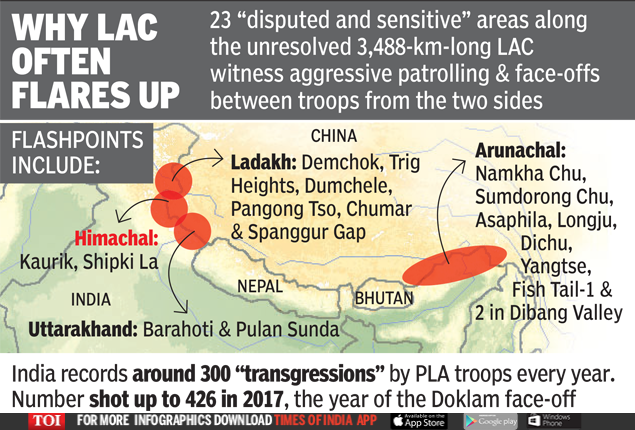
Today's lesson addresses the learning outcome: Analyze the sources of recurring border tensions between China and India. The Sino-Indian border dispute is one of the world's longest-running and most complex territorial conflicts. It is a potent mix of colonial-era ambiguity, post-colonial nationalism, and modern strategic competition between two rising powers. We will trace the historical origins of the dispute, examine the key areas of contention, and analyze the strategic dynamics that continue to fuel tensions today, leading to deadly clashes even in the 21st century.
1. A Colonial Inheritance: The Roots of the Dispute
The fundamental source of the Sino-Indian conflict is the absence of a mutually recognized, clearly demarcated border. The current de-facto boundary, the Line of Actual Control (LAC), emerged from a legacy of ambiguous and competing lines drawn during the British colonial period.
To get a clear overview of the geography and the historical claims, please start by watching this video from Vajiram and Ravi, an Indian educational institute.
HISTORIC! - INDIA & CHINA Withdraws TROOPS | Galwan Valley Clash | Vajiram And Ravi
This video provides a foundational overview of the India-China border, classifying it into three main sectors and explaining the conflicting historical claims that define the dispute.
Please watch from 02:23 to 04:33 and then from 07:12 to 09:33. Focus on: The identification of the Western, Middle, and Eastern sectors. The key disputed territories: Aksai Chin in the West and Arunachal Pradesh in the East. The two competing British-era lines in the Western sector: the Johnson Line and the Macartney-MacDonald Line.
As the video explains, the dispute is rooted in two different interpretations of colonial-era boundaries:
- In the Western Sector (Ladakh): India's claim to the Aksai Chin plateau is based on the Johnson Line of 1865, which placed it within the princely state of Jammu and Kashmir. China's claim is based on the later Macartney-MacDonald Line of 1899, which placed it under Chinese control.
- In the Eastern Sector (Arunachal Pradesh): India's claim is based on the McMahon Line, which was agreed upon in the 1914 Simla Convention between Britain, China, and Tibet. China, however, never ratified the agreement and rejects the line's legitimacy, claiming Arunachal Pradesh as "South Tibet."
This historical ambiguity is not an accident. The British Empire's primary concern was the "Great Game" with Tsarist Russia, and the remote, inhospitable Himalayan frontier was not a priority for precise demarcation.
Sino-Indian Border Dispute: A Brief Introduction
To go deeper into this colonial legacy, this article from E-International Relations provides a detailed scholarly account of why the British left behind such an unresolved and contentious inheritance.
Please read the section titled 'The Border Dispute: A Colonial Legacy'. Pay attention to how British strategic priorities (or lack thereof) led to shifting, informal boundary lines in both the western and eastern sectors.
The key takeaway is that when India gained independence in 1947 and the People's Republic of China was established in 1949, the two new nations inherited a frontier with no agreed-upon legal definition, setting the stage for conflict.
2. The 1962 War and the Creation of the LAC
The simmering dispute erupted into a full-scale war in 1962. Tensions had escalated after China's 1950 invasion of Tibet and its subsequent construction of a strategic highway (G219) through the Aksai Chin plateau, which India claimed as its own territory. India responded with a "Forward Policy," establishing small military posts in the disputed areas to assert its claim, leading to a swift and massive Chinese military response.
HISTORIC! - INDIA & CHINA Withdraws TROOPS | Galwan Valley Clash | Vajiram And Ravi
Let's return to the Vajiram and Ravi video for a concise summary of the 1962 war and its immediate outcome.
Please watch from 09:33 to 11:42. Focus on the immediate causes, India's intelligence failure, and the territorial result of the war.
The war was a decisive military victory for China and a traumatic national defeat for India. China achieved its primary objectives: it secured control over Aksai Chin, thereby protecting its strategic road linking Xinjiang and Tibet. While Chinese forces made deep advances in the eastern sector, they later declared a unilateral ceasefire and withdrew to positions largely behind the McMahon Line.
This outcome created the Line of Actual Control (LAC)—the de-facto boundary that exists today. It is not a legally settled international border but a military-held line reflecting the post-war status quo.
To understand China's strategic calculus, it's crucial to see the war not just as a territorial grab, but as a coercive action to achieve specific goals.
[PDF] China and the Border Dispute with India After 1962
Professor M. Taylor Fravel, a leading expert on China's military, provides a clear analysis of Beijing's motivations for the war. This reading explains why China chose to attack.
Please read the section 'China’s Goals in the 1962 War' (pages 4-5). Identify the three main goals Fravel outlines for China's attack: protecting Tibet, demonstrating resolve, and restoring stability on the frontier from its perspective.
From China's perspective, the war was a punitive action designed to "teach India a lesson," halt the Forward Policy, and compel New Delhi to accept a negotiated settlement on Beijing's terms. This established a pattern of behavior where China uses military force to manage the dispute and restore what it defines as "stability."
3. Modern Tensions: Infrastructure, Deterrence, and Clashes
After decades of relative quiet, border tensions have flared up dramatically since the 2000s. This is not due to new territorial claims, but rather a new phase of competition driven by infrastructure development and shifting strategic postures.
The Infrastructure Race and "Salami Slicing"
A primary source of modern friction is China's massive construction of dual-use infrastructure—roads, railways, airfields, and dams—all along the Himalayas. This effort serves to solidify its control over disputed territory and dramatically improve the PLA's ability to mobilize and sustain forces.
How China is preparing for conflict with India
This video from CaspianReport provides an excellent visual analysis of China's infrastructure projects and explains their strategic purpose.
Please watch from the beginning to 01:19 and then from 02:53 to 08:50. Pay attention to: How infrastructure building redefines territorial claims by establishing 'presence'. The specific upgrades to highways and airports that create military corridors. The strategic implications of China's mega-dams on rivers flowing into India (hydro-hegemony).
This strategy is often described as "salami slicing"—taking small, incremental actions that, individually, do not warrant a major response but collectively change the strategic landscape over time. India has responded by racing to build its own border infrastructure, leading to a classic security dilemma: each side's defensive actions are perceived as threatening by the other, fueling a cycle of mistrust and escalation.
Case Study: The 2020 Galwan Valley Clash
This infrastructure race has brought troops into closer and more frequent contact, leading to standoffs and clashes. The most serious of these was the June 2020 clash in the Galwan Valley, where soldiers fought with crude, non-firearm weapons, resulting in the first combat fatalities on the border in 45 years.
HISTORIC! - INDIA & CHINA Withdraws TROOPS | Galwan Valley Clash | Vajiram And Ravi
The Vajiram and Ravi video provides a detailed timeline of the events leading up to the deadly 2020 clash.
Please watch the 'chronology of the recent clashes' from 11:42 to 15:44. Note how a series of small scuffles and troop buildups over several weeks escalated into a fatal confrontation.
The Galwan clash was significant because it shattered the relative peace that had been maintained by a series of confidence-building agreements signed in the 1990s and 2000s. It demonstrated that the underlying dispute remained volatile and that the new era of close-proximity patrolling and competitive infrastructure building had created dangerous conditions for rapid escalation.
The Overarching Strategic Logic
Why does China continue to press its claims and risk conflict? From Beijing's perspective, this is about more than just territory. As M. Taylor Fravel argues, China views the Indian border as a "secondary strategic direction." Its primary focus is on Taiwan and the Western Pacific. The goal on the Indian border is to maintain stability through deterrence.
How China is preparing for conflict with India
Let's return to the CaspianReport video for a sharp analysis of this deterrence logic.
Please watch from 10:36 to 14:07. The video argues that China's Himalayan buildup is not for launching an offensive, but for preventing one. Focus on understanding this 'second front' logic: how does strengthening its position in the Himalayas deter India from acting if China is preoccupied with a conflict elsewhere (e.g., Taiwan)?
This logic creates a dangerous paradox. From China's view, its buildup is defensive deterrence. From India's view, it is offensive coercion. This perception gap is a central source of recurring tension.

Conclusion
The recurring tensions between China and India are not the result of a single cause but a complex interplay of historical, strategic, and political factors.
Key Takeaways:
- Colonial Legacy: The absence of a mutually agreed border, a direct result of ambiguous British colonial demarcation, is the original source of the dispute.
- The 1962 War: This conflict established the de-facto Line of Actual Control (LAC) and left a deep psychological scar, particularly in India, shaping national perceptions of the threat from China.
- Infrastructure Race & Security Dilemma: In the modern era, tensions are driven by a competitive race to build roads, airfields, and other military infrastructure, which brings troops into dangerous proximity and fuels mutual suspicion.
- Strategic Deterrence: China views its actions as a way to deter India and secure a "secondary front," ensuring India cannot take advantage of a potential conflict elsewhere. India, however, perceives this as aggressive expansionism.
- Competing Nationalisms: Ultimately, both nations view the disputed territories through a lens of national sovereignty and historical right, making compromise politically difficult for leaders in both Beijing and New Delhi.
Preview of the Next Lesson:
Having examined the complex relationship with India, we will continue our tour of China's continental periphery. In the next lesson, we will focus on another strategically vital area: the Korean Peninsula. We will analyze China's strategic interests and policy approach toward both North and South Korea, exploring its role as an ally, a security provider, and an economic partner.