Day 8: The Rationale for Intervention: Fixing Broken Markets
Yesterday’s Bridge:
Yesterday, we diagnosed the specific ways markets can fail, identifying problems like externalities, public goods, and information asymmetries. Today, we shift from diagnosis to prescription, exploring the fundamental rationale for government intervention and the main tools governments use to correct these market failures.
The Core Concept: The Rationale and Tools of Intervention
The core rationale for government intervention is to correct market failures, with the goal of aligning private incentives with broader social welfare. When the "invisible hand" fumbles and leads to inefficient or undesirable outcomes, the government can step in to guide the market toward a more socially optimal result.
While there are many reasons for government action, correcting market failures is a primary economic justification.
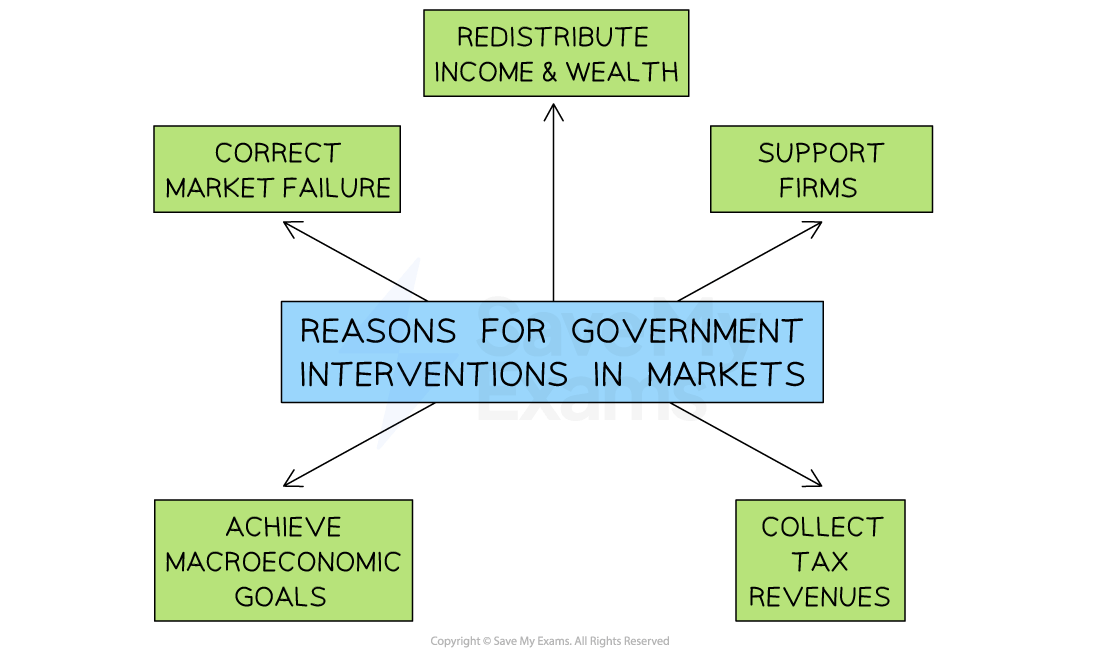
The key question is not if the government should intervene, but how and when. The main approaches can be broadly categorized into two types: direct regulation and market-based policies.
1. Regulatory Policies: The "Command and Control" Approach
The most direct form of intervention is through regulation. These are rules and laws that either require or forbid certain behaviors.
- To correct negative externalities: Governments can ban harmful activities (e.g., dumping toxic waste), set limits on pollution (e.g., emissions standards for cars), or require the adoption of specific technologies.
- To correct information asymmetries: Governments can mandate information disclosure (e.g., nutritional labels on food) or require professional licensing (e.g., for doctors and pilots) to ensure a minimum quality standard.
- To provide public goods: Governments can use regulation to ensure public access, such as laws guaranteeing universal access to emergency services.
Market Failures, Taxes, and Subsidies: Crash Course Economics #21
To understand the logic and application of regulatory policies, let's watch this segment from Crash Course Economics.
Watch from 06:23 to 08:12. Notice how regulations are used not only to limit negative externalities (like pollution) but also to generate positive ones (like compulsory education).
2. Market-Based Policies: Adjusting Incentives
Instead of commanding behavior, market-based policies use the price mechanism itself to change incentives. The goal is to make private costs and benefits reflect the true social costs and benefits.
- Taxes (to discourage negative externalities): By taxing goods that create external costs (e.g., cigarettes, gasoline, carbon emissions), the government increases the private cost for producers and consumers, leading them to produce and consume less. These are often called Pigouvian taxes.
- Subsidies (to encourage positive externalities): By providing subsidies for goods that create external benefits (e.g., university education, R&D for new technologies, solar panel installation), the government lowers the private cost, encouraging more production and consumption.
- Tradable Permits (Cap-and-Trade): This is a hybrid approach. The government sets a total limit ("cap") on a negative externality like pollution. It then issues permits to firms, which can be bought and sold ("trade"). This creates a market for the externality itself, incentivizing firms that can reduce pollution cheaply to do so and sell their permits to firms for whom it is more costly.
Market Failures, Taxes, and Subsidies: Crash Course Economics #21
The Crash Course video also explains these market-based policies clearly.
First, watch the segment on taxes and subsidies from 08:12 to 09:23. Then, watch the explanation of 'cap and trade' from 09:23 to 10:28 to see a real-world market-based solution in action.
Test your understanding!
A city government wants to reduce traffic congestion (a negative externality). It is considering two policies:
- Banning cars with only one occupant from downtown during rush hour.
- Implementing a "congestion charge," where every car entering downtown during rush hour pays a fee.
Which policy is regulatory, and which is market-based?
Show answer
Policy 1 (banning certain cars) is regulatory. It is a direct command-and-control rule.
Policy 2 (the congestion charge) is market-based. It uses a price (the fee) to change the incentives for drivers, making them internalize the cost of the congestion they create.
Illustrative Example & The "So What?" Factor
Understanding these intervention tools is critical for a strategist, as they are the weapons of modern economic statecraft.
-
The EU's Carbon Border Adjustment Mechanism (CBAM): The EU has a "cap-and-trade" system for carbon emissions. To prevent its industries from being undercut by competitors in countries with no carbon price (a phenomenon called "carbon leakage"), the EU is implementing the CBAM. This is essentially a tax on imports from countries without equivalent climate policies. Geopolitical Implication: This is a direct use of a market-based policy to influence the economic and environmental policies of other nations. It forces trade partners like China, India, and Turkey to either decarbonize their industries or face a significant tax, turning climate policy into foreign policy.
-
The US CHIPS and Science Act: This act provides over $50 billion in subsidies to encourage the construction of semiconductor fabrication plants in the United States. The rationale is twofold: it supports the positive externalities of domestic R&D and high-tech manufacturing, and it addresses the national security risk of relying on fabrication plants in Taiwan. Geopolitical Implication: This is a clear example of "industrial policy" aimed directly at competing with China in a critical technology sector. It reshapes global supply chains and signals a move away from pure free trade toward strategic, government-guided competition.
-
Direct Provision of a Public Good - GPS: The Global Positioning System (GPS) was developed and is maintained by the U.S. military, funded by taxpayers. It is a global public good. Geopolitical Implication: By providing this service for free, the U.S. has created immense economic value and soft power. However, this has also spurred rivals (Russia with GLONASS, China with BeiDou, EU with Galileo) to develop their own systems to reduce their strategic dependence on a U.S.-controlled asset.
Anchor Resource
The Organisation for Economic Co-operation and Development (OECD) is a central player in analyzing how and why governments intervene. Their recent report on the "return of industrial policies" is a perfect anchor document, as it outlines the modern justification for these interventions.
The return of industrial policies (EN)
This OECD policy paper, 'The return of industrial policies', provides a high-level summary of the theoretical justifications for government intervention in today's context.
Please read paragraph 11 in the section '3.1. Motivations for industrial policies' (page 14). This paragraph directly states the core rationale: unpriced externalities, public goods, and other social costs are the theoretical justification for intervention. Notice how it also includes national security and regional disparities—key concerns for a geopolitical analyst.
Daily Challenge
Your task is to identify these interventions in the wild. Choose a major economy (e.g., Germany, Japan, India) and find one recent, specific example for each of the following:
- A subsidy intended to create a positive externality (e.g., for green energy, electric vehicles, or research).
- A tax or regulation intended to curb a negative externality (e.g., a plastic tax, emissions standards, or rules on industrial waste).
For each, briefly describe the policy and its stated goal. This will train you to see policy not just as news, but as a deliberate government tool.
Next Day Preview
We've now covered the core microeconomic principles and understand why governments might intervene in the economy. But where does the money for subsidies, public goods, and regulatory agencies come from? Tomorrow, we open the government's books to begin our study of fiscal policy, starting with the main components of a government's budget: revenues, expenditures, and deficits.