Hello! Welcome to your next lesson.
In our last session, we explored "The Third Level," where Charley's frustration with the modern world led him to seek escape as a solution to his alienation. Today, we turn to "On the Face of It" by Susan Hill, a play that offers a powerful alternative: overcoming alienation not by escaping the world, but by finding genuine connection within it.
Our learning outcome is to analyze the relationship between Derry and Mr. Lamb to explain the theme of overcoming alienation. We will examine how their interaction challenges their initial isolation and leads to a profound transformation, all while practicing with questions similar to those you'll face in your exam.
1. Two Worlds of Loneliness: Derry and Mr. Lamb
The play introduces two characters who are physically disabled and isolated, but who cope with their loneliness in starkly different ways.
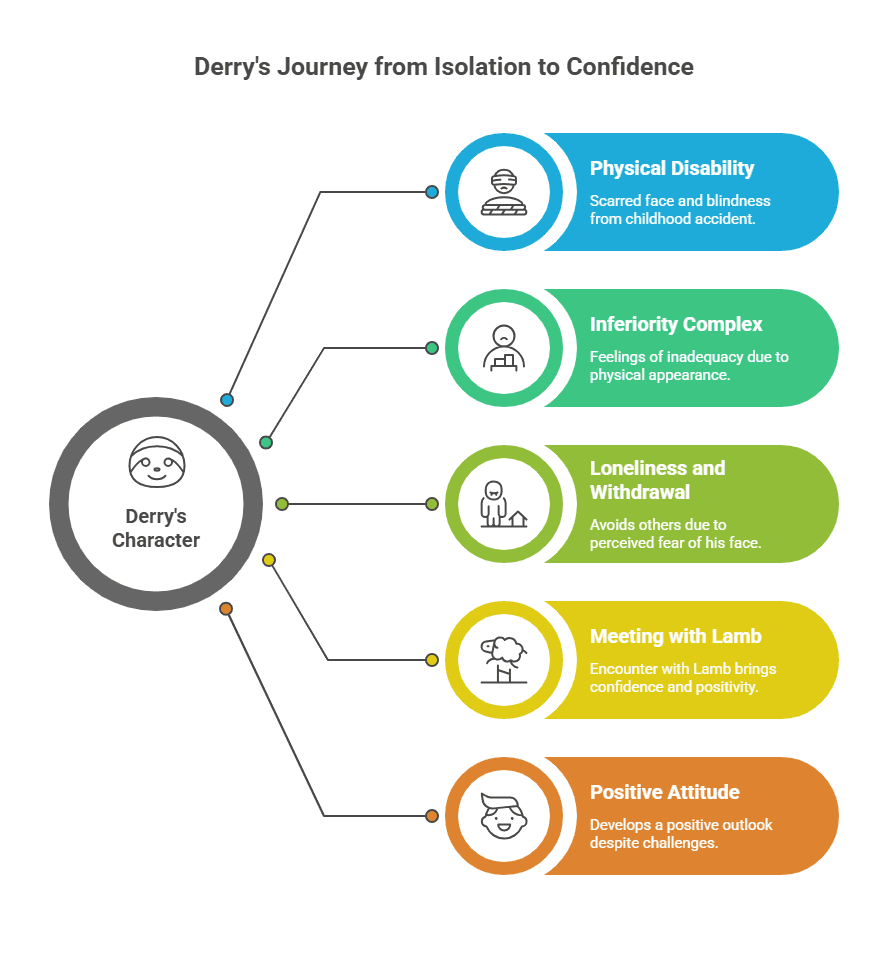
- Derry: A fourteen-year-old boy whose face is scarred by acid. He is bitter, withdrawn, and consumed by self-hatred, believing everyone pities or fears him.
- Mr. Lamb: An old man with a tin leg. He is optimistic, open, and finds joy in the world around him, despite being the subject of children's teasing.
To get a quick overview of their contrasting personalities, let's watch a short summary.
On The Face of It Class 12 English | Summary, Theme, Q&A | CBSE Board Exam 2026| By Dear Sir |
This clip from Dear Sir English provides a quick and clear introduction to Derry and Mr. Lamb, outlining their physical disabilities and, more importantly, their opposing mindsets.
Watch from 00:10 to 03:01. Focus on the descriptions of Derry's 'inferiority complex' and Mr. Lamb's 'optimistic' and 'positive' nature.
Derry’s alienation is not just because of his scar, but because of his belief that the scar defines him entirely. This self-pity is the prison he needs to escape from.
2. A "Peculiar" Encounter: Challenging Perceptions
Derry enters Mr. Lamb's garden seeking solitude, but instead finds an unexpected conversation. He finds Mr. Lamb's way of speaking "peculiar." This is a key moment in their relationship. Let's analyze why, using a question from your provided exam paper (Q.P. Code 1/1/1, Q.11(iii)) as our guide.
‘You speak Peculiar Things.’ Why does Derry find Mr. Lamb’s conversation peculiar? (On the Face of it)
This is a frequently asked question. To understand the answer, watch the following analysis.
On The Face of It Class 12 English | Most Important PYQs, Extract & Competency Questions
This video by Sunil Panda directly explains why Derry finds Mr. Lamb's conversation so strange. It gets to the heart of their initial interaction and what makes Mr. Lamb different from everyone else Derry has met.
Watch the segment from 06:50 to 09:11. Pay close attention to the contrast between how society (pity/fear) treats Derry versus how Mr. Lamb treats him (normal, kind conversation).
As the video explains, Derry is used to two reactions: pity or fear. Mr. Lamb offers neither. He speaks to Derry as an equal, discussing simple things like the wind, light, and darkness. He doesn't focus on Derry's face or his own tin leg. This normal, kind, and accepting conversation is so unusual for Derry that he finds it "peculiar." It's the first step in breaking down Derry's wall of isolation because Mr. Lamb sees a person, not just a disability.
3. The Philosophy of Acceptance
The relationship between Derry and Mr. Lamb is built on Mr. Lamb's life-affirming philosophy. He actively teaches Derry to see the world, and himself, differently. His key ideas are:
- No Distinction: He sees no difference between a "weed" and a "flower," stating, "It's all life... growing. Same as you and me." This challenges Derry's belief that his scar makes him inferior.
- Openness: Mr. Lamb keeps his gate open and has no curtains on his windows because he is "not fond of... shutting things out, shutting things in." He embraces the world, and by extension, welcomes Derry into it.
- Perception is Key: He tells Derry that bees can be heard as "buzzing" or "singing" depending on one's attitude. The world isn't inherently ugly or hostile; our perception shapes our reality.
The contrast in their attitudes is a common long-answer question. Let's explore a model answer that breaks down this central theme.
On The Face of It Class 12 English | Most Important PYQs, Extract & Competency Questions
This next clip provides a detailed comparison and contrast of Derry and Mr. Lamb. It's a perfect resource for preparing a long-answer question on their relationship and the theme of overcoming alienation.
Watch from 13:59 to 16:41. Notice how the answer is structured: it starts with their shared disability, contrasts their attitudes (pessimism vs. optimism), and concludes by showing how Mr. Lamb's ideas help Derry change.
Mr. Lamb's optimism isn't naive; it's a conscious choice. He accepts his reality ("Lamey-Lamb") without letting it embitter him. By sharing this perspective, he gives Derry the tools to re-evaluate his own life and see that he is more than just his "ugly" face.
4. The Transformation: Choosing Connection Over Isolation
The climax of Derry's emotional journey is his decision to return to Mr. Lamb's garden, defying his mother's warnings. His mother represents the fearful, prejudiced society that has kept him isolated. By returning, Derry makes a conscious choice to embrace connection and Mr. Lamb's philosophy.
He tells his mother:
"Because if I don’t go back there, I’ll never go anywhere in this world again."
This line shows that he understands that retreating back into isolation would mean a life of permanent emotional imprisonment. Mr. Lamb's garden has become a symbol of acceptance and hope that he must fight to hold onto.
A powerful way to understand this transformation is to imagine Derry reflecting on Mr. Lamb's influence after his death. This is a popular creative writing question in board exams.
Derry's Speech at Mr. Lamb's Funeral
This webpage contains a model answer for a long-answer question where Derry gives a speech at Mr. Lamb's funeral. Reading this will help you internalize the profound change in Derry's character.
Find Question 8 under the '2024 Board Exam' section, which starts 'Imagine you are Derry speaking at the funeral of Mr. Lamb...'. Read the model answer carefully. Note how Derry acknowledges his past fear and credits Mr. Lamb for teaching him to see beyond his physical appearance.
Though Mr. Lamb's death is tragic, his legacy lives on through Derry. He has successfully passed on his message of hope and acceptance, ensuring Derry will not return to his old, alienated self.
Conclusion
Today, we've analyzed how the powerful relationship between Derry and Mr. Lamb serves as the central mechanism for overcoming alienation in "On the Face of It."
Key Takeaways:
- Alienation's Root: Derry's alienation stems not just from his physical scar, but from his deep-seated self-hatred and the belief that he is unworthy of acceptance, a feeling reinforced by society's prejudice.
- The Power of Acceptance: Mr. Lamb's relationship with Derry is transformative because he offers genuine, non-judgmental acceptance. He treats Derry as an individual, not a victim.
- Choosing Connection: Ultimately, the play argues that the antidote to alienation is not escape, but the courageous choice to form meaningful connections and adopt a positive, open perspective towards life.
Preview of the Next Lesson:
This lesson concludes our study of the individual texts. In our final session, we will focus on the Capstone: Mastering Long Answer Questions. We will learn how to deconstruct comparative questions and structure a cohesive, evidence-based argument, for instance, by analyzing characters like William Douglas from "Deep Water" and Mukesh from "Lost Spring" together. This will equip you with the writing skills needed to excel in the literature section.