Hello! Welcome to your lesson.
In our previous session, we broke down how to write concise, comparative short answers by contrasting the perspectives of Derry and Mr. Lamb. We focused on how their attitudes, not their disabilities, shaped their lives.
Today, we'll shift our focus to the Vistas chapter, "Journey to the End of the Earth." We will concentrate on a frequently tested topic from this chapter. Our learning outcome is to explain the significance of the 'Students on Ice' programme as a tool for perspective change. We'll approach this, as you prefer, by looking at how to answer exam questions on this specific theme. This is a crucial topic for your board exam preparation.
1. Understanding the 'Students on Ice' Programme
Before we analyze its significance, let's establish a clear understanding of what the programme is. The chapter provides a lot of context, but for exam purposes, we need to be precise.
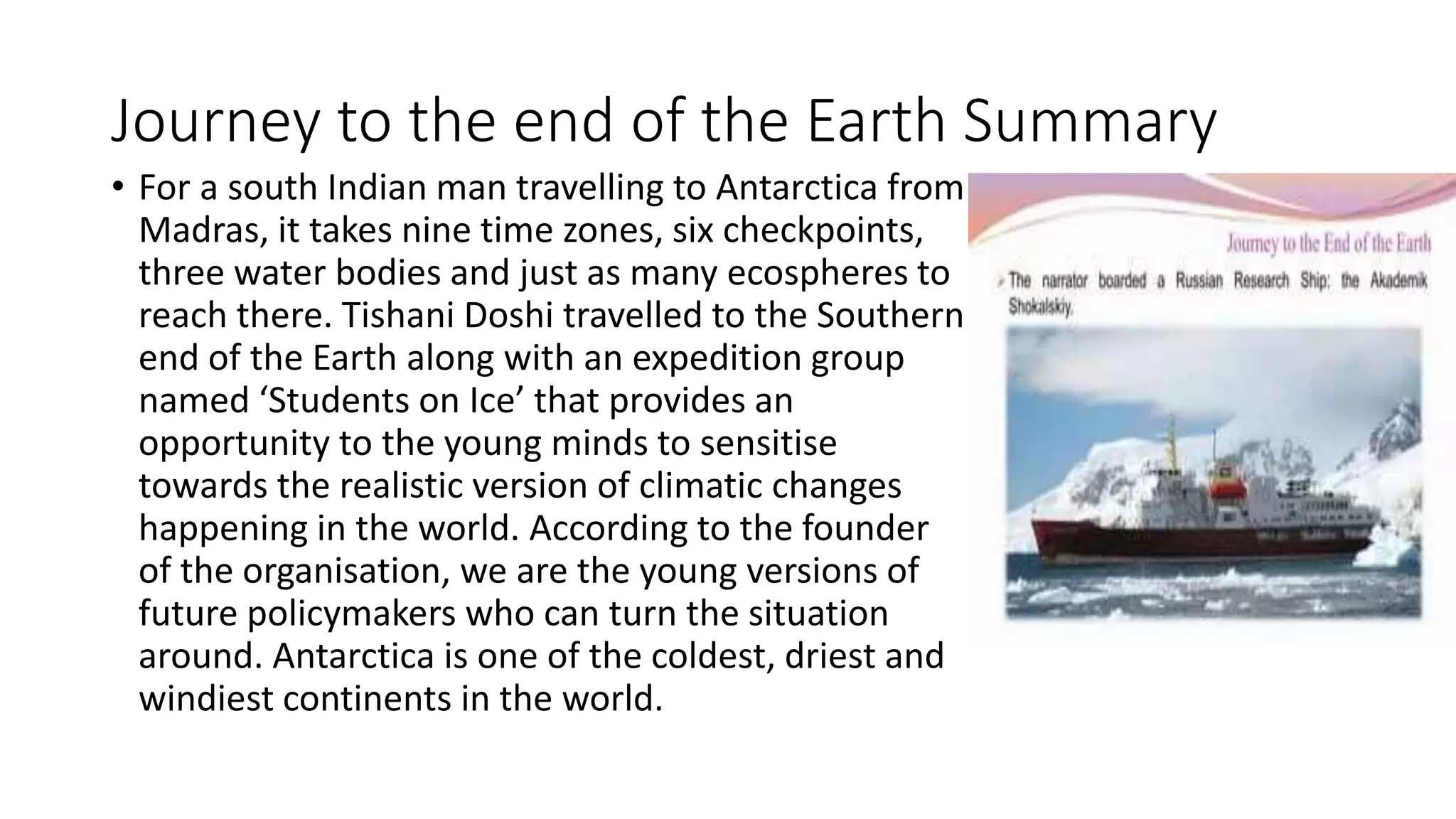
To get a quick, targeted summary, let's watch a short video clip.
Journey to the end of earth class 12 english important questions
This video by Simran Sahni provides an excellent, exam-focused definition of the 'Students on Ice' programme. It covers the 'who, what, and why' in a very clear manner.
Please watch the segment from 07:54 to 08:33. Focus on identifying the founder of the programme, its target participants, and its main objective.
From the video and the text, we can distill the core facts:
- What it is: An educational expedition to Antarctica.
- Who started it: A Canadian educator named Geoff Green.
- Who it is for: High school students.
- Primary Goal: To expose students directly to the realities of climate change and create a new generation of environmentally-conscious leaders.
2. The Rationale: Why Students?
A key question the chapter addresses is why Geoff Green stopped taking celebrities and wealthy tourists, and started focusing exclusively on high school students. Understanding his reasoning is fundamental to explaining the programme's significance.
His decision was based on a long-term vision, or farsightedness.
Let's watch another clip that directly explains this rationale.
Journey to the end of the earth | Class 12 | Most Important PYQs, Extract & Competency Questions
This explanation from Sunil Panda's channel directly addresses why Geoff Green chose students. It contrasts them with the previous participants (celebrities) and explains why students are the ideal agents for change.
Watch the clip from 23:04 to 24:33. Note down the key reasons why students are considered 'future leaders' who will 'respect the planet'.
The core reasons for choosing students are:
- They are the future generation of policy-makers who will lead nations and make important decisions.
- Unlike retired celebrities, they are at an age where they are impressionable and ready to absorb, learn, and most importantly, act.
- They possess the idealism, energy, and time to become advocates for the environment.
Geoff Green realized that creating real change wasn't about getting donations from the rich, but about planting the seeds of awareness in the minds of future leaders.
3. The Mechanism: How the Programme Changes Perspectives
The programme is a "tool for perspective change" because of how it teaches. It replaces abstract knowledge with a direct, visceral experience. The chapter highlights this powerfully:
"It’s easy to be blasé about polar ice-caps melting while sitting in the comfort of our respective latitude and longitude, but when you can visibly see glaciers retreating and ice shelves collapsing, you begin to realise that the threat of global warming is very real."
This is the central mechanism. Reading about climate change in a textbook is one thing; witnessing it firsthand is another. By taking students to Antarctica, the programme:
- Makes the threat tangible: Students see the melting ice with their own eyes.
- Creates an emotional impact: The experience fosters a sense of urgency and responsibility.
- Transforms perspective: It shifts their view from passive concern to an active desire to protect the planet.

4. Application: Answering Exam Questions
Now, let's apply this understanding to a typical short-answer question, like the one from the CBSE paper you provided (Q.P. Code 1/1/1).
Question: ‘Students on Ice Programme’ proves Geoff Green’s farsightedness. Explain with reference to the text of ‘The Journey to the End of the Earth’. (40-50 words) [From resource LINK, Q2]
To answer this effectively, you need to connect "farsightedness" to the choice of "students" and their potential as "future policy-makers."
Let's study a model answer from a reliable source.
Journey to the End of the Earth Previous Years Question with ...
The resource 'Journey to the End of the Earth Previous Years Question with ...' provides a very concise and accurate answer to this exact question. Let's analyze it.
Read Question 2 and its answer. You'll find it right after the extract-based questions. Notice how it links Green's choice of students to the goal of influencing future policy.
Deconstructing the Model Answer:
The answer in the resource is effective because it hits all the key points within the word limit:
- Who: High school students (future policy-makers).
- What: An expedition to experience rising temperatures and melting ice shelves.
- Why (Farsightedness): To make them estimate the trouble mankind is headed for, thereby sensitizing them to act in the future.
Here is a slightly refined version you can use:
Geoff Green’s farsightedness is clear in his ‘Students on Ice’ programme. He chose high school students, the future policy-makers, over celebrities. He wanted them to witness the effects of global warming firsthand, hoping this life-changing experience would inspire them to act and protect the planet in the future.
This answer is approximately 50 words and directly explains why the programme demonstrates foresight.
Conclusion
You have now analyzed the 'Students on Ice' programme from an examination perspective. By understanding its purpose, rationale, and mechanism, you are well-equipped to tackle any short-answer question on this topic.
Key Takeaways:
- Significance: The programme is significant because it aims to create future environmental leaders by providing a direct, transformative experience.
- Farsightedness: Geoff Green's genius was in realizing that educating the youth is the most powerful long-term strategy for protecting the planet.
- Mechanism of Change: The programme's power lies in making climate change a visible, tangible reality, moving it from a distant concept to an urgent personal mission.
Preview of the Next Lesson:
In our final lesson, Capstone: Mastering Long Answer Questions, we will build on the analytical skills from this and previous lessons. We will learn how to structure a detailed, evidence-based argument for 120-150 word questions, including those that require comparing characters or themes across different texts.