Hello! Welcome back to your focused preparation for the CBSE English exam.
In our last lesson, we established the core theme of Pablo Neruda's 'Keeping Quiet': the call for collective silence and stillness to enable introspection. We saw how this creates what the poet calls an "exotic moment."
Today, we will build directly on that foundation. This lesson is dedicated to mastering the interpretation of the key images Neruda uses to describe that moment. Specifically, we will focus on understanding what the 'exotic moment' truly entails and what is symbolized by the 'fisherman... not harm whales' and the 'man gathering salt... look at his hurt hands'. By the end of this session, you will be able to confidently analyze and answer context-based questions on this crucial stanza.
1. Visualizing the 'Exotic Moment'
Let's begin by looking at the specific stanza that is so often featured in exams. The images within it are central to the poem's message.
It would be an exotic moment
without rush, without engines,
we would all be together
in a sudden strangeness.Fishermen in the cold sea
would not harm whales
and the man gathering salt
would look at his hurt hands.
This stanza paints a picture of a world paused.
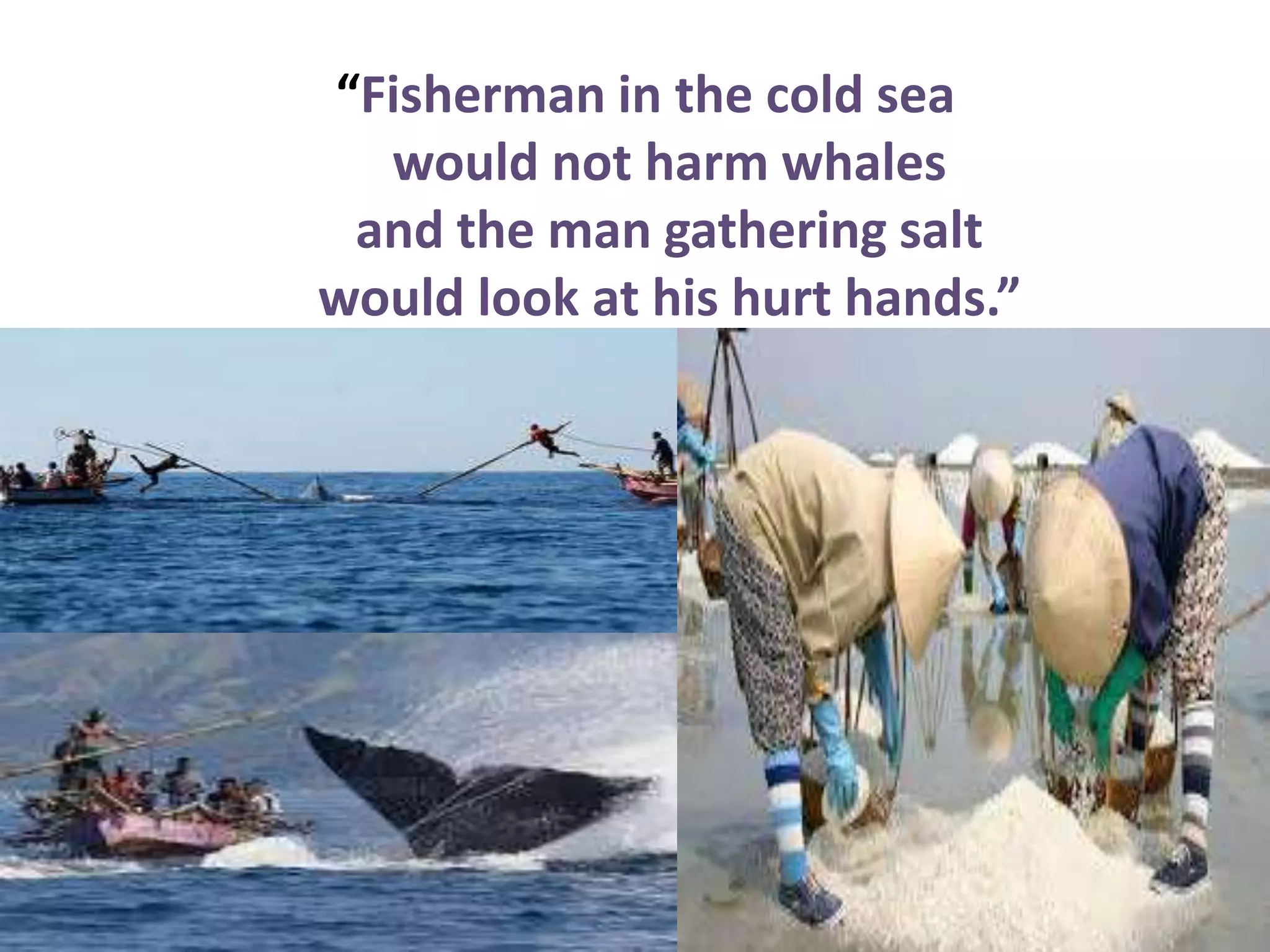
The poet is not just describing a lack of noise; he is illustrating a profound shift in human activity and awareness. To fully grasp the meaning of these images, we will break them down one by one.
2. Deconstructing the Imagery: From Strangeness to Self-Awareness
The "exotic moment" is characterized by a "sudden strangeness." This isn't a negative feeling, but rather the unique and unfamiliar sensation of global unity and peace. The absence of "rush" and "engines" signifies a break from the frantic, mechanical pace of modern life that often prevents us from thinking.
This pause has two immediate, symbolic consequences: one directed outward (towards nature) and one inward (towards ourselves).
To see how experts deconstruct this for exam answers, please watch the following video analysis. It directly tackles extract-based questions related to this stanza.
Keeping Quiet Class 12 | Central Idea and Extract Based Questions | Class 12 English
This clip from the 'Commerce Adda Class 12' channel provides an excellent, question-by-question analysis of this specific extract. It explains the meaning of each image in the context of answering exam questions.
Please watch from 09:17 to 14:10. The instructor will walk you through questions like 'What does the poet mean by exotic moment?' and will explain the significance of the fisherman and the salt gatherer.
As the video explains, the imagery works on two levels:
- Fishermen would not harm whales: This represents a cessation of humanity's thoughtless destruction and exploitation of the natural world. In the moment of quiet, the fisherman has a chance to reflect on his actions and stops his harmful activity.
- The man gathering salt would look at his hurt hands: This is a powerful image of self-introspection. In the daily grind ("rush"), the man is so focused on his work that he doesn't even notice the pain he is inflicting upon himself. The pause gives him a moment to become aware of his own suffering and the consequences of his relentless actions.
Together, these images show that the stillness Neruda desires leads to a more humane and aware existence, healing our relationship with both nature and ourselves.
3. Applying Your Understanding to Exam Questions
Now, let's practice applying this understanding, just as you would in the exam hall. Your provided past paper (Q.P. Code 1/1/1) contains the very extract we have been discussing.
Let's use a resource that provides written answers for these types of questions. This will help you see how the concepts we've discussed are phrased in a model answer.
Keeping Quiet Previous Years Question with Answers
This resource from SuccessCDS.net contains a set of questions and answers for the 'exotic moment' extract, similar to the one in your paper. Reading through them will solidify your understanding.
Find 'Q2. Read the following extracts and answer the questions' which begins with 'It would be an exotic moment'. Please read through all the sub-questions (i to vi) and their corresponding answers. Notice how the answers define the 'exotic moment' and link introspection to a better life.
Practice with a Different Question Format
Now, let's tackle a short-answer question that focuses on the same imagery. This tests your ability to synthesize the information without the guidance of multiple-choice options.
Question: (Based on 2019 CBSE Paper)
Give examples from ‘Keeping Quiet’ to show that Neruda was a peace-loving person who cared for both humans and nature.
Think about your answer: How would you use the imagery of the fisherman and the salt gatherer to answer this?
Now, review a model answer.
Keeping Quiet Previous Years Question with Answers
Here is a model answer to the question above. Compare it with the points you considered.
Please read the answer provided for Q4, which starts with 'Give examples from ‘Keeping Quiet’...'. Note how it concisely uses the examples of the fishermen and the salt gatherer to prove the point.
The model answer demonstrates how to effectively use these specific images as textual evidence to support a claim about the poet's philosophy.
Conclusion
This lesson has been a deep dive into the most significant imagery of 'Keeping Quiet'. By understanding what these symbols represent, you can unlock the poem's deeper meaning and craft more insightful exam answers.
Key Takeaways:
- The 'exotic moment' is a rare and peaceful state of collective stillness, free from the noise and rush of daily life, leading to a feeling of 'sudden strangeness' or universal brotherhood.
- The image of the 'fisherman not harming whales' symbolizes a pause in humanity's destructive actions against the natural world.
- The 'man gathering salt looking at his hurt hands' symbolizes the moment of self-reflection when we become aware of the physical and spiritual harm our own relentless actions cause us.
- Interpreting these images correctly is key to answering extract-based questions effectively.
Preview of the Next Lesson:
We have now thoroughly covered 'Keeping Quiet'. In our next session, we will move to the second high-priority poem, 'A Thing of Beauty' by John Keats. We will analyze how Keats presents beauty as a constant source of joy and solace, and we will practice interpreting its key images, such as the 'bower quiet' and the 'flowery band', using our question-driven approach.