Welcome to your first lesson on the Hubbard model. Our goal in this course is to build a deep, working understanding of this cornerstone model of modern condensed matter physics, preparing you for theoretical research in the field. To do that, we must first build our toolkit. The language of modern many-body theory is second quantization, and over the next few lessons, we will construct this formalism from the ground up.
Today, our focus is on the "why." Before diving into the mechanics of second quantization, it's crucial to understand why the familiar quantum mechanics you've mastered—often called "first quantization"—becomes unwieldy and impractical when faced with the vast number of interacting electrons in a solid. This lesson will explore the limitations of the first-quantized approach and motivate the shift in perspective that leads to the more powerful second-quantized framework.
The Challenge of Many Bodies
From your studies in quantum mechanics, you are well-acquainted with describing a system using a wavefunction that depends on the coordinates of all particles involved. For an -particle system, this is a function , where represents the position and spin of the -th particle. The evolution of this wavefunction is governed by the Schrödinger equation.
The first hint of trouble comes from the sheer size of the state space. As you can imagine, dealing with the electrons in a typical solid is a formidable task.
Chapter 4 Introduction to many-body quantum mechanics
To appreciate the scale of this complexity, please read the first section of this document from ETH Zurich.
Read the section titled "The complexity of the quantum many-body problem". Pay close attention to the argument about how the dimension of the Hilbert space scales exponentially with the number of particles, d^N. The example of just 30 spin-1/2 particles highlights how quickly the problem becomes computationally intractable even for a small system, let alone a macroscopic solid.
The Indistinguishability Complication: Fermionic Antisymmetry
The exponential growth of the Hilbert space is just the beginning. The situation is further complicated by a fundamental principle of quantum mechanics: identical particles are indistinguishable. For electrons, which are fermions, this means the total many-body wavefunction must be antisymmetric with respect to the exchange of the coordinates of any two electrons:
This antisymmetry requirement, which is the origin of the Pauli exclusion principle, must be built into any valid description of the system. The standard way to enforce this in first quantization is by constructing basis states as Slater determinants.
A wonderful video by Dr. Mitchell explains this construction and the problems it leads to.
This video provides an excellent and clear motivation for moving beyond the first-quantized picture.
Please watch the segment from constructing basis states. This part explains how the product states of single-particle orbitals fail to have the correct symmetry and introduces the Slater determinant as the proper way to construct an antisymmetric basis state for N fermions. Then, watch the following segment from problems with first quantization. This section is the core of today's lesson. It clearly articulates the three major drawbacks of this formalism.
As you just saw, the first-quantized formalism, while formally correct, presents several severe practical and conceptual problems:
-
Computational Intractability: A single basis state, a Slater determinant, is a sum of terms. When you calculate the expectation value of an operator, , you need to handle on the order of terms. Given your experience with computational projects, you can immediately see that a factorial scaling makes any direct calculation for more than a handful of particles impossible.
-
Redundant Information: The wavefunction keeps track of which specific particle is in which state (e.g., "particle #5 is at position "). But since the particles are identical, this information is physically meaningless. The only meaningful statement is about the set of occupied states, not which particle occupies which state.
-
Fixed Particle Number: The framework is built for a fixed number of particles, . This is cumbersome in statistical mechanics, where it is often far more convenient to work in the grand canonical ensemble, allowing the particle number to fluctuate around an average value.
These issues make it clear that we need a more efficient and conceptually cleaner way to think about many-body systems.
A New Perspective: The Occupation Number Representation
The solution lies in a fundamental shift of perspective. Instead of labeling the particles, we label the available single-particle quantum states. We then describe the many-body state not by listing particle coordinates, but by specifying the number of particles occupying each state.
This is the occupation number representation. A basis state is written as:
Here, is the number of particles in the single-particle state . For fermions, the Pauli exclusion principle simplifies this dramatically: an electron can either be in a state or not. Thus, the occupation numbers can only be 0 or 1.
The collection of all possible occupation number states, for all possible total particle numbers, constitutes a new, larger Hilbert space called Fock space.
This text from the University of British Columbia provides a concise summary of the problems with first quantization and introduces the occupation number basis.
First, quickly read the section "The origin of these complications" at the end of section 2.1. It neatly summarizes the issue of "useless information" that we discussed. Next, read the beginning of section 2.2, titled "2nd quantization". This formally introduces the abstract vectors |n_1, n_2, \ldots \rangle and the concept of Fock space.
This new representation elegantly sidesteps the problems of first quantization:
- Indistinguishability is built-in: By describing the state by occupation numbers, we have thrown away the meaningless particle labels. There is no concept of "exchanging" particles, only of changing the occupation of states. The Pauli principle is simply the rule that .
- No redundant information: The description is maximally efficient. It contains only the physically relevant information: which single-particle states are occupied.
- Variable particle number: Fock space contains states with any number of particles (), from zero (the vacuum state ) to infinity. It is the natural arena for grand canonical descriptions.
The image below provides a powerful visual for the occupation number concept, comparing a system of bosons with a system of fermions at low temperature.
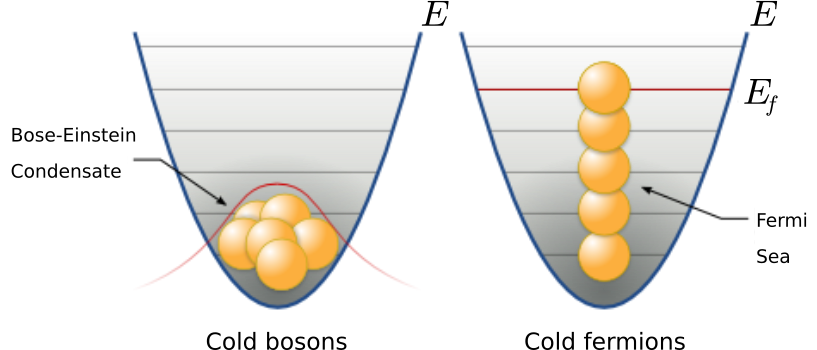
This shift from particle-labeled wavefunctions to occupation-labeled states is the conceptual heart of second quantization. The formalism itself provides the mathematical machinery—the operators—to work within this new picture.
Conclusion
In this lesson, we established the need for a new formalism to tackle many-fermion systems. We saw that the first-quantized approach, based on explicitly antisymmetrized wavefunctions like Slater determinants, suffers from three critical flaws: crippling computational complexity, the inclusion of physically meaningless information, and an awkwardness in handling systems with variable particle numbers.
The key takeaway is that a more natural description for identical particles is the occupation number representation, where we specify how many particles populate each available single-particle state. This perspective, which is the foundation of second quantization, automatically handles particle indistinguishability and the Pauli principle in a much more elegant and efficient way.
In our next lesson, we will begin to build the mathematical tools of this new framework. We will define the fundamental objects of second quantization: the fermionic creation and annihilation operators. These operators will allow us to add or remove particles from specific states, and we will see that their algebraic properties—their anticommutation relations—encode the essential physics of fermions.