Hello! In our last lesson, you did an excellent job mastering the relationship between the angle at the center and the angle at the circumference. Today, we'll build directly on that knowledge to explore a new theorem that is both elegant and extremely useful for solving IGCSE exam problems: angles subtended by the same arc at the circumference are equal.
This lesson will guide you through defining and proving this theorem, and most importantly, applying it to find unknown angles. You'll see that this rule is a direct and logical consequence of the one you learned previously. By the end of our session, you'll be able to spot this pattern in complex diagrams and provide the formal reasoning required for top marks.
1. Defining the Theorem: Angles in the Same Segment
Let's begin by understanding what this theorem states. Imagine two points, A and B, on the circumference of a circle. They define an arc. Now, if you pick any two other points on the circumference, say C and D, the angles and will always be equal. These angles are said to be in the same "segment" of the circle.
The image below gives a perfect illustration of this property.
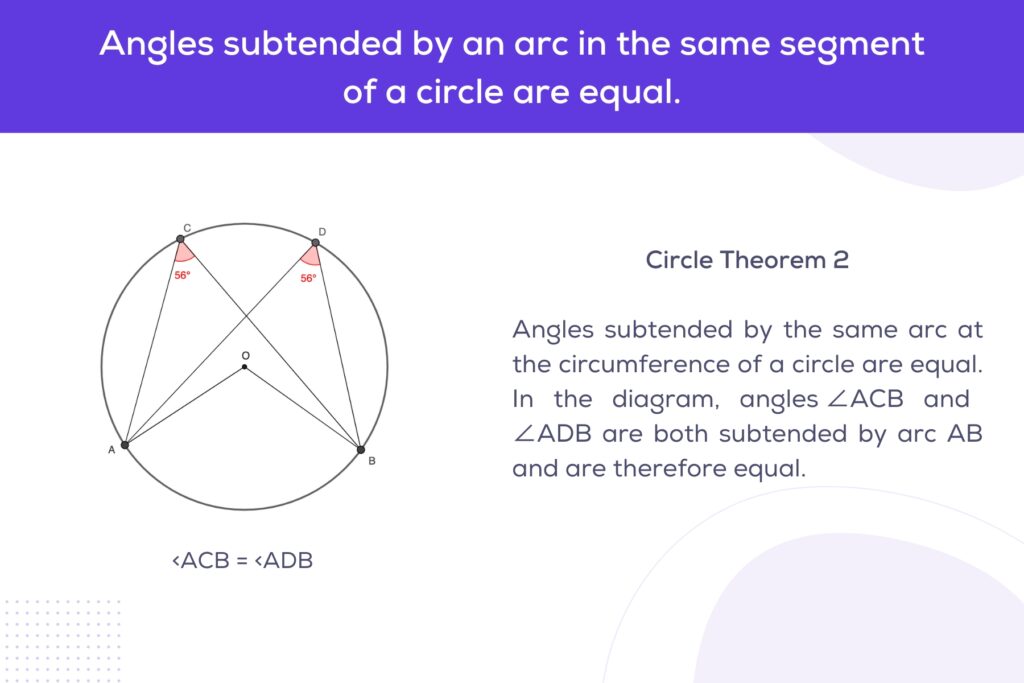
For your IGCSE exam, it's crucial to use the precise wording. The following resource from Save My Exams, tailored for the Cambridge syllabus, provides the exact definition and formal reason you'll need.
Angles in the Same Segment | Cambridge (CIE) IGCSE Maths Revision Notes 2023
This revision note clearly explains the theorem and the specific terminology you need for your exam.
Please read the first part of the note, starting from the top. Focus on the formal definition and memorize the key phrase you must use as a reason: "Angles in the same segment are equal". A very common way this pattern appears is as a "bowtie" shape, so pay close attention to the diagram and description of this visual cue.
2. The Proof: A Direct Consequence
Why are these angles equal? The proof is a beautiful piece of logic that relies entirely on the theorem we covered in our last lesson: "the angle at the center is double the angle at the circumference."
The video below gives a concise and clear demonstration of this proof. As you watch, notice the simple but powerful strategy: both angles at the circumference are related back to the same angle at the center.
Circle Theorem Proofs - GCSE Higher Maths
This video from 1st Class Maths provides a step-by-step walkthrough of the formal proof.
Please watch the section from this part of the video. The presenter will prove that \angle ABD = \angle ACD. Follow how they introduce a point at the center (O) and use it to connect both angles to the central angle \angle AOD.
Let's quickly recap the steps of the proof:
- Construct Radii: Introduce the center of the circle, , and draw lines from to the endpoints of the arc (let's call them A and D). This forms the angle at the center. Let's call this angle .
- Apply the Previous Theorem (First Angle): The angle at the circumference, , is subtended by the same arc as . Therefore, based on our last lesson, .
- Apply the Previous Theorem (Second Angle): The other angle at the circumference, , is also subtended by the same arc. Therefore, .
- Conclusion: Since both and are equal to , they must be equal to each other.
This proof is a great example of how mathematical principles build upon one another. You've used one theorem to prove another.
3. Application: Finding the "Bowtie"
Now for the practical part: using this theorem to solve problems. The key skill is pattern recognition. As you saw in the Save My Exams resource, this theorem often creates a shape resembling a bowtie or, as one instructor humorously calls it, "Spider-Man eyes."
The following video is excellent for training your eye to spot this pattern in different orientations, which is essential for IGCSE exam questions.
IGCSE/O LEVEL Maths - Angle Properties of Circles (Concepts and Past Papers)
This video from Mathlete by Saad focuses on exam-style problem-solving and offers a memorable analogy to help you identify the theorem quickly.
First, watch the section from this segment, where the "bowtie" or "Spider-Man eyes" pattern is explained. Then, see it used to solve a straightforward exam question in this brief clip. The key is to trace the angles back to the arc they are facing.
Your Turn: Practice Problems
It's time to put your knowledge to the test. The Siyavula online textbook has some well-designed practice questions. Try to solve the first two problems shown in the exercise set. Remember to state the reason for your answer.
8.2 Circle geometry | Euclidean geometry
These problems will help you practice applying the theorem in different diagram configurations. The solutions are provided for you to check your work.
In the document, scroll down to the heading "Subtended angles in the same segment" and find "Textbook Exercise 8.3". Attempt the first problem to find the value of angle a. This is a direct application. Next, attempt the second problem to find the values of angles c and d. You'll need to use the circle theorem to find c first, and then apply a basic triangle angle rule to find d.
Solutions Walkthrough:
- Problem 1: Angle and the angle are both subtended by the same arc. Therefore, . The reason is: Angles in the same segment are equal.
- Problem 2:
- To find : Angle and the angle are subtended by the same arc. Therefore, . Reason: Angles in the same segment are equal.
- To find : The angle is an exterior angle to the small triangle at the top. The exterior angle of a triangle equals the sum of the two opposite interior angles. So, . Since we know , we have , which gives .
This second problem is a great example of what you'll see in exams—a multi-step question that combines a circle theorem with other geometric rules.
Conclusion
Well done! You have now added another essential tool to your geometry toolkit. We have seen how this new theorem is not just a random rule to memorize, but a logical extension of the "angle at the center" theorem.
Here are your key takeaways from this lesson:
- The Theorem: Angles subtended by the same arc at the circumference are equal.
- The Formal Reason: For your IGCSE exam, you must state: "Angles in the same segment are equal."
- The Visual Cue: Look for the characteristic "bowtie" shape where four points on the circumference are connected.
- The Proof: The theorem is proven by showing that any two such angles are both equal to half of the same angle at the center.
In our next lesson, we will shift our focus slightly to another key component of circles: chords. We will explore the properties of isosceles triangles that are formed when two radii meet a chord, a concept that frequently appears alongside angle theorems in more complex problems.