In 1964, Ali’s movement and punches had made Liston struggle, while a reported shoulder injury provided substantial evidence for why Liston did not answer the bell for round seven. The result was clear; claims that the fight was fixed were not established. Their rematch on May 25, 1965, poses a different problem: a punch and knockdown are visible, but the count and stoppage unfolded in confusion.
This lesson takes about 35–40 minutes. You will reconstruct the first-round ending, examine what the neutral-corner rule required, and weigh accounts from people who saw the fight. The aim is neither to dismiss the punch as “phantom” nor to treat every detail of the official result as beyond question.
A punch, a fall, and an interrupted fight
Watch the fight footage once at normal speed before studying the replay. Ali throws a short right as Liston comes forward; Liston goes down, attempts to rise, and falls back. Ali stands near him and shouts rather than staying in a neutral corner. Liston eventually gets up, the fighters briefly resume, and referee Jersey Joe Walcott stops them. The broadcast then announces Ali as the winner by knockout.
Muhammad Ali vs Sonny Liston II (1965) [FULL FIGHT]
Watch “Muhammad Ali vs Sonny Liston II (1965) [FULL FIGHT],” posted by Adam Matyszewski, as a record of the visible sequence—not as a way to measure the punch’s force.
Watch fight and stoppage from the opening action through the result announcement. Notice Ali’s position while Liston is down, Walcott’s movements, and the brief resumption. Then hear Ali’s first answer about the finishing blow and watch the replay discussion. Compare what Ali initially remembers with what he says while viewing the replay.
Immediately afterward, Ali says he cannot tell whether the decisive blow was a left hook or a right cross because events happened so quickly. During the replay, he identifies the right-hand counter. His initial uncertainty is useful evidence of how difficult the action was to perceive in real time; it does not mean no punch landed.
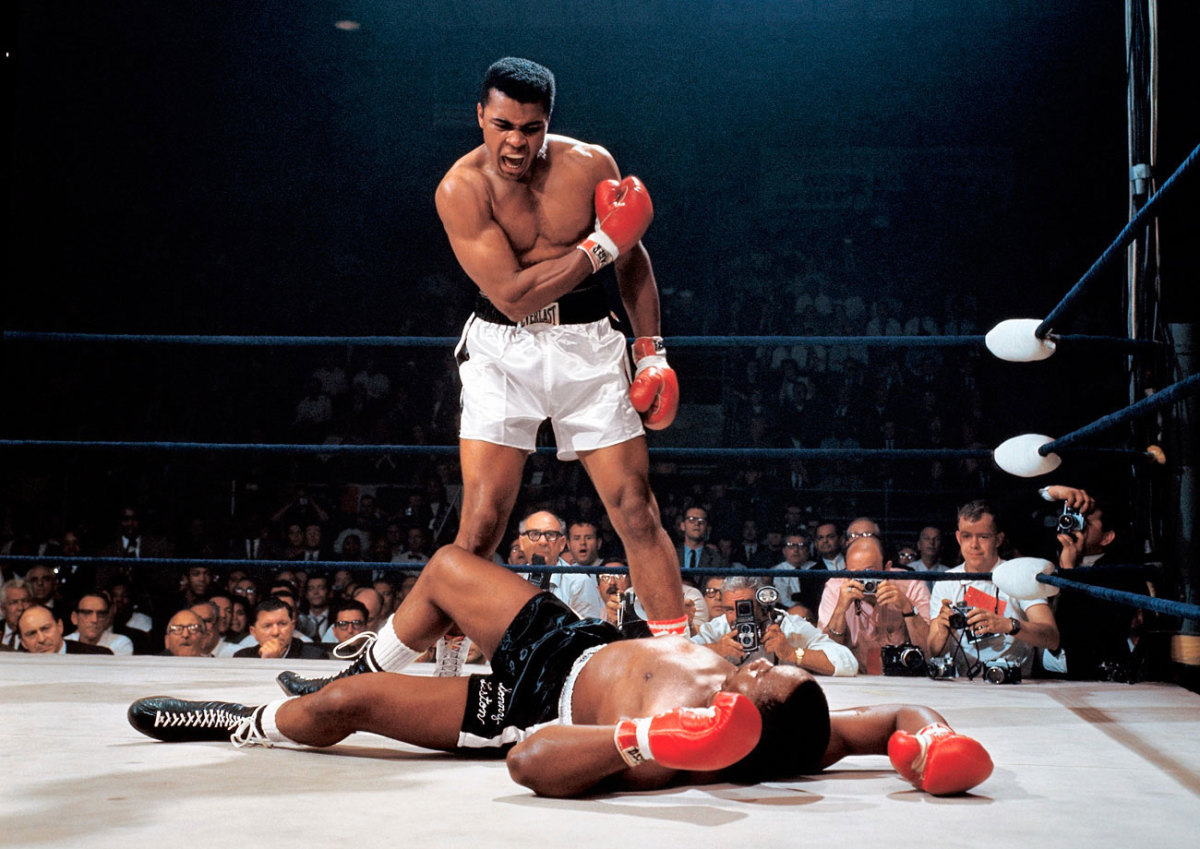
The photograph’s power has helped define the fight’s memory. It is also only one instant. It cannot tell us how Liston fell, how long he remained down, or what the referee and timekeeper communicated.
Why the neutral corner mattered
When a boxer is knocked down, the other boxer must go to a neutral corner—one assigned to neither fighter. The timekeeper begins counting the time after the knockdown; the referee directs the standing boxer away, picks up the count, and administers it to the boxer who is down. If the standing boxer does not remain in a neutral corner, the referee must deal with that breach rather than simply conduct an uninterrupted count.
Ali repeatedly approached Liston. Walcott spent time trying to move him away and did not deliver a clear, continuous audible count over Liston. According to a contemporary Sports Illustrated account, Walcott later turned toward someone at ringside who told him that the count had passed ten. That person, boxing publisher Nat Fleischer, was not an official in the bout. By then Liston had risen and the fighters had briefly resumed; Walcott stepped in to stop them.
A quick, hard right and a needless storm of protest
Read this Sports Illustrated account for its description of the punch and its close account of Walcott’s actions. Its confident interpretation of the punch is an argument to assess, not a substitute for the footage.
In the main article, find the paragraph beginning “The knockout punch itself was thrown.” Read the punch account through the ringside observers’ reactions. Then find the paragraph beginning “The suddenness of Clay’s blow plunged everybody.” Read the count account through Walcott’s explanation after the stoppage. Focus on what the writer observed, what witnesses said, and what Walcott said about his decision. Contemporary sources sometimes call Ali “Clay”; this lesson uses the name Ali.
A separate account preserves the participants’ disagreement. Liston said he had been waiting to hear Walcott count; Walcott said he expected the timekeeper to continue counting while he dealt with Ali, but could not locate him. The account also reports disagreement over the bout’s time, despite the announcement of a one-minute knockout.
50 years later: Muhammad Ali-Sonny Liston II - ESPN
Read the ESPN account for the competing statements about the count and its concise explanation of the officials’ duties.
In the article’s discussion of the ending, locate the passage immediately after the winner-and-time announcement, beginning “There was wild confusion about the official time.” Read the count dispute to the end of its explanation of the timekeeper’s and referee’s roles. Keep Liston’s statement, Walcott’s statement, and the description of the rule distinct.
There are two questions, and conflating them causes much of the argument. First, did Ali land a blow capable of hurting Liston? Second, was the knockdown count handled properly? A mishandled count does not prove the punch was harmless. Equally, a genuine punch does not make the officiating orderly.
What witnesses—and cameras—can establish
The Sports Illustrated writer describes a fast right to Liston’s jaw and quotes former champion Floyd Patterson and light-heavyweight champion José Torres, both at ringside, describing it as a strong, well-delivered punch. Their close views matter, particularly because spectators elsewhere may have missed a compact blow. But even a well-placed observer cannot measure its force or directly know how badly Liston was hurt.
Other observations pulled in another direction. Heavyweight George Chuvalo cried “Fix!” and later argued that Liston’s eye movements showed he was not badly hurt. The same article quotes a doctor who disputed Chuvalo’s interpretation, saying such movements can accompany temporary unconsciousness. This exchange illustrates a limit of witness testimony: noticing an eye movement is not the same as reliably diagnosing a boxer’s condition from ringside.
A quick, hard right and a needless storm of protest
Return to the Sports Illustrated account to compare Chuvalo’s accusation with the doctor’s response. Neither statement is a direct medical examination of Liston on the canvas.
In the main article, find the paragraph beginning “Watching Liston after the end.” Read the witness disagreement through the doctor’s explanation. Notice the difference between reporting what Chuvalo said he saw and accepting his conclusion about what it meant.
The footage gives firmer ground on sequence: a right is thrown, Liston falls, Ali fails to remain in a neutral corner, no clear count reaches Liston, and Walcott stops the bout after a brief restart. It gives weaker ground on physical state and intent. A camera angle may make a short punch hard to see, and a recording cannot tell us Liston’s level of disorientation or whether he made a deliberate choice to stay down.
Liston’s own statement that he could have risen but did not hear a count deserves attention. It is consistent with the visible officiating problem, but it does not establish that he was unhurt: a boxer can be hurt, recover enough to rise, and still wait for a count. Nor can we treat a participant’s later explanation as a direct view into his condition at the moment of impact.
Assessing the larger claims
“Phantom punch” is a memorable label, but it can blur two different propositions. If it means many people did not clearly see the short right land, that fits the difficulty of watching it in real time. If it means Ali threw no effective punch, it goes further than the footage and the ringside accounts support.
The claim that Liston took a deliberate dive goes further still. The rapid ending, disputed count, and Liston’s earlier connections to questionable figures in boxing made suspicion understandable. None of those facts, alone or together, demonstrates an agreement to lose. Conversely, the evidence for a real punch does not allow us to calculate exactly how much of Liston’s time on the canvas was due to the blow, confusion about the count, or both.
Finally, criticism of the stoppage need not be a claim of a fix. Walcott’s account of relying on information from ringside sits uneasily beside the absence of a clear count delivered to Liston and the momentary resumption of fighting. Walcott also said afterward that Liston was too impaired to continue safely. Those are distinct possible grounds for stopping a bout: a completed count and a referee’s judgment about a boxer’s safety. The disorder makes the count especially disputable without proving that Walcott intended a dishonest result.
Conclusion
Ali’s short right and Liston’s knockdown are better supported than the assertion that no meaningful blow landed. The footage and accounts also show a genuine officiating failure: Ali did not stay in a neutral corner, Liston received no clear audible count, and Walcott stopped the fight only after it briefly resumed. Witnesses help explain both the punch and the confusion, but they cannot settle Liston’s internal condition or prove a deliberate dive.
The next lesson follows Liston after this defeat. His subsequent fights offer a way to assess his continuing abilities without treating the rematch’s disputed ending as the whole of his career.