Hello! Let's get started with our third lesson.
Introduction
In our last session, we dissected the GMAT's adaptive algorithm. The main takeaways were that the test is "top-heavy"—especially the Verbal and Data Insights sections—and that your performance on the initial questions has a disproportionate impact on your score. This understanding is the foundation for any effective GMAT strategy.
Today, we'll use that knowledge to make your first major strategic decision: choosing a provisional section order. The goal is not to find a single "magic" sequence but to develop a personalized strategy that leverages your strengths and manages your mental energy throughout the exam. By the end of this lesson, you will have a clear framework for selecting an initial section order, which you will then test and refine through practice.
The Two Core Philosophies of Section Order
On the GMAT Focus, you can tackle the Quant, Verbal, and Data Insights sections in any of the six possible permutations. This choice is significant because it allows you to control for two critical factors: momentum and mental fatigue.
Generally, top GMAT performers align with one of two main strategies. Let's start by hearing a breakdown from a GMAT coach who analyzes real student data.
Understand the GMAT Scoring Algorithm with 99%tile Student Case Studies
This video from GMAT Club clearly outlines the two primary schools of thought on section order, helping to frame the decision you need to make.
Please watch from 01:00:06 to 01:02:37. The presenter discusses two opposing strategies based on a test-taker's focus and energy levels. He refers to them as the 'focus strategy' and the 'motivation strategy'.
As you just heard, the two dominant approaches are:
- The "Strength-First" Approach (for Momentum): You start with your strongest section. The goal is to secure a high score in one area early on, which builds confidence and psychological momentum that carries you through the rest of the test.
- The "Weakness/Energy-First" Approach (for Focus): You start with your most mentally taxing section. The logic is to allocate your peak mental energy and focus to the area where you need it most, before fatigue sets in.
It's worth noting there's a debate in the GMAT community about whether the test is "section-level adaptive" (i.e., your performance on section 1 influences the starting difficulty of section 2). The presenter in the video you just saw is skeptical, and GMAC has not confirmed this. Therefore, our strategy will focus on the proven factors you can control: your own psychology and energy management.
Case Study: A 60-Point Jump from Changing Section Order
To see the real-world impact of this decision, let's look at a case study of a student who scored a 755. He attributes a significant score increase directly to optimizing his section order.
GMAT 755: Improved My GMAT Score by Fixing Execution, Not Knowledge
This interview segment from GMAT Club is a powerful demonstration of section order strategy in action. A top-scoring student explains how a simple change led to a massive improvement in his mock scores.
Watch the clip from 00:16:51 to 00:18:45. Pay close attention to his original order, his new order, and his precise reasoning for the switch. This provides a crucial insight into managing mental fatigue.
Ritvik's experience is a fantastic illustration of the "Energy-First" principle. His reasoning wasn't just about strongest vs. weakest; it was about the nature of the mental effort. He moved Verbal—a section he was strong in but also found engaging and interesting—to the end. This allowed him to tackle the more cognitively draining sections (Quant and DI) while he was fresh, and use the more enjoyable Verbal section to power through when his energy was lower.
This highlights a key nuance: your "weakest" section might not be your most "draining" one.
Building Your Provisional Strategy
Now it's time to apply these concepts to your own profile. We'll walk through a structured self-assessment to create a provisional strategy.
First, let's look at a framework that outlines the key questions to ask yourself.
Best GMAT Order Strategy: How to Choose Your Section Order
This article from Target Test Prep provides a set of excellent self-assessment questions to guide your strategic thinking.
Please read the sections titled 'How to Craft Your Section Order Strategy,' 'Know Your Test-taking Style,' and 'Know Your GMAT Strengths and Weaknesses.' As you read, actively reflect on your own test-taking habits and experiences from your CAT preparation.
Using that framework, let's create your plan.
Step 1: Assess Your Strengths & Weaknesses
Based on your Computer Science background and CAT preparation, it's reasonable to assume Quant is a significant strength. How do you perceive your abilities in Verbal and Data Insights?
- Verbal: Is this an area of high confidence or one that requires more concentration?
- Data Insights: This section blends quant and verbal reasoning. Does this format feel intuitive, or does the context-switching require extra mental effort?
Step 2: Analyze Your Fatigue & Focus Patterns
Reflect on your past experiences with long, standardized tests like the CAT.
- Do you perform best when you warm up with something easier, or do you prefer to tackle the biggest challenge head-on?
- At what point in a 2-3 hour exam does your focus typically start to decline?
- Which type of work (e.g., complex calculations, dense reading, logical puzzles) drains your mental energy the fastest?
Step 3: Formulate Two Hypotheses to Test
Based on your self-assessment, define two different section orders you plan to experiment with in your practice tests. Here are some examples of what they might look like:
-
Hypothesis A (Strength-First):
Quant -> DI -> Verbal.- Rationale: Capitalize on your biggest strength first to build confidence and "bank" a high score. Since DI has a strong quantitative component, it follows logically. You leave Verbal for last, similar to Ritvik's strategy.
-
Hypothesis B (Energy-First):
Verbal -> Quant -> DI.- Rationale: If you find Verbal to be the most mentally draining, tackle it when you are at your absolute freshest. Follow it with your strength (Quant) to recover, and finish with the mixed-skill DI section.
This chart shows all the possible combinations you can choose from. Your optional 10-minute break can be taken after the first or second section.
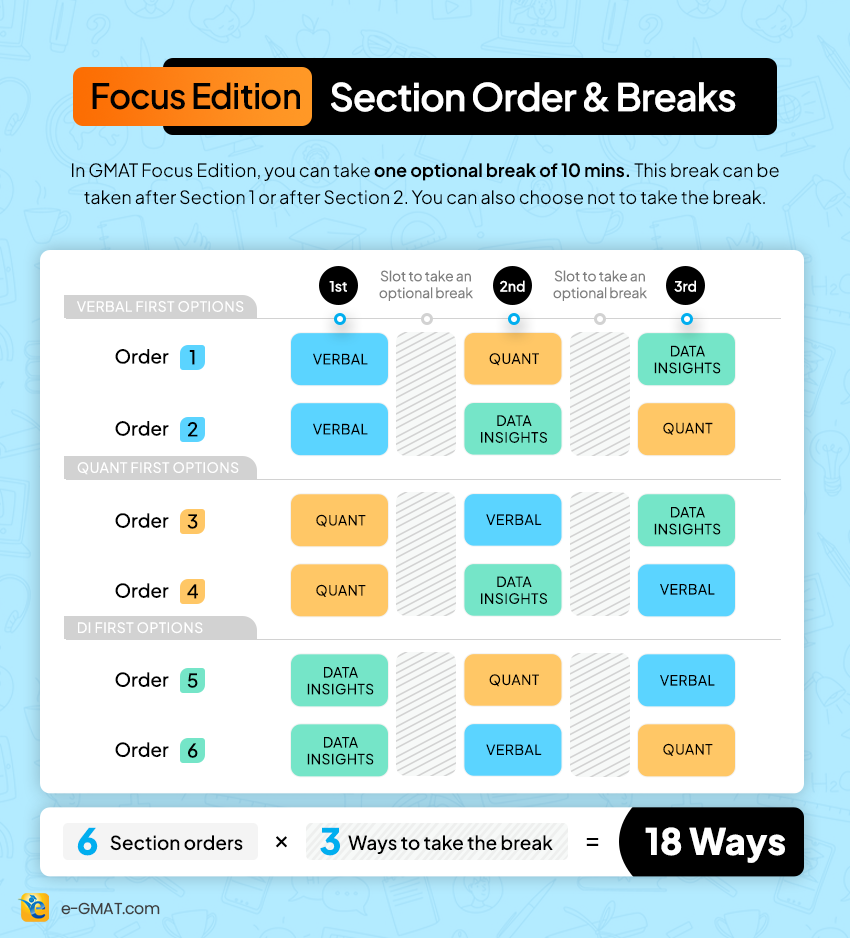
The key is not to decide definitively today, but to select two logical, competing strategies to test.
Conclusion
You now have a robust framework for approaching one of the most important strategic decisions on the GMAT. Remember that this is a personal choice with no universal right answer.
Key Takeaways:
- Your section order is a tool to manage mental energy, focus, and test anxiety.
- The two primary philosophies are "Strength-First" (to build momentum) and "Weakness/Energy-First" (to apply peak focus where it's needed most).
- A top scorer's experience shows that the "best" order is often about managing cognitive load, not just playing to your strongest subject.
- The final decision must be validated through practice tests. Your "on-paper" strategy needs to survive contact with a real, timed exam.
As you begin your practice, commit to trying out your two chosen hypotheses on full-length mock exams. Track not only your scores but also how you feel during and after each section. This qualitative data is just as important as the quantitative results.
Next Lesson Preview
Once you have a high-level plan for pacing and section order, the next layer of strategy involves micro-level decision-making during the test. In our next lesson, we'll develop a framework for when to strategically guess versus when to invest more time, helping you optimize your performance on a question-by-question basis.