Welcome back! In our last lesson, you created a technical blueprint that breaks down the complex problem of meal quality monitoring into a clear set of machine learning sub-tasks. You now have a plan that specifies the inputs, outputs, and goals for your image and text models. This is a major step forward.
However, a blueprint is only as good as the materials you have to build with. Today, we'll confront a critical reality of all real-world ML projects: your data will have gaps, blind spots, and limitations. Our goal is to identify where your data modalities (images, text, metadata) fail to provide a strong signal for a violation, and then to develop practical strategies to handle these gaps. Acknowledging what your system cannot do is just as important as defining what it can do. This prevents you from building a system that is confidently wrong and ensures your final solution is robust and reliable.
The Limits of a Signal: What Can't You See?
A "signal" in your data is a detectable pattern that reliably corresponds to a real-world event. A photo of a banana is a strong signal for the presence of a banana. But what is the signal for excessive salt in a curry? Or for bacterial contamination?
Let's think critically about some of the violations we've discussed.
- Invisible Ingredients: Can an image model tell if a dal was cooked with too much oil or salt? Can it measure the protein content? In most cases, the visual signal is non-existent. The appearance of a high-salt curry and a low-salt curry might be identical.
- Microbial Contamination: Unless food is visibly moldy or contains insects, a standard photograph provides zero signal for the presence of harmful bacteria like E. coli or Salmonella. A meal could look perfect and still be dangerous. The strongest signal for this often comes from text complaints about sickness, but this is a reactive signal that appears after people have already been harmed.
- Nutritional Value: Can you determine the Vitamin A content of a vegetable dish from a photo? This is impossible without laboratory testing. Your image model can identify that a carrot is present, but it cannot quantify its nutritional properties.
A recent study evaluating AI-powered nutrition apps confirms these limitations. Even sophisticated commercial apps struggle with the very same challenges you're facing.
This research paper from the journal Nutrients evaluates how well commercial apps can identify foods and estimate nutritional content from images. Its findings are directly relevant to your project's limitations.
Please read the first paragraph of the Discussion section. Focus on the sentence that begins "AI-enabled image recognition". This summarizes the core problem: identifying food items is achievable, but estimating properties like calories (or in your case, quality) is very difficult. Next, read the paragraph that starts with "To fully harness". Pay close attention to the discussion on the difficulties in identifying components in mixed dishes and the inability to detect ingredients added during cooking, like butter, fat, or salt. This highlights the exact "invisible ingredient" gap we are discussing.
The key takeaway is that for many important violations, your data modalities have significant blind spots. An image is not a chemical analysis lab. We must design our system with this reality in mind.
Strategy 1: Using Proxies When Direct Measurement Fails
When you can't measure what you truly care about, the next best thing is to measure something that is closely correlated with it. This "something else" is called a proxy. Your goal is to find reliable proxies for the violations that are otherwise invisible.
You've encountered this concept before. The diagram below shows the gap between what we want to measure (the ground truth) and what we can measure (the proxy).
Let's apply this to your project:
-
Goal: Measure if a meal provides sufficient protein.
- Direct Measurement (Impossible): Grams of protein.
- Proxy (Possible): The presence of a protein-rich food item. Your YOLO object detection model can be trained to identify
dal,egg, orpaneer. Detecting one of these items in an image becomes a proxy for the provision of protein.
-
Goal: Detect if the dal is excessively watery.
- Direct Measurement (Impossible from image): Viscosity.
- Proxy (Possible): A text complaint that explicitly mentions "watery dal". Here, the text modality serves as a proxy for a physical attribute that the image modality cannot capture.
The use of proxies is a powerful and pragmatic strategy. However, it's important to choose your proxies carefully. A poorly chosen proxy can introduce systematic error, or "Proxy Bias".
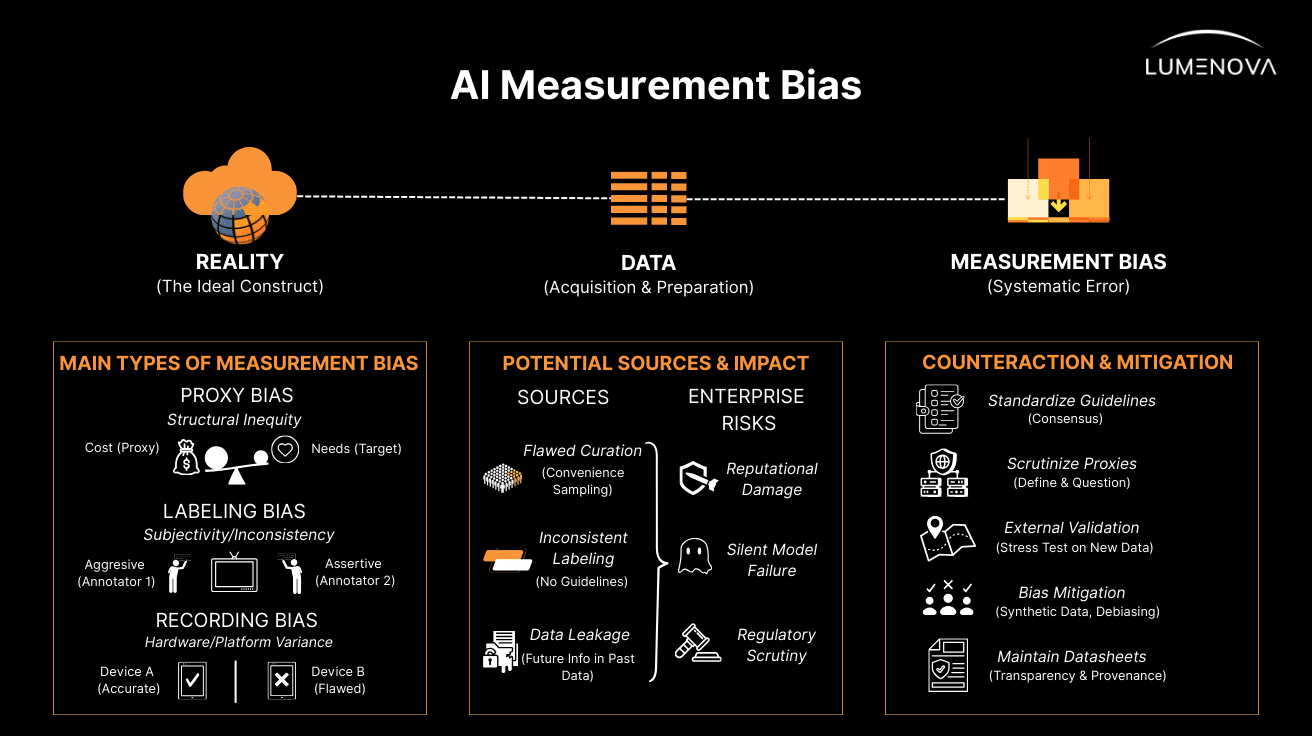
For example, using the mere presence of any vegetable as a proxy for a "nutritionally complete" meal is a bad proxy. A tiny sprig of cilantro as a garnish is not the same as a full serving of spinach. Your decision logic will need to account for not just the presence, but also the approximate quantity of the proxy item, which you can estimate from the bounding box area provided by your YOLO model.
Strategy 2: Handling Missing Data and Weak Signals
So, what do you do when a data point is missing a modality entirely (e.g., a text complaint with no associated image) or when a modality's signal is unreliable? A robust system must not fail; it should adapt.
Graceful Degradation and Fallback Logic
Your system should be designed to function even with incomplete data. This is often called "graceful degradation." If an image fails to load, the system shouldn't crash; it should proceed using the text and metadata it does have.
This is primarily an architectural decision. In a late fusion model like yours, it's easier to implement.
Multimodal Machine Learning: Practical Fusion Methods
This article discusses practical patterns for building multimodal systems, including how to handle missing or noisy data.
First, read the subsection "Handling Missing or Noisy Modalities". It introduces "modality dropout," a training technique where you intentionally hide modalities from the model, forcing it to learn how to work with incomplete data. Next, in the "Recommendations" section, read the part on choosing a fusion strategy. Note its point about late fusion being resilient to asynchronous or noisy modalities. This validates the architectural choice you've made. Finally, read the subsection on using modular architectures. This reinforces the idea of building separate models for each modality so that a failure in one does not bring down the whole system.
The core idea is to build your system in a modular way. The image model runs, the text model runs, and the fusion layer is designed to combine whatever outputs are available. If one modality is missing, the fusion logic can be programmed to rely on the others and potentially lower its overall confidence score for the final prediction.
Model-Based Imputation
In some cases, you can predict, or impute, missing values. While simple imputation (like filling missing numbers with the mean) can corrupt your dataset, a more sophisticated approach is to use machine learning itself to fill the gaps.
This video provides an excellent explanation of why and how to use a model for imputation.
Advanced missing values imputation technique to supercharge your training data.
This video explains and demonstrates an advanced technique for imputing missing values using a machine learning model.
First, watch the introduction from the beginning to understand why simple imputation is often a bad idea and what the model-based alternative is. Next, see a concrete implementation for numeric data from this timestamp. Here, a LightGBM regression model is trained on the complete data to predict missing values in a specific column. Finally, see how this can be adapted for categorical data from this part, where a classification model is used instead of a regressor.
How could you apply this?
Imagine you have many data points where the school_type ('urban' vs. 'rural') metadata is missing. You could train a classifier that uses the other available data (e.g., district name, text of the complaint, or even features from the image) to predict the missing school_type. This imputed value could then be used by your main model, giving it more context. This is an advanced strategy but one that leverages your strong technical background.
Acknowledging and Scoping
Finally, sometimes the most honest and effective strategy is to simply acknowledge a limitation and explicitly define it as being out of scope.
For a violation like non-visible bacterial contamination, your system has no reliable signal. The correct approach is not to build a model that tries and fails, but to state clearly: "This system does not detect microbial contamination." Your model's output label should be precise: visible_contamination instead of just contamination.
This manages expectations for stakeholders and prevents your system from being used for purposes it was not designed for. A model that knows what it doesn't know is far more valuable than one that is overconfident.
Conclusion
In this lesson, we have moved from an idealized blueprint to a realistic, robust plan. You've learned to identify the inevitable gaps and blind spots in your data and have explored a portfolio of strategies for addressing them.
Key Takeaways:
- Identify Your Blind Spots: Critically evaluate your data modalities to understand which violations they can and cannot provide a signal for. Image recognition has significant limitations for detecting "invisible" properties like nutritional content or non-visual contamination.
- Use Proxies Pragmatically: When direct measurement is impossible, identify and measure a proxy that is strongly correlated with your target outcome (e.g., use the presence of
dalas a proxy for protein). - Design for Failure: Build a resilient system that can handle missing data through graceful degradation, fallback logic, and modular architecture.
- Impute Intelligently: When appropriate, use ML models to predict missing values, providing a richer dataset than simple imputation methods allow.
- Know Your Limits: For gaps that cannot be bridged, the best strategy is to explicitly define them as out-of-scope. This builds trust and ensures your system is used responsibly.
You have now completed the core work of translating a real-world problem into a set of well-defined, realistic ML tasks. In our next and final lesson for this module, we will summarize these findings by formally stating the key assumptions and limitations of your project. This will serve as a crucial document for guiding development and communicating with any future stakeholders.