Welcome to the first lesson of your project-based course on monitoring school meal quality. We'll begin by building a solid foundation, focusing on the "why" behind your project before diving into the "how." Your goal is to build a system that can detect meal quality violations in a massive public nutrition program. To do that effectively, we first need to understand the program itself: its purpose, its scale, and its rules.
This lesson is dedicated to understanding India's Mid-Day Meal Scheme, now known as PM POSHAN. By the end, you'll be able to describe its structure, its enormous scale, and most importantly, its specific nutritional goals. This domain knowledge is not just background information; it is the bedrock upon which you will define your machine learning problem, design your data labels, and ultimately build a system that solves a real-world problem.
The Big Picture: What is PM POSHAN?
The Pradhan Mantri Poshan Shakti Nirman (PM POSHAN) scheme is one of the largest school nutrition programs in the world. It evolved from the earlier Mid-Day Meal Scheme, which has been operating in India for decades. At its core, it is a centrally sponsored scheme managed by the Ministry of Education, designed to provide one hot, cooked meal to eligible children every school day.
To get a comprehensive overview of the scheme's purpose and history, let's start with a video.
PM POSHAN - Provisions & Potentials
Watch the following segments from the video "PM POSHAN - Provisions & Potentials" by Swapnil Tembe.
First, watch the introduction to the scheme, which covers its history and who it serves. Then, jump to the section explaining why the scheme is needed. Pay close attention to the dual goals: improving nutrition and boosting educational outcomes.
As the video explains, the scheme's objectives are twofold:
- To improve the nutritional status of children, combating malnutrition and hunger which can impair cognitive development.
- To improve educational metrics by encouraging children from disadvantaged backgrounds to enroll in, attend, and stay in school.
The scheme is universal for its target group, meaning it's provided to all eligible children without discrimination based on social class, caste, or gender. This promotion of social equity is a key feature of the program.
Scale of the Operation
Understanding the sheer scale of PM POSHAN is crucial to appreciating why an automated monitoring system like the one you're building is so valuable. Manual oversight is incredibly challenging for a program of this size.
Let's look at the official numbers.
PM POSHAN - Prime Minister's Overarching Scheme For Holistic ...
Please read a brief section from the official government portal for the PM POSHAN scheme.
Focus on the paragraph that begins with this sentence. It quantifies the number of beneficiaries and schools covered.
As you just read, the scheme covers over 118 million children across more than 1.1 million schools. For context, this is more than the entire population of countries like Germany or the UK. The financial commitment is also substantial, with a budget of approximately ₹1.24 trillion (about $1.36 billion USD) for 2024-2025. This massive operational scale highlights the need for efficient, scalable monitoring solutions.
The Core of the Problem: Nutritional Goals
Now we arrive at the most critical part of this lesson for your project: the specific, measurable goals of the scheme. These norms are not just guidelines; they are legally binding under India's National Food Security Act, 2013. They will form the "ground truth" for defining what a "violation" is.
The scheme specifies both nutritional output (calories and protein) and food input (quantity of ingredients).
PM POSHAN - Prime Minister's Overarching Scheme For Holistic ...
Return to the "PM POSHAN - Scheme Details" document and read the "Benefits" section.
Focus on the two key lists provided: The nutrition norms, which specify the target calories and protein. The food norms, which specify the required quantity of different food groups in grams.
To summarize these crucial details, here are the minimum daily requirements:
1. Nutritional Norms (Energy and Protein)
- Primary (Classes 1-5): 450 kcal of energy and 12 grams of protein.
- Upper Primary (Classes 6-8): 700 kcal of energy and 20 grams of protein.
2. Food Quantity Norms (Ingredients)
This is what translates the nutritional goals into practical cooking instructions.
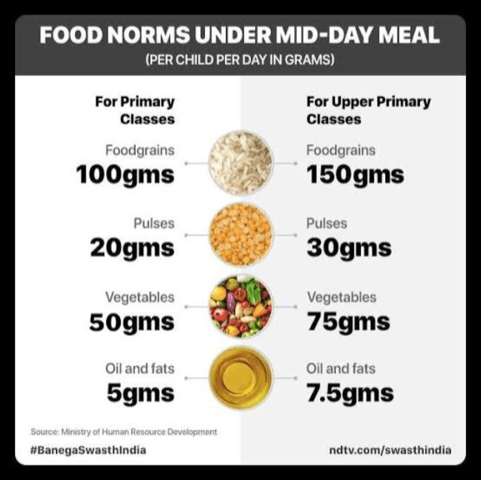
These numbers are the quantitative foundation of your project. A meal that fails to meet these standards is, by definition, a violation. For example:
- An image showing a meal with only rice and no visible pulses (dal) or vegetables would suggest a quality violation.
- An image showing a very small portion of food might indicate a quantity violation, falling short of the gram-based norms.
The Implementation Structure
Finally, it's helpful to have a high-level understanding of how the scheme is managed. A complex, multi-level administrative structure is responsible for getting food from a central warehouse to a child's plate.
The responsibility is shared across different levels of government:
- National Level: The central government (Ministry of Education) sets policy, allocates funds, and monitors the program.
- State Level: State governments are responsible for the overall implementation, funding, and ensuring the logistics are in place.
- District/Block Level: Local authorities manage allocations to schools and oversee implementation in their area.
- School Level: This is where the execution happens. School Management Committees (SMCs), which include parents and teachers, are supposed to monitor the quality of meals. Cook-cum-helpers, often from local women's self-help groups, prepare and serve the food.
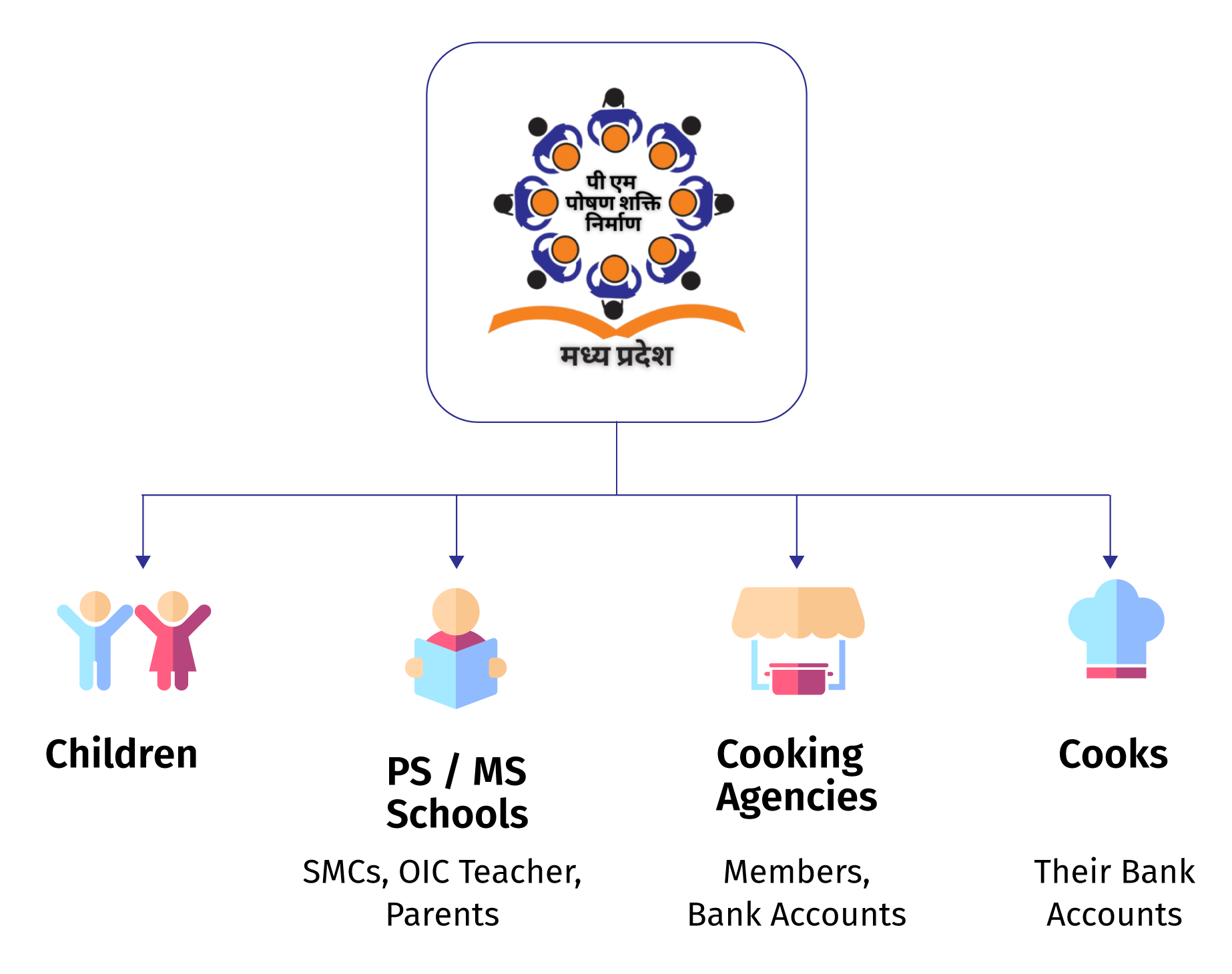
Given your background in designing systems, you can think of this as a complex distributed network. Data for your project might originate from any of these levels—a parent's complaint (village level), an official report (district level), or a photo of a meal (school level). Understanding this structure helps in tracing the source of data and identifying where interventions could be most effective.
Conclusion
In this lesson, we have taken the first crucial step in your project: understanding the problem domain. You've learned that PM POSHAN is not just a food delivery program but a massive socio-economic initiative with clear, legally mandated goals.
Here are the key takeaways:
- Dual Purpose: The scheme aims to improve both the nutritional status and educational outcomes of school-aged children in India.
- Massive Scale: It serves over 118 million children in more than 1.1 million schools, making it one of the largest initiatives of its kind globally.
- Measurable Goals: The scheme has specific, quantitative norms for calories, protein, and the weight of key food groups. These numbers are the foundation for defining "violations" in your ML model.
- Structured Implementation: A multi-tiered administrative system, from the national government down to local school committees and cooks, is responsible for its execution.
In the next lesson, we will move from the ideal state of the scheme to the real-world challenges. You will begin to identify the common types of meal quality violations that occur in practice, drawing from news reports and other sources. This will help us bridge the gap between the official rules and the messy reality your system needs to navigate.